|
Wednesday, June 27, 2007
Ribbit
 Ribbit Ribbit is a board game in which 2-5 young players (5-10) race to get their frog to the finish line. The next thing you need to know is that it is designed by one of the most prolific, and reliably innovative designers in the industry: Reiner Knizia. There are 5 wooden frogs, each of a different color. Selecting from a small stack of 5 cards, one for each frog, each player secretly determines which frog she wants to be the winner. There's also a deck of movement cards. These cards determine which frog gets moved how many spaces, forward or back. Some cards apply only to the frog that is furthest behind. These cards help to make sure that all the frogs stay in the race.  Players take 5 cards from the deck of movement cards and decide which card they want to play. If one frog ends its turn on a space (lily pad, of course) that is already occupied, that frog jumps on top of the other frog's back. If a player wants to move that other frog, both frogs get moved. Here again we see an innovative, and strategically significant play principle. If the frog you want to win is on the bottom of a frog pile, every time you try to move closer to the goal (the pond), you move everyone else closer as well. The fact that players don't really know what frog each player wants to win adds but mystery and an opportunity to be deductively as well as analytically engaged. Younger players may not be canny enough to appreciate this particular subtlety, but older players will find it engaging and suspenseful. All these factors (secret frogs, frog piles, the "last frog" movement cards) result in a unique play experience for young children - and yet, none of the various innovations are too challenging or difficult for them to learn. A great contribution where great contributions are most needed. Labels: Kids Games

Tuesday, June 26, 2007
Sizzletoad
 In answer to the question: "what do you get when you combine rock-paper-scissors with tic-tac-toe?" You get Sizzletoad - a board game with a near perfect blend of strategy and chance, one of the few strategic games that kindergarteners could enjoy as much as, say, fourth-graders. You can play Sizzletoad with 2-4 players. Because the game is based on familiar games, its mechanics can be readily understood, even though it offers a very different play experience. Instead of using fingers to play the game, you use cards. This is also a little different. The cards (24 of them) are divided equally between players. Equally, but randomly, so another element of luck is added to the strategic mix. You might want to play a Paperduck, but you can't if you don't have one in your hand. The rock-scissors-paper part (Sizzletoad-Paperduck-Fossilstick actually) works a bit differently with three players. But it most definitely works. The tic-tac-toe part is also a little different. The player who wins the Sizzletoad-Paperduck-Fossilstick showdown wins the other players cards, and gets to play any one of those cards on to the tic-tac-toe grid. However, the first player to get three of any card in a row is the winner of that round. All these differences are just enough to make everything you might know about strategies for playing tic-tac-toe and rock-scissors-paper useful, while you find yourself engaged in a very different, and challenging game. The cards are small (perfect for a child's hand). There are four, lovely, crystal playing pieces, and a folding board. All-in-all, a unique invitation to play, and think. Labels: Kids Games
Sixteen
 Sixteen Sixteen is an original card game for two players, ages 8 and older. It is easy to learn (about 5 minutes) and takes about 15 minutes to play, though players will find themselves wanting to play again and again before they put the deck away. Each player is dealt three cards. The remaining cards are placed face-down in the middle of the table as the draw pile. The cards are numbered 0-6. There are two of every card, but only one zero card for each suit. There are also two wild cards. Players take turns, picking a card, and then adding a card to a fanned-out, face-up play pile. There are two ways to win a set: when the face-up cards total 16, or when the last three cards in the win pile are all the same color or number. So, you have to pay a lot of attention to what's in the pile, as well as what's in your hand, as well as make some educated guessing about what could very possibly be in you-know-who's hand. If the play pile goes over 16, a "bust" is declared and the other player gets the win. The player with the most sets when all cards have been played wins the round.  All of this results in some rather delicious strategic implications. The game can become quite competitive, but the elegance of the game, and the element of luck, keep the competition focused, and light-hearted. The instructions describe four optional play variations, one of which extends the game play to younger children (perhaps as young as 6), but the game plays best with the recommended ages. The card graphics are simple, yet very clear and functional. The cards of nicely shufflable stock. All in all, Sixteen is an unusually well-designed card game, unique, easy to learn, inviting, and with high replay value. In other words, Major FUN! Labels: Family Games
Monday, June 18, 2007
Dots Amazing!
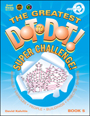 You need a real artist to take a simple children's puzzle, like Connect-the-Dots, and transform it into something worthy of mature, adult-worthy consideration. A real artist. And that's just what David Kalvitis is, an artist. And that's just what he's accomplished with his many Dot-to-Dot books. Let me give you a few examples. Stars puzzles: You start at number 1, as you would expect, and continue connecting dots in order until you come to a star. Then you have to look for the next number, which could be anywhere else in the puzzle, and continue from that number to the next star. And on and on, number-to-number-to-star. Jumping around from place to place on the puzzle, you really have no idea what you're drawing, sometimes until the very last star. Arrows: You see this big field of arrows - no dots at all. Just arrows. So there's absolutely no visual hints about what the puzzle is about. You look for a circled arrow and start there, following where it points until you come to another arrow, and you take off in that direction. Of course, if you make a mistake, just one, small, easily explicable error, you soon find youself wandering realms of graphic chaos. Which is why, despite Kalvatis' heartfelt recommendations that all his puzzles be done with a marker, we find ourselves frequently recommending a soft pencil with a very good eraser. Compass: Here, you get nothing but an array of dots with a few symbols sprinkled in hither and yon. You look for a star and, then read the directions printed above the puzzle. And I do mean directions. Like, from the star, go: N (North(, and then Wx2 (two dots west), and then SWx2, and then on and on and on, and if you do it exactly right, you'll end up at an A. And then, from the A, you start on the next line of instructions.... For an elementary school teacher, the different puzzle types involve skills that are closely tied to the mathematics curriculum. For the rest of us, they are an invitation to return to a deeply satisfying, often remarkably peaceful pastime.  These are but three of the innovative, challenging and inviting variations of connect-the-dots Kalvitis has created for us. And, if you're a social puzzler, it turns out that many of them can be solved cooperatively - especially the big puzzles, or puzzles like the Star puzzles that you solve in segments. There are five volumes of the " Greatest Dot-to-Dot" series, so far. The first four are a great introduction to the wide variety of puzzle types. The fifth volume is most appropriately called " Super Challenge," where you'll find puzzles that span two pages and hundreds and hundreds of dots. There are also four volumes of Kalvitis' Newspaper Dot-to-Dot puzzles - smaller, but every bit as innovative. Each puzzle is a work of art in its own right. When you complete a puzzle, you are rewarded with images that are themselves often surprisingly vivid, sometimes rich in detail, sometimes spare and subtle. Often drawn in perspective. Never stiff. Never blocky. Always surprising. Labels: Kids Games, Thinking Games
Hasbro's Express Games
 Take three of world's most popular games - Monopoly, Scrabble and Sorry - and turn them into new games that you can play in 20 minutes or less. What do you get? Would you believe you get some genuinely new, significantly fun games? You have to abandon your expectations just a wee bit to appreciate what Hasbro's new Express Games series. The Express version of Monopoly isn't what you'd expect if you're thinking Monopoly, as in the board game, with all that money and those wonderful playing pieces and the trading and the sheer vengeance of watching someone land on one of your hotel-laden properties. It's a kinder, gentler dice game, where your major opponent is your own greed. And the Express version of Scrabble? Also a dice game. Where you play on a smaller board. And after you move, you remove, actually, the word that the previous player made. Which makes for a new challenge each turn. A new game, really, where the focus again is not strategic, but on your skills as a wordsmith. And then you have Sorry. Again, there's no actual board. But if Express Scrabble and Express Monopoly both express a swifter, and less competitive contest, Express Sorry is everything you'd want in a game of vindication and retribution. Again there is no board. Dice, pawns and discs. Each of up to 4 players or teams has a disc to indicate which color pieces she is trying to gather. The dice indicate which of the four different-colored pawns you can collect from the center disc, or from the other players' discs. The dice have, of course, a wild side. But even wilder is the "Slide" side which allows you to change the color you are trying to collect, or to slide any of the opponent's discs to a new color. All of the Express games are far more than 20-minute versions of the board games they are named after. They are more than reinterpretations. They are different games. Games in their own right. And they will take you by surprise. Very fun, unique surprises that you will want to experience many times, with just about everyone you know.
Monday, June 11, 2007
Thataway
 Thataway Thataway is an easy to learn, quick to play, totally engaging addition to Gamewright's collection of 12 Minute Games. The card game, designed for 2-5 players, is a race in which players compete to build the longest chain of cards. Some cards point left or right, others up or down, still others point both directions (so you have a choice of either). At the beginning of the game, the cards are divided into as many draw piles as there are players. Since players can draw from any pile, it doesn't really matter if the piles are equal. As soon as you have a playable card, you place it on the table, face up. When you draw a card that can be connected to it (if, for example, you've played a left-facing arrow, the only card that can't connect to it is a right-facing arrow), you place that card, face-up, and adjacent to the connecting card. There are also Gorilla cards. As soon as you play a Gorilla card, the game is over. The player with the longest chain of connected cards wins that round. Cards that are played already are placed in a scoring pile. Cards that remain in a player's hand are passed to the player on the left, and added to that player's pile. The game continues until a fourth Gorilla is played. Since, as soon as you draw a Gorilla, you have the chance to end the round, you have to pay attention not only to how many cards are in your chain, but also to everyone else's chains. This adds a delicious tension to the game. It's hard enough watching your own cards, having to watch everyone else's is just enough to distract you into losing - end the round too soon or too late, and someone else can score higher. The game is more of a race than it is a strategic interaction. You're much more focused on winning than you are on making anyone lose. Consequently, the competition, as fierce as it is, is also quite gentle. You can lose without taking it personally. And, for all the tension, you tend to spend most of the time laughing. Thataway turns out to be a surprisingly entertaining little game, easy to learn, long enough to get significantly involved, short enough to want to play again next time. Major FUN for everyone 8 and over. Labels: Family Games
Friday, June 01, 2007
Confoundingly Crazy Crate-O-Mystery
 The Confoundingly Crazy Crate-O-Mystery (from Fundex Games, available here) is a confoundingly clever way to introduce kids into magic. They get magic apparatus (ok, toys), comic book-like instructions, and an instructional DVD that shows them how each of the ten tricks included in this kit is performed, and the secrets that make each trick work. These materials are central to the magic of the Cofoundingly Crazy Crate-O-Mystery. The biggest obstacle to mastering any illusion is learning how to do it. You can go to a magic shop and buy hundreds of wonderful tricks, but when it comes to learning how they work, and how to perform them, you have to rely on cryptically written instruction slips, usually in small print, that convey little if anything of the art of it all. Most of the 10 magic tricks are performed with with the assistance of wonderfully toylike apparatus, which is exactly how it should be. There's plastic monkey with detachable tail, feet, arms, hat and banana. And a sheet of tattoos. There's the crate itself, made of sturdy cardboard with magnetically sealing doors on 4 sides. There's a special magic handkerchief. And some other stuff. I don't want to get too specific here, because it might give away some of the secrets to the Confounding Craziness of it all. You'll also need two cookies and a dime. And I can't tell you why.  Magic is a very special kind of play. It's part science and part theater. The Confoundingly Crazy Crate-O-Mystery is a well-presented introduction and invitation to a unique form of fun - one that can last a lifetime. Especially recommended for kids who are old enough to read (8 and up), disciplined enough to practice and perfect their secret arts, and enjoy being the center of awe-struck attention. Major FUN, indeed. Labels: Toys
| |


