|
Monday, November 25, 2002
A to Z
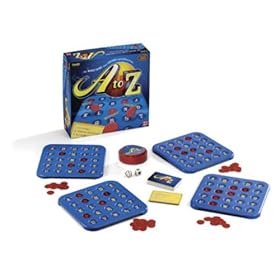
There's nothing funny about A to Z, and yet, this game made us laugh, almost non-stop, for an entire hour. Each player or team gets an alphabet board. Dice are rolled. A category is selected from a card. And then that player or team has fifteen or thirty seconds (depending on the dice) to name items that fit the category. As soon as an item is named, its first letter gets covered on the alphabet board. Name as many items as possible within the time limit, each starting with a different letter, and then name more, in a different category, when it gets to be your turn again. The object is to be the first player or team to complete the alphabet. Transparent discs are used to mark which letters have been used.  There were eight of us, so we played it in teams. It turned out to be so much fun to play with a teammate that I'd recommend, even if there are exactly four players, that you play it in two teams. Some of the categories are excruciatingly difficult. Like, names of foreign newspapers, or famous military leaders. Others are delightfully easy, especially for us average American folk - like snack foods or fast food restaurants. So, you might think that success depends on the luck of the category drawn. And you'd continue thinking it until someone throws the dice and the hand symbol appears. Then, when naming items, instead of trying to find things that begin with one of the ever-dwindling assortment of available letters (like Q and Z), you select someone else's board, and remove their discs. Since the letters already covered tend to be those that are easiest to use, things have a way of evening out with depressing rapidity. The mechanical timer ticks and flips noisily when the time limit is reached. It's a little difficult to see the fifteen second mark (there are only two time limits - either the full 30 seconds or the painfully brief fifteen), affording the opportunity for the only negative criticism I could find for this remarkably absorbing, unique, challenging, easy to understand, and genuinely fun word game. Labels: Family Games, Keeper, Party Games, Senior-Worthy, Word Games

Gavitt's Stock Exchange
 Did you know that the stock trading game PIT was originally called Gavitt's Stock Exchange invented in Topeka, Kansas in 1903? Did you know that the original game was at least as fun as PIT and even simpler to play? Well, neither did I. But apparently someone did. Someone in halfway around the world. In Australia, no less, who saw in the game such high play value that he decided to reproduce it as faithfully as possible - well, more faithfully than possible, given that the cards are laminated thoroughly enough to take the kind of punishment that is the inevitable destiny of such a highly interactive, exciting, fast-action game. This is the game where you try to trade cards (stocks) with other players - either one or two cards at a time - in the effort to corner the market and get all eight cards of one stock. Everybody trades simultaneously, and with enough people it really feels like your playing in the pit of a stock exchange. Though Gavitt's Stock Exchange can be played by two to six players, it's definitely a case of the more the merrier. We tried it with two, and it was kind of fun. And then with three, and it was more the kind of fun you'd call fun. But with with six it borders on pants-wetting fun. Especially if you more or less tacitly allow cheating. There's something about playing with turn-of-the-century-looking cards that makes the game as charming to look at as it is fun to play. Fun enough to get a Major FUN Award. The rules are a little difficult to read because of the authentically small print. They are quaint, but unnecessarily complicated. Read enough to get started, and then get started. After a while, you can read more of the rules, for fun and authenticity. Labels: Party Games
Sunday, November 24, 2002
SET gets a Major FUN award
 Today's Major FUN Award goes to a SET, a card game of perception and logic for one or more players, age six and up. SET is such a fun challenge, so absorbing, so elegantly designed that it got the Major Fun award even though it's not really a party game (though, conceivably, there's no upper limit to the number of players), or a particularly new game (it was invented about twenty-five years ago) or the kind of game that makes you laugh.  Each card has from one to three symbols of one of three different shapes, of one of three different colors, either outlined, shaded or solid. This outlined, shaded or solid bit makes for yet another complication, so the SET makers, if I may so designate them (actually, it's SET Enterprises) have thoughtfully packaged the cards in two separate decks. The smaller deck contains just the solid ("filled") symbols, and is, consequently, much easier to play with. The game begins by laying out twelve cards, face -up. Simultaneously, players compete to find three cards that comprise a SET. A SET is: "three cards in which each of the card's features, looked at one-by-one, are the same on each card, or, are different on each card." My wife understood this immediately. After playing several rounds, I discovered myself understanding it (I could find SETs) but still not being able to verbalize exactly what a SET is. Apparently, it's one of those left-right brain things. Which is key to why this game is so compelling. And why it works so well with even school-age kids. And why it's won so many awards. Including the coveted Major Fun award. Also, because the design is so elegant, it invites variations, several of which, including a cooperative version (always my favorite) are described on the SET site. SET Enterprises also offers a daily puzzle. It's a great way to get a sense of the game, and a genuinely absorbing challenge in and of itself. SET is a great family game, a great game for school kids, an equally great game for adults, to play by yourself or at a party, or in a restaurant... Challenging. Elegant. Most truly Major FUN Award-worthy. Labels: Family Games, Senior-Worthy, Thinking Games
Tuesday, November 05, 2002
Squint
If you've ever played Pictionary, you know how strangely cryptic, and yet amazingly effective drawings can become. As you get more familiar with the game and with each other, you reach a point where you can communicate remarkably abstract concepts with just a few lines.  Squint Squint, from the consistently innovative and well-made games of Out of the Box Publishing is today's Major FUN Award-award winner. Instead of drawing, you use any combination of Shape Cards to construct your clue. Since it's so Pictionaryish, it's really easy to understand how to play. Until, that is, you actually try. And then it seems impossible. Until you keep trying. And, oddly enough, it is quite possible. Challenging, you bet. But surprisingly possible. As the game goes on, and people become more familiar with the shapes and what you can do with them (you can even "animate" them by sliding sections back and forth), it gets more and more intriguing. It definitely requires ingenuity, creativity and good imagination. Which makes the experience all that much more compelling. There are three different words or phrases to try to guess on each of the 168 Squint cards (well, six if you count both sides). The role of a die determines which of the three you must use. (We decided not to use the die, and leave the choice up to the clue-giver. The challenge is deep enough at first, and, even though the three different choices are assigned different levels of difficulty - and point value - what may be difficult for one person to communicate can prove easier for the next.) The scoring is exceptionally compassionate. Both the guesser and guessee get points for a correct response. Rounds are timed, so gameplay is fast and tense. The longer you play, the more adept you become at giving and interpreting clues. Eventually, you astonish each other with your collective brilliance. We learned to use a ruler to indicate the bottom of the construct. We also seriously contemplated looking for a white surface upon which to arrange the cards. But, as the manufacturers so eponymously explain, squinting really helps. Squint is a unique, brilliantly challenging guessing game that makes people feel good about their individual and collective genius. For 3-6 players, ages 12 and up. Labels: Party Games
Monday, November 04, 2002
Man Bites Dog
 Man Bites Dog Man Bites Dog wins the Major FUN Award for its humor, its playability, its invitation to creativity, its quickness, and, most of all, it's fun. It's a card game the object of which is to create high-scoring headlines. Each card contains a word or a phrase and a score value. Headlines can have such bizarre grammatical structures that players can, with a modicum of creativity, compose a headline out of almost any cluster of words. The key word here is "almost." Sometimes it's impossible. Sometimes you have to stretch your concept of linguistic clarity beyond the breaking point. Take, for example, the following hand: CONVICT, SUSPECT, UROLOGIST, BLONDE, DUMPS. Luckily, DUMPS is one of those words that can be a noun or a verb. Otherwise, you'd be lost (you can replace up to three cards). So, how about BLONDE UROLOGIST DUMPS CONVICT? That'd work. So would BLONDE UROLOGIST DUMPS SUSPECT. Well, more or less. But you'd get another 5 points if you could use CONVICT. You can't have a SUSPECT CONVICT, though. How about CONVICT UROLOGIST DUMPS BLONDE SUSPECT? Well, you get the point. But to actually get the points, everyone else must agree that your headline actually makes sense. This keeps the game from getting too competitive, because ultimately everyone is working together to keep the game going. The game play is fast - a hand takes maybe five minutes to play. Since the average hand scores from 50-150 points, and the game is over as soon as someone reaches 500, the whole game rarely takes more than a fun, comfortable 20 minutes. It feels a little poker-like (you get five cards and can exchange up to three), which invites the creation of a minor infinity of non-gambling poker-like variations. Man Bites Dog is recommended for 2 to 6 players, ages 8 and up. And a very good recommendation it is. Labels: Party Games, Word Games
| |


