|
Tuesday, March 16, 2010
The Parsons Effect - Perturbation
Further exploration of the Parsons Effect demonstrates what happens when you spin a hexagon-shaped magnet-cluster near similar hexagon-shaped magnet-clusters.
Parsons comments: "It's like, when the one that is spinning is in full spin, the other, more stayed hexagon-shaped magnet clusters choose to ignore all that frenzied enthusiasm. But as it slows down, the others start noticing, and, with a wiggle and perhaps even a spin of their own, acknowledge the whirl."
Labels: magnetic, Neodymium, Toys

Monday, March 15, 2010
Hexaspin - The Parsons Effect
Discovered by Charles Parsons, behold - a whole new world of hexagon spinning. The center ball is pushed just a teeny bit lower than the rest so that the hexagon rests on one point. Labels: Neodymium, Toys
Wednesday, March 10, 2010
Imaginets
 Think Colorforms - thick, bright, hefty, magnetic, geometrically-shaped colorforms. Imagine these thick, bright, hefty, geometrically-shaped colorform-like pieces that you carry around in a wood-framed suitcase. Now, while you're at it, think Tangrams. That would explain the deck of large, two-sided cards, printed with colorful designs of varying complexity - each of which can be made with some or all of the thick, bright, hefty, colorful, geometrically-shaped pieces. OK. We're getting close.
 Now, add a dry-erase marker or two. Note how you can draw, and of course, erase on the inside of both panels of the suitcase. Which means, if you want, you could make any shape out of any combination of pieces, outline the shape with a marker, and make your own puzzle. Can you take all the pieces off and put them back on?
Imagine all the things you could do with this set, all the places you could play with it, the puzzles you can try to solve, the puzzles you can create, the designs you can make. If your imagination is good enough, you'll understand why this toy is called Imaginets, and why it was given a Major FUN award.
Imaginets is a toy that can engage children in a wide variety of creative and intellectual play experiences. It is easily shared (lay it flat and you have two, clearly de-marked play surfaces), and just as easily something that your child can play with by herself. It's roughly the same size and feel of a briefcase or laptop computer, and thus lends itself to dramatic play. The ability to draw on the surfaces (no, the dry-erase markers are not included, and yes, it'd be neat if they were) adds a unique dimension to this activity, increasing the invitation to play, to exploration, to creativity and interaction. Labels: Puzzles, Toys
Tuesday, March 09, 2010
Mini Weapons of Mass Destruction
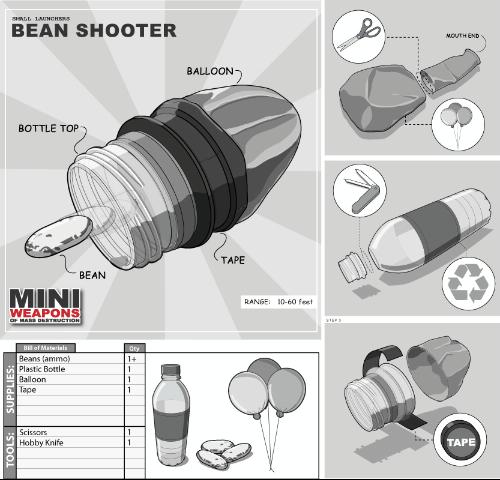
 If I could travel back in time and give my early adolescent self a gift of potentiation and portends of power, it would be a copy of John Austin's Mini Weapons of Mass Destruction. If I were my father, on the other hand, I'd take that book away from me in a most timely and uncompromising manner, hide it in a place where only I could find it, and read it from cover to cover.
On yet another hand, my going on 8-, going on 21-year old granddaughter loves this book.
Mini Weapons of Mass Destruction contains 241 pages of detailed, painstakingly illustrated instructions for making (and here I read from the table of contents) launchers and bows, slingshots, darts, catapults, combustion shooters (combustion shooters!), minibombs and claymore mines, and, finally, concealing books and targets.
Did I mention combustion shooters? Like the famous match rocket which you can make out of paper or wooden matches, with nothing more than aluminum foil, a needle or pin, a medium binder clip (Austin loves those binder clips), a toothpick and a large paper clip? O, there are warnings. "Eye protection and a safe firing range are musts" declares the ever-pragmatic Austin. "Match rocketry is not an exact science," he cautions, "misfires and modifications will be needed to find the perfect balance." Match rockets! How inexorably cool is that?
There are two things that make Mini Weapons of Mass Destruction such a fun read: 1) every "weapon" is made out of common household objects, and 2) the instructions are exceptionally clear and well-illustrated. OK. There are three things: 3) the sheer ingenuity of the designs. It's the very kind of book MacGuyver might have read during his training course. For fun. Of course.
Want more? Visit John's site. Learn a little about him. Print out a few targets. Get instructions for building more. Meditate on the nuances of "implements of spitball warfare."
from Bernie DeKoven, funsmithLabels: Toys
Sunday, March 07, 2010
An introduction to the Neodymium magnet executive puzzle toy
 The four following reviews are almost identical, each featuring a different rendition of the same magnetic puzzle/toy concept. There are minor differences, and, depending the player's preferences, one might prove definitely more, shall we say, "attractive," than the rest. But comparing them to each in any effort to determine which was truly best only led us to the kinds of thinking that this website is not designed to support.
When we find an exceptional toy or game, one of sustainable play value, our goal is simply to add our bit of recognition and support, to recommend them as something worthy of your playtime. Our goal is not to tell you which is, for example, the best chess set you can buy, because chess is chess. And though the look and feel of different chess sets may appeal to different people, the fact is, if you want to play chess, it's still a good game, even if you're playing in with bits of paper. Rarely, we find a newly invented toy or game available, almost simultaneously, from 4 different sources. Given our mission here, the only solution we could arrive at was to create 4 different reviews, awarding each the Major Fun seal.
We think you'll enjoy this toy a great deal. Read the reviews. Check out the websites. It really doesn't matter which you end up buying. Each will bring you hours of challenging, engaging, and, hopefully, major fun. Labels: magnetic, Neodymium, Puzzles, Toys
Wednesday, March 03, 2010
Neocubes
 We've been taking a very close look at a puzzling phenomenon, known as The Neo Cube. The website alone is sufficiently filled with invitations and incentives for purchasing these extremely attractive technical marvels to explain why we've been looking so closely.
Attractive indeed. Attracting curiosity, creativity, dexterity, ingenuity. Visually and tactually engaging. They are executive wonder toys. Moderately expensive investments, that payoff in hours of meditative, and sometimes significantly aggravating play.
Neocubes are made of Neodymium magnets - the strongest, longest lasting of rare earth magnets. These magnets really, really want to stick together. Assembling them into any of the amazingly attractive configurations shown on the web or featured in their documentation sometimes requires very strong fingers and deep, abiding dedication. Assembling the 6x6x6 cube (a challenge so fundamental that it has become a magnetic-ball-puzzle industry standard to include at least 216 - or 6-cubed balls) can get significantly frustrating, not because it is conceptually difficult, but rather because the balls can offer surprisingly strong resistance to being pulled apart or forced together in any way other than that which seems to appeal to them at the moment.
Neocubes comes in a blister pack that includes 8 extra magnets, instructions and a drawstring bag. The back of the pack contains ample warnings about the dangers of swallowing, heating, or handling these magnets should their coatings be compromised. The manufacturers strongly and understandably advise that these magnets should not be played with by children younger 12.
The spectacular variety of sculptural puzzles that these magnetic balls lend themselves to can be found everywhere on the web. On flickr you can find image after image of Neocubes. On Youtube you can watch a minor myriad of people making mini-metal-marble magnetic magic with Neocubes. As you watch, it is clear that making these extremely attractive configurations is as much a performance art as it is an act of conceptual mastery.
Until this review, the story of these amazing magnet balls has been uniformly focused on the many marvelous puzzle-like activities available to the magnet-ball-empowered few. Our explorations have revealed equally marvelous toy-potential. Here is a very simple example - showing what happens when you roll one ball at another, with appropriate speed and something like aim, on a plate. Turn up your sound to appreciate the fullness of the inherent glee.
With this very preliminary foray into the "toyetic" qualities of it all, we hereby invite your contributions of similarly jolly, playworthy discoveries. This first is but a taste. (Actually, more of a hint than a taste as the frame speed of the video doesn't show the full spinning glories we experienced. But a tasty hint, nonetheless.) image by Frans (3Djavu.nl)Labels: magnetic, Neodymium, Puzzles, Toys
Buckyballs
 We've been taking a very close look at a puzzling phenomenon, known, in this particular instantiation, as Buckyballs - a puzzle made of 216 (count 'em) extremely attractive (read "magnetic") balls.
Attractive indeed. Attracting curiosity, creativity, dexterity, ingenuity. Visually and hapticly engaging. They are executive wonder toys. Moderately expensive investments, that payoff in hours of meditative, and sometimes intensely aggravating play.
Buckyballs are made of Neodymium magnets - the strongest, longest lasting of rare earth magnets. These magnets really, really want to stick together. Assembling them into any of the amazingly attractive configurations shown on the web or featured in their documentation sometimes requires very strong fingers and deep, abiding dedication. Assembling the 6x6x6 cube (a challenge so fundamental that it has become a magnetic-ball-puzzle industry standard to include at least 216 - or 6-cubed balls) can get profoundly frustrating, not because it is conceptually difficult, but rather because the balls can offer surprisingly strong resistance to being pulled apart or forced together in any way other than that which seems to appeal to them at the moment.
Buckyballs comes with ample warnings about the dangers of swallowing, heating, or handling these magnets should their coatings be compromised. Noting quite clearly that the minimum recommended age is 13.
The spectacular variety of sculptural puzzles that these magnetic balls lend themselves to can be found everywhere on the web. On flickr you can find image after image of Buckyballs. On Youtube you can watch a minor myriad of people making mini-metal-marble magnetic magic with Buckyballs. As you watch, it is clear that making these extremely attractive configurations is as much a performance art as it is an act of conceptual mastery.
Until this review, the story of these amazing magnet balls has been uniformly focused on the many marvelous puzzle-like activities available to the magnet-ball-empowered few. Our explorations have revealed equally marvelous toy-potential. Here is a very simple example - showing what happens when you roll one ball at another, with appropriate speed and something like aim, on a plate. Turn up your sound to appreciate the fullness of the inherent glee.
With this very preliminary foray into the "toyetic" qualities of it all, we hereby invite your contributions of similarly jolly, playworthy discoveries. This first is but a taste. (Actually, more of a hint than a taste as the frame speed of the video doesn't show the full spinning glories we experienced. But a tasty hint, nonetheless.)
Labels: magnetic, Neodymium, Puzzles, Toys
Tuesday, March 02, 2010
Cybercube
 We've been taking a very close look at a puzzling phenomenon, known as CyberCube. We tried to look no further than their amazing, lovely to look at website, filled with invitations and incentives for purchasing these extremely attractive magnetic marvels, but couldn't stop there. We had to have one, at least. The very shiny silver one. Though the gold one looked at least as attractive, and the nickel and black at least as playworthy as the others.
Attractive indeed. Attracting curiosity, creativity, dexterity, ingenuity. Visually and haptically engaging. They are executive wonder toys. Moderately expensive investments, that payoff in hours of meditative, and sometimes moderately aggravating play.
Made of Neodymium magnets - the strongest, longest lasting of rare earth magnets, the Cybercube magnets really, really want to stick together. Assembling them into any of the amazingly attractive configurations shown on the web or featured in their documentation sometimes requires very strong fingers and deep, abiding dedication. Assembling the 6x6x6 cube (a challenge so fundamental that it has become a magnetic-ball-puzzle industry standard to include at least 216 - or 6-cubed balls) can get profoundly frustrating, not because it is conceptually difficult, but rather because the balls can offer surprisingly strong resistance to being pulled apart or forced together in any way other than that which seems to appeal to them at the moment.
They also all come with ample warnings about the dangers of swallowing, heating, or handling these magnets should their coatings be compromised. CyberCube recommends that they most definitely should not be played with by children aged 8 or under.
The spectacular variety of sculptural puzzles that these magnetic balls lend themselves to can be found everywhere on the web. On flickr you can find image after image of CyberCube. On Youtube you can watch a minor myriad of people making mini-metal-marble magnetic magic with CyberCube. As you watch, it is clear that making these extremely attractive configurations is as much a performance art as it is an act of conceptual mastery.
CyberCube come in a variety of packages and colors. You can get them in tins - which are fun to build on and, when the balls are stored inside the tin, helps eliminate the magnetic field. You can get them in boxes. You can get them in boxes (the magnets are a little smaller and cost a little less). You can get enough to make a 6x6x6 cube (with a few extras) or a 7x7x7 cube.
Until this review, the story of these amazing magnet balls has been uniformly focused on the many marvelous puzzle-like activities available to the magnet-ball-empowered few. Our explorations have revealed equally marvelous toy-potential. Here is a very simple example - showing what happens when you roll one ball at another, with appropriate speed and something like aim, on a plate. Turn up your sound to appreciate the fullness of the inherent glee.
With this very preliminary foray into the "toyetic" qualities of it all, we hereby invite your contributions of similarly jolly, playworthy discoveries. This first is but a taste. (Actually, more of a hint than a taste as the frame speed of the video doesn't show the full spinning glories we experienced. But a tasty hint, nonetheless.)
Labels: magnetic, Neodymium Puzzles, Toys
Monday, March 01, 2010
Zen Magnets
 We've been taking a very close look at a puzzling phenomenon, known as Zen Magnets. Actually, you need look no further than their website to be delighted and enticed by a myriad invitations and incentives for purchasing these extremely attractive technical marvels.
Attractive indeed. Attracting curiosity, creativity, dexterity, ingenuity. Visually and haptically engaging. They are executive wonder toys. Moderately expensive investments, that payoff in hours of meditative, and sometimes moderately aggravating play.
Zen Magnets are made of Neodymium magnets - the strongest, longest lasting of rare earth magnets. They are also exceptionally lovely to behold in all their reflective, mirror-polished glory. These magnets really, really want to stick together. Assembling them into any of the amazingly attractive configurations shown on the web or featured in their documentation sometimes requires very strong fingers and deep, abiding dedication. Assembling the 6x6x6 cube (a challenge so fundamental that it has become a magnetic-ball-puzzle industry standard to include at least 216 - or 6-cubed balls) can get significantly frustrating, not because it is conceptually difficult, but rather because the balls can offer surprisingly strong resistance to being pulled apart or forced together in any way other than that which seems to appeal to them at the moment. Which explains why Zen Magnets comes with a plastic card that can be used as a prying tool.
They also come with ample warnings about the dangers of swallowing, heating, or handling these magnets should their coatings be compromised, advising, in no uncertain terms, that these magnets should not be played with by children younger than 12. The spectacular variety of sculptural puzzles that these magnetic balls lend themselves to can be found everywhere on the web. On flickr you can find image after image of Zen Magnets. On Youtube you can watch a minor myriad of people making mini-metal-marble magnetic magic with Zen Magnets. As you watch, it is clear that making these extremely attractive configurations is as much a performance art as it is an act of conceptual mastery. Zen Magnets also comes with a drawstring velvet bag (which is especially useful when you don't have the time or wish to make the effort to get them into any particular formation) and six extra magnet balls.
Until this review, the story of these amazing magnet balls has been uniformly focused on the many marvelous puzzle-like activities available to the magnet-ball-empowered few. Our explorations have revealed equally marvelous toy-potential. Here is a very simple example - showing what happens when you roll one ball at another, with appropriate speed and something like aim, on a plate. Turn up your sound to appreciate the fullness of the inherent glee.
With this very preliminary foray into the "toyetic" qualities of it all, we hereby invite your contributions of similarly jolly, playworthy discoveries. This first is but a taste. (Actually, more of a hint than a taste as the frame speed of the video doesn't show the full spinning glories we experienced. But a tasty hint, nonetheless.)
Labels: magnetic, Neodymium, Puzzles, Toys
Monday, November 02, 2009
HABA Ball Run
 The HABA Ball Track Building Set is, by all measures, a toy to treasure. Made of European Beechwood, the pieces are beautifully finished, and a pleasure to touch, lift, position, reposition. The basic set includes just enough ready-made sections of track and tunnels to make the purpose of the toy immediately accessible, and more than enough building elements to invite curiosity, imagination and endless elaboration. The HABA Ball Track Building set will engage children in hours of play, exploration, design, construction and, above all, experimentation. The fact is, that any construction toy that involves building marble runways, even one made of plastic, provides children with a near perfect environment for gaining the basic understanding of and appreciation for the processes that are central to all scientific pursuits. Given a set with a variety of both construction and track elements, creating a marble runway that really works invites observation and testing, experimentation and patience, refinement and repetition, elaboration and further testing. Children are sensitive creatures, and though they may not express a specific preference for wood over plastic, the warmth, heft and precision of this thoughtfully made wooden toy will deepen and enrich the play experience for as long as they continue to play.  Though the HABA Ball Track Building set provides everything needed for many, many hours of absorbing fun, there are supplemental sets available that extend the value of the set, renewing the invitation to play by introducing new properties and functions. We tried the Cascade (a zig-zag, waterfall-like box that makes a lovely sound as marbles drop through), the Speed Track (a long, high ramp, that, as advertised, makes the marble go very fast, prompting new explorations of what you can make the system do), and the Score Counter (adding a random, but fun way to compete). But were most excited by the HABA Games for HABA Balltrack an extension that significantly adds to the overall play value of the entire set. It, in fact, redefines the set by introducing the idea of games. The ball run is not a game. It's a construction toy, the object of which is to build something - not play something. By adding games to the set, the entire toy gets redefined. Suddenly, there are rules, social structures, so many more variables to play with, which, in turn, get extended and redefined by the nature of the toy.  For example, the set of miniature nine-pins (wooden, of course - 8 natural color, one red). So now the child has something to aim for. How many rolls will it take before she can knock down all the pins? Who can knock down the most? Can you knock all the pins down except for the red one? Should you use the large marbles? Roll them down the special large marble ramp? Both ramps? Should you both roll your marbles at the same time, from opposite sides? Should you use the large marbles to hit the small marbles so that they roll into the pins? Should you use the small marbles to hit the large? Should the small marbles have to be launched from the very beginning of the entire marble run? Can you re-aim a ramp while a marble is rolling? And then there are the three arches - targets to roll through. One is worth three points, another only two, and a third, the widest, only one point. Where do you put those arches? Where does the marble have to come from? And then there's the floor, the whole room - everything becomes a target or an additional obstacle or another ramp. With the game extension, the whole Ball Run takes its place in the child's world, becomes one aspect of a small universe of things to roll at and under and through, becomes even more of a shared thing, an invitation to play that your child can extend to his family and siblings and community. Labels: Dexterity, Kids Games, Tops for 2009, Toys
Thursday, August 06, 2009
Travel Litterbug
 If you were a Jack-in-the-Box who wanted to be game, Litter Bugs is what you'd be. You'd be just as surprising, suspenseful, and almost as frightening, as a good jack-in-the box, but unpredictably and instead of getting cranked, people would take turns pressing your buttons, never knowing which one of eight was going to make you pop, having one less choice with each passing of the trash can. You might not be a toy trash can, per se. Or a trash can with such an evil, oddly smirking face, as illustrated. But if you were a toy trash can with a toy trash cad lid, attached, beneath which a large, very fly-looking plastic fly lies ready.. to....... pop-up. To play the surprisingly one-piece Travel Litter Bugs game, one of you presses down on the plastic fly - all the way down until the fly, well, clicks. Close the lid. Randomly select any randomly selected button. Push it down. Give the trash can to one of your partner/opponents. Let them push down any of the other still unpushed-down buttons. And so on and so on, button-by-button, until there are, for example, only two buttons left and it's your turn and you still can never tell which is going to release the fly, which, just as you press the other button, suddenly pops straight up, forcefully flipping open the toy lid in satisfyingly complete surprise. You can play with it by yourself, with you friends, you can play with it as a toy, you can play it to decide who goes first. (Rocky and I were play/working on a puzzle together, using the toy as a kind of victory timer. Every time one of us would get a piece in, we'd get/have to press a different button.) Travel Litterbugs is an elegant, well-designed toy/game, for children of any persuasion. As decisive as a game of Rock/Scissors/Paper, fun as a jack-in-the-box, and about as long to play. Major FUN! Labels: Family Games, Kids Games, library, Toys
Wednesday, July 22, 2009
The Bilibo Game Box - a child's tool kit for game invention
The Bilibo Game Box is not just a toy. It is a tool kit for the very young game designer (age 4 and up) and an invitation to inventiveness for the rest of us.
The Game Box contains a die with interchangeable faces and six sets of differently-colored discs that fit in each face. There's also a set of six, plastic, hand-sized "mini-Bilibos," in each of the six colors corresponding to the colors of the discs.
Bilibos are shaped something like pregnant plastic Pringles, with holes that look almost like eyes. Full-sized Bilibos are big enough for a kid to sit, spin, rock, float, climb in or on, or pretend with. The simple, friendly, colorful design invites creativity, exploration, and invention, and nurtures playfulness. No moving parts. Just a funny shape to explore, define, redefine, shape your dreams on. Mini-Bilibos are just as strange, just as funny, just as fun to play with. And, as son-in-law Tom observed, function quite satisfactorily as doll helmets.
The die is called a Bilibo Pixel. It is made of some surprisingly bouncy and slightly stretchy plastic. The corners are so wonderfully rounded that it rolls as well as bounces almost as well as a rubber ball. Button-like pieces fit in each of the faces of the die where there are cavities deep enough not only to accommodate any of the discs, but also to fit little messages or prizes, or, if you are so inclined, weights. So you can play around with fate, as it were, making some of the faces the same color or all of the faces different, adding and removing things behind the colored buttons to influence where the die might fall and add further elements of surprise.
The Bilibo Game Box gives your child a set of almost infinitely enticing properties and relationships to explore. Without even reading anything even closely approximating rules, the child will find herself using the die in some way to indicate which mini-Bilibo she should aim for. Aim what, you might ask. Any of those color-coded, button-like discs which can be slid or juggled or tossed or tiddled under or over or through. Or strung together, for that matter, or strung together with a mini-Bilibo.
As children continue to explore the properties and relationships of the Bilibo Game Box, they will inevitably discover that the elements can be used in conjunction with a surprisingly varied array of other objects in their environment - chairs and steps, tables, counter-tops, floors. They can make targets and game boards with sheets of paper, ramps and obstacles out of paper plates and sheets of cardboard, die-launchers and Bilibo-flippers out of spoons and rulers.
 Alex Hochstrasser, designer of the Bilibo Game Box and associated products, has created a work of playful genius. The simplicity of the components belie the elegance of design and the depth of understanding of the nature of creative play.
There are several delightful videos https://www.youtube.com/bilibo on Youtube that illustrate a few of the plethora of possibilities contained in the Bilibo Game Box, and a well-illustrated booklet that accompanies each Game Box for yet more ideas, and, soon, even more will be on the Bilibo website.
Despite all these resources, please, consider this: the more you and your children play together with this, openly, inventing games from scratch, without any guidance other than that which comes from your collectively playful hearts, the greater the value of your experiences with this remarkable toy. If you want ideas, let your children be your guide. The Bilibo Game Box is remarkably innovative and brilliantly designed, but the real value of it only becomes apparent when it is used as a tool for playful, inspired invention. Labels: Kids Games, Tops for 2009, Toys
Thursday, July 02, 2009
The Bubble Thing
 Making big bubbles - and I mean really big bubbles - is at least as much a technology as it is an art. David Stein, inventor of The Bubble Thing, has created a really-big-bubble-blowing technology that works well enough for you to make really big bubbles now, and develop the art later.
His Bubble Thing has two components: a really-big-bubble-making wand, and a bottle of the mysterious "Bubble Mix." (David says: "If you run out of mix, baking powder will tide you over and work good too.") ("Tide" you over? Is that Freudian product placement?) The really-big-bubble-making wand (a.k.a. "the Bubble Thing") is a very large open-and-closeable fabric loop on a tubular handle. You dip the closed loop in a bucket of soap suds, raise it, open it, wave it sideways and it makes really, really big bubbles. And then there's a bottle of bubble mix which, when added to water and dish soap, provides, shall we say, the "ultimate solution" for your really-big-bubble-blowing needs. Yes, it can get a bit messy and slimy and soapy. But even more yes, it will astonish you with your suddenly-acquired really-big-bubble-blowing powers.
 The instructions even include, bless them, a game called the "Popping Game." You "win one point for popping little bubbles (smaller than a basketball)." But you lose five points when you pop a big bubble. Squirt-gun, frisbee- and finger-popping are all recommended. Ah, a bubble game. Surely there must be a myriad of such.
As a matter of no coincidence at all, bubble-maven Stein has teamed up with the editors at Klutz Press to produce a handy guide to really-big-bubble-making called How to Make Monstrous, Huge, Unbelievably Big Bubbles. The Bubble Wand you get with the book, Stein explains, is the same size as his own version.
It's most definitely an outdoor toy. It's most clearly designed to be used by people old enough to be sensitive to things like a shifting wind and the soap-in-the-eye potential, and young enough to want to make really, really big bubbles. And the fun, the fun, is like totally major. Labels: Toys
Tuesday, June 09, 2009
The Big Bilibo - better than the box it came in
 Bilibo Bilibo is a toy. A large, colorful toy. With no moving parts, unless you count the children who play with it. Like any toy, it is designed for a certain kind of child with equally certain kinds of parents - creative, imaginative, active children, whose parents understand and support unstructured, unpredictable, non-directed play. The Bilibo is the mother of the Bilibo Game Box - the very Bilibo Game Box glowingly reviewed here just last month.  For children between the ages of 18 mos and 8 years, the Bilibo is something to sit in or on, to rock or twirl or scoot in, to stand on, to wear. It is a water toy and a sand toy and a family room toy. It is a toy for storing other toys in. Just what this toy means to kids depends on the adult as much as the child. The way you play with your child, the expectations you have, the limits you impose, the other toys you have out for play... all impact the way your child experiences the Bilibo, and you experience your child. Alex Hochstrasser, the inventor of what has become the Bilibo system, comments: "...most children have fun with Bilibo anyways, because that's how they play. They learn much more when they explore and discover things by themselves...I wanted to create a toy that was not gender or age specific but rather grows with the kids and, depending on age and interests, can be used in ever new ways. The closest I had as a role model was probably the card board box." But it is also true that if adults are present, they influence the child's play, overtly or covertly. Parents need to be careful of their expectations. Even the most gifted children might not immediately take to the Bilibo. They need time with it. Time to explore or not. To kick it around, sit on it, or ignore it. Its presence in their play environment, like the presence of an empty cardboard box, will, in time beckon to them. The best influence you can have, especially with a toy like Bilibo, is in your willingness to let the child discover and define the toy for herself. For example, from the persepective of a physical therapist who has obviously allowed the child undirected access to the toy, it becomes a multi-purpose tool. The therapist writes: "I thought I would tell you how much one child I work with enjoys the Bilibo toy. He is 5 and totally blind. He spins quite fast around in it on a hard surface floor. He is able to catch himself with his arms what ever direction he tips over which is helping him with upper body development and balance skills.
"It also cradles small/multi involved children with low tone, very nicely encouraging them in bringing their hands to midline. When a large enough child is in there (and I am supporting the Bilibo not to roll about), rather than arms/hands flopping about at the sides, the arms end up more in the middle of the body, to hold a toy. Of course with experience many of these kids like a bit of gentle rocking to and fro as well."  Alex adds: " the stimulation of the child's vestibular system by spinning and balancing in the shells would be an interesting area where Bilibo shines. (The vestibular and proprioceptive systems play a key role in the development of the brain and reading and writing skills in particular.)" If you already have the Bilibo Game Box, the big Bilibo makes an ideal expansion component, and vice versa. It's almost a given that children will weave family fantasies around the relationship between the big Bilibo and mini-Bilibos. Then there are the profound discoveries to be made about mini-Bilibo-spinning inside a big-spinning-Bilibo, spinning, perhaps, in a different direction. And what about the Bilibo Pixel? Does it roll and bounce and do even more fun things when it's inside a big, spinning Bilibo? And if you can afford more than one (child or Bilibo), there's yet other orders of magnitude of games and fantasies, probability and physics, social and biodynamics to explore. For kids (or parents) who don't yet have a Bilibo, there's an ample collection of inspirational clips on YouTube. On the other had, once your kids start playing with their Bilibo collection, they'll have all the inspiration you need. If you're good, maybe they'll let you play, too. Labels: Toys
Monday, April 27, 2009
Purveryor of Playfulness
 She calls herself Danna Bananas. Clicking through her online store, also called Danna Bananas, is an adventure in whimsy. She has assembled a collection of some of the most novel novelties I've ever encountered on one site - page after page of wacky, funny, laugh-provoking, and often genuinely playworthy tchotchkes.  Take, for example, Airfork One, "made of sleek stainless steel encased in food-grade, dishwasher-safe silicone. Just the thing to bring those mashed potatoes and peas in for a safe landing...Packed in a recyclable clear PET box."  It's a fun thing. It's a functional thing. It is sensitive to the realities of child-rearing - embodying a game that hundreds of thousands of parents have played with their babies as they often desperately try to get them to finish their food. It is for these reasons, and others manifesting themselves throughout her website, that Ms. Bananas joins the ranks of the select few, to be known now and forever more (or less) as a Defender of the Playful. Danna Bananas, DotP, has managed to share with us her gift of playfulness. She offers us and the rest of the known universe access to silly, sometimes remarkably inexpensive (c.f. Finger Twister), sometimes the semi-miraculous (c.f. the bouncing-on-water Waboba Ball), and often the actually somewhat practical (c. also f. the Banana Handle. Again I quote: "...very appealing non-slip handle grip! You’ve never seen a chimpanzee burn himself on a hot pan, have you? Of course not! That's because Banana Handle's heat-resistant silicone construction protects hands, both human and primate. Slide the ripe yellow peel onto any pan handle and you are fully protected, hands down.") - inviting laughter, paving the way for play. And US residents don't pay tax! What more, I ask you, could you ask? Tweet her on Twitter.
Labels: Defender of the Playful, Toys
Thursday, November 20, 2008
Katamino
 Katamino Katamino is based on a geometric puzzle called " Pentominoes." "Pentominoes," reports the Association of Teachers of Mathematics, "can be used to develop children’s understanding of the concepts of area and perimeter, transformational geometry including enlargement, congruence and symmetry, nets, volume and classification." Katamino takes the concept further, into a series of games and puzzles that can absorb the spatial reasoning faculties of children as young as three, and adults as old as they want to think they are.  The multi-language instruction booklet includes illustrations for hundreds of puzzles and several challenging games. At its simplest level, it is a building toy, which, like all good building toys, can become very challenging. Then it becomes a puzzle. The it becomes a more and more challenging as players attempt to put more of the pentomino pieces together in larger and larger rectangles. There's a very useful bar that gets placed in different positions on the board to limit the playing area. This same bar is also used to divide the board into two different halves so that two players can race each other to complete a rectangle. Another game variation involves using an 8x8 board (printed on the back of the instruction booklet). Players take turns placing the pentominoes on the board. The last player able to play wins. To make the game easier, or the constructions more complex, the manufacturers include one- and two-unit blocks. The pieces and frame are all made out of wood. Though the colors of the wooden pieces don't precisely match those in the instructions, their shapes are easily discernible and the colors are close enough for players to figure out all the rules and variations as well as the two- and three-dimensional puzzles. Don't be misled by its similarity to other games. Fundex's Katamino is a unique invitation to a lifetime of challenging fun. Labels: Family Games, Puzzles, Thinking Games, Toys
Monday, February 04, 2008
Mirror-aculous® Art Activities
 Every now and then it becomes my privilege, as your personal Major FUN, to bring you news about a toy or game company that has found a way to transform the commonplace into the extraordinary. See, for example, my story on a renewed approach to connect-the-dots puzzles. Note especially how enthusiastically you found me waxing. Today I find myself once again waxing my enthusiasm. You have, of course, heard of the anamorphoscope, and all the various wonders connected thereto, ranging in wonderworthiness from the, shall we say, "mirror-aculous" works of Leonardo Da Vinci to the many photo-marvels of cinematic illusion? Have you by any chance also heard of the toy company that has brought this most delightfully illusion-prone technology to the hearts and hands of children - a company called, now say it with me, " OOZ & OZ?" Like the artist/developer of those transformed connect-the-dots puzzles, Myrna Hoffman, the founder of OOZ & OZ, has managed to make a common coloring-book-like activity into something wonderfully new and deeply engaging. Again, like the connect-the-dots artist, she has explored this new visual twist in great depth and with equally deep devotion. The technology centers on a thin sheet of mirrored Mylar, which, wrapped around a paper cup, becomes a kind of anamorphoscope - anamorphoscopic enough to make it possible to view and create anamorphs. The art is in the remarkable variety of packages and activities that Ms. Hoffman has created.  To get a feel for that variety, take a look at the Circus Kit. It comes with two mirrored cups, a box of crayons, and 32 pages of anamorphic images to color. Coloring an anamorphic drawing is a challenge in itself. If you try coloring the image without referring to the reflection, you can't really tell what you're coloring. If you try to color the drawing while looking at the reflection, you have an eye-hand coordination challenge of significantly amusing profundity. I called Myrna and asked her what she recommended: to do the coloring while looking at the reflection or just to look directly at the paper. Her answer: "yes." In addition to the coloring activities there are drawings where you color-only-the-spaces-with-two-dots, incomplete drawings that you try to fill in by connecting dots, other, even more incomplete drawings that don't even have dots to guide you, and mazes - all transformed by the anamorphic challenge. The kit itself comes in a cleverly designed box that can be used to transport the entire collection as well as a portable, laptop desk for that anamorph-anywhere experience. Another, and even more affordable package is designed for parties - you get eight large anamorphed placemats, eight mirror wraps (Mylar sheets that you wrap around a paper cup), and instructions for "bonus activities." These are very reasonably priced, and perfect for an art class, a session of therapeutic art for seniors, or a family gathering. My wife, who has taught art for many years, noted that the anamorph activity is an excellent way to help teach novice artists to learn to "draw what you see, rather than to draw what you think you see." You can even get a custom morph of pretty much any image you send them. Ms. Hoffman's sensibilities, to affordability, to children, to play, to art, science and learning; to ecological concerns, are everywhere evident. We're talking Major FUN. Labels: Kids Games, Toys
Thursday, August 23, 2007
Q-BA-MAZE
 Q-BA-MAZE Q-BA-MAZE is a marble run construction toy, in the tradition of Boyongolo, the HABA Ball set, the Quercetti Marble Run, the Skyrail Marble Run Roller Coaster, and, of course, Cuboro. In the tradition of, and yet, unique, and uniquely worthy of our collective attention. Actually, all these toys, and many more like them, are worthy of our collective attention. Building a marble run engages both creative and scientific reasoning. Every design must ultimately "work," not only aesthetically, but also mechanically. No matter how good it looks, if the ball doesn't go where you think it should, or if the run isn't as long as you hope it should be, you're just going to have to build it differently. Now, back to Q-BA-MAZE. I promise not to use the word "amazing" more than once - after this. First, allow me to use the word "cube." As in Cuboro, the basic building block is a, well, block. Unlike Cuboro, there are only three types of blocks, they are made out of a durable polycarbonate, translucently acrylic-like plastic, and they fit together in most satisfyingly interlocking configurations. They can slide into each other along their sides, they can be stacked on to each other, they can be built up and out into cantileverishly cunning constructs. They also work. One of the three, the one that opens on both ends, works in a most curiously delightful manner. It is a switch, of sorts. With no moving parts. But when a ball drops into it, the ball will often hesitate before traveling left or right, sometimes hesitate a most tantalizingly long time, as if deliberating. And this turns out to be a particularly delicious deliberation, adding just that extra touch of surprise, just that extra change in rhythm that makes the whole, multi-colored construct that much more surprising, that much more engaging. Q-BA-MAZE comes with a bunch of steel balls - not because they're easy to lose, and definitely not because they're easy to swallow (hence, the small child advisory), but because the more balls you drop into it, the more complex the pattern of the fall, the more fun it is to watch - a visual equivalent of the difference between melody and symphony. Watch the video, read the blog, construct your own myriad of delights, or build any of the configurations you find online, like this one, if you happen to have purchased the 50 count set (36 blocks and 14 balls). You'll be amazed. Labels: Thinking Games, Toys
Friday, June 01, 2007
Confoundingly Crazy Crate-O-Mystery
 The Confoundingly Crazy Crate-O-Mystery (from Fundex Games, available here) is a confoundingly clever way to introduce kids into magic. They get magic apparatus (ok, toys), comic book-like instructions, and an instructional DVD that shows them how each of the ten tricks included in this kit is performed, and the secrets that make each trick work. These materials are central to the magic of the Cofoundingly Crazy Crate-O-Mystery. The biggest obstacle to mastering any illusion is learning how to do it. You can go to a magic shop and buy hundreds of wonderful tricks, but when it comes to learning how they work, and how to perform them, you have to rely on cryptically written instruction slips, usually in small print, that convey little if anything of the art of it all. Most of the 10 magic tricks are performed with with the assistance of wonderfully toylike apparatus, which is exactly how it should be. There's plastic monkey with detachable tail, feet, arms, hat and banana. And a sheet of tattoos. There's the crate itself, made of sturdy cardboard with magnetically sealing doors on 4 sides. There's a special magic handkerchief. And some other stuff. I don't want to get too specific here, because it might give away some of the secrets to the Confounding Craziness of it all. You'll also need two cookies and a dime. And I can't tell you why.  Magic is a very special kind of play. It's part science and part theater. The Confoundingly Crazy Crate-O-Mystery is a well-presented introduction and invitation to a unique form of fun - one that can last a lifetime. Especially recommended for kids who are old enough to read (8 and up), disciplined enough to practice and perfect their secret arts, and enjoy being the center of awe-struck attention. Major FUN, indeed. Labels: Toys
Thursday, May 24, 2007
50 Ways to Use Your (Pool) Noodle
 50 Ways to Use Your Noodle 50 Ways to Use Your Noodle is the first book to receive a Major FUN award. There's something inherently funny about saying the words "Pool Noodle." Go ahead. Give it a try. Say: pool noodle, pool noodle, pool noodle. See what I mean? Even thinking about a pool noodle, a noodle in a pool, a pool full of pool noodles is kind of fun. And playing with a pool noodle, in a pool, of course, sitting on one, lying on one, lying on several...fun, all fun. Well, what Chris Cavert and Sam Sikes tell you what you can do with pool noodles, on the land, even, is every bit as fun, and even more inventive than that. They've written two noodle books, as a matter of fact: 50 Ways to Use Your Noodle and 50 More Ways to Use Your Noodle. Now, before I go any further, I want to warn you. Page through these books, and you're going to want to invest heavily in pool noodles. At about $3/noodle, we're not talking junk. Though you could purchase Tubular Polyethylene Foam Pipe Insulation, Pre-Slit, 3/8" Wall Thickness, For Use On 1/2" Copper Pipe Or 1/4" Iron Pipe, for maybe $3 for 4 3-foot sections. Which is more junk-like, but not much cheaper. Not only are you going to want to buy many, many pool noodles (at least one for each player), but you're going to want to (dare I mention this? yes, yes, I must) cut some of your noodles into 3-foot "Midaronis," 3-inch "Minironis," and 1-1/4-inch "Meatballs." OK, by now you get a good sense of the tone of the whole thing: fun, funny, creative, inventive. So you're ready for at least one game. Like, for example, Balloon Volleyball, played with Midaronis. Do I need to explain this any more? Everyone with their own Midaroni. Trying to hit a large balloon over a volleyball net. Do you need me to tell you what fun this can be? Or how about the baseball-like "Bustin Burgers" game - where one player sails pool noodle Meatballs to the Midaroni-swinging batter? You might not expect the more creative activities, like the semi-self-explanatory "Noodle Doodles." And in all likelihood, you wouldn't have begun to anticipate the group team-building, problem-solving aspect of the whole thing, with exercises like seeing how many Meatballs or Minironis two people can hold between them. And yes, in the 50 More Ways book you'll even find pool noodle games you can play in the - can you believe it - pool. Together, the Noodle books are a treasure of creative, playful, problem-solving fun that should prove an invaluable resource to any youth leader, team builder, or provocateur of playfulness. RE: Noodle Economics Chris comments: "we found that the foam pipe insulation is okay for some of the noodle book activities, however, it doesn't have the rigidity for most games. Also, you lose the "visual" pull the colors have. Even though you might pay $3.50 (or so) for a noodle, you'll cut the long ones in half - thus cutting your cost in half. And, as long as the participants don't pick on or chew the noodles they last a very long time - the return on investment is great. Bonus: if you buy in the fall they are really cheap - stores don’t like to warehouse them because they take up so much space (some stores give them away to educational programs just to get rid of them before the winter months)." from Bernie DeKoven, funsmithLabels: Games, Toys
| |