|
Friday, May 07, 2010
Word on the Street, Jr.
Taking a game for adults and making it accessible for a younger audience is tough. You want to preserve the elements that made the original so fun for older players. You have to consider the cognitive development (and sometimes fine motor control) of younger children. You also want your game's brand to carry through—someone (the parent with the money) should look at your game and say, "I love that game! I bet little whats-its-name will like this kids' version too!" The wrong way to do it is to have your marketing department slap the game’s name and logo on a board with a spinner and hope the kids will be entertained by the random movement of colorful pieces. The right way to do it is like Word on the Street, Jr.
We reviewed the original Word on the Street a while back. It's major fun. We wanted to see how Word on the Street, Jr. held up in comparison. Specifically, we wanted to see if the junior set would engage adults and children at the same time. Sound impossible for a word game? Sound like two great tastes that have no business being in the same kitchen let alone the same plate? THINK AGAIN!! It’s a hoot.
The rules: Word on the Street, Jr. has all the letters of the alphabet running down the center of the game board which depicts a street. Each letter is a tile. Two teams compete to see who can get the most letters on to their side of the street. Teams draw a card with a prompt, such as, "name of a vegetable" and then have 30 seconds to come up with a word that matches the category. The letters that spell the word are moved one space toward the team for each time they appear in the word. For example, "carrot" would move the C, A, O, and T one space but the R would move two spaces. Once a team moves a letter to their side of the street, the letter is out of play and can't be moved the rest of the game.
The Junior version of the game includes the vowels (missing from the original) and the categories are a bit broader to accommodate developing vocabularies. Each category card has two sides, the blue side being a bit tougher than the green side.
I have only played the Junior version and it is plenty nerve-wracking. The 30 second timer keeps the game moving and the challenge is to come up with words that have lots of double or triple consonants. My eight-year-old enjoys playing with me and my wife (the adults play with the no vowels rule), but the most fun I had was in watching my daughter and her friends. The kids caught on to much of the strategy and gave their thinking muscles a work-out. Often they forgot that they were on different teams and volunteered their best responses to whatever category happened to be face up. They yelled. They laughed. They brought out their biggest words. In general, they acted like caffeinated jumping beans — which is a sure indication that major fun is afoot.
If you go to the Word on the Street site, and scroll down a bit, you'll also find a downloadable form you can use to create your own additional cards for the game. This is major cool, because you can make the game engage players on so many more levels with categories like: "12-letter words," "family members," "chores," "word in a Mylie Cyrus song."
Original concept for Word on the Street, Junior by Jack Degnan. Copyright 2009, Out of the Box Publishing, Inc.
Will Bain, Games Taster Labels: Family Games, Kids Games, Word Games

Sunday, April 25, 2010
Jenga Max
 Out of the box, the components of Jenga Max do not bear any resemblance to the by now iconic rectangular blocks that made up the original game. But do not let the bright colors and strange plastic pieces scare you away! Jenga Max retains the same tension and thrill of Jenga, with the addition of a unique visual flair.
It’s still a stacking game. Manual dexterity is a must. Unlike the original which unnerved players by slowly destabilizing the base of a tower, Jenga Max challenges players to load colorful plastic pieces onto a ring that is held above the table by a magnet. In the end, the effect is the same. Unbalance the structure, mishandle a piece, or just be the sorry sap to overload the magnet’s attraction and (say it with me) JENGA!! It all comes crashing down.
Building stuff up is fun but bringing it to ruins is satisfying on a disturbingly universal level.
 As you’ve probably noticed if you have visited this site more than once, visual design is an important component of Major Fun games. Jenga Max not only works as a great stacking game, but it also attracts your attention with the way the pieces fit together. The game comes with 36 plastic blocks in three colors: yellow, orange, and red. Each block has two holes on one end and a rectangular notch on the opposite side. Players stack the pieces by hooking the notch into the holes. By virtue of the piece design, the resulting chains form intriguing arcs and surprising angles. As players add more and more pieces, the entire contraption looks like a translucent, alien flower or sea creature.
Jenga Max captivates children and adults. The unique patterns and designs that arise through play give players reason to pause before each move, just to admire the beautiful principles of the lever and counter-balance. From the experience of my family, my eight-year-old loved the more competitive side of the game while my five-year-old just wanted to see if we could get all the pieces off the ground.
And there are few things that evoke the spirit of Major Fun more than yelling JENGA when your work of art smashes into the table and you have to gather the pieces up for round two.
Jenga Max is a product of Parker Brothers and Hasbro Games, © 2009. You can find more pictures, a video and an animated demo of the game in action on their site.
Will Bain, Games Taster Labels: Dexterity, Family Games, Party Games
Monday, March 22, 2010
Zenith
 Triangles are cool. They invite choice in matters of symmetry and lead to all kinds of complex designs once you link more than a few of them together. I find there is something a bit unsettling about geometric patterns that are based on triangles if the pattern is left incomplete, but I experience a rush of satisfaction when the last piece is placed and the figure is finished. Zenith, a strategic tiling and stacking game by MindWare, tapped into this fascination I have with triangles. The game demonstrated how robust and fun a competition can be with only a few simple rules and some thoughtfully designed game-pieces. In keeping with the magic number, I’ll break game-play down into three parts: the goal, the tiling, and the stacking. The goal: Be the last player to place one of your triangular tiles.  The tiling: Each player has a set of colored, wooden triangles (58 in a 2-person game, 29 in the 3- or 4-person games). They take turns setting their triangles on the game board which is patterned with white triangles that indicate where players may place their pieces. The game comes with four boards, each with a slightly different pattern and named after a mountain (Mt. Fuji, Pikes Peak, Twin Peaks, and Krakatoa). The stacking: Moving up makes things interesting. A player can place a tile on top of three lower tiles IF the player’s color is one of the bottom tiles. Here’s where the triangle’s unique symmetry creates complexity and strategic choices. Players try to block their opponents, but they must also make sure that they leave plenty of options as lower levels fill up and the upper levels get smaller and smaller. Not only is Zenith a joy to play from a competitive point of view, I found a lot of satisfaction in simply handling game-pieces that are so thoughtfully crafted. The triangular game tiles are solid, colorful, double-sided, finished wood. They invite a lot of creative, careful manipulation and building while your opponents are debating their next move. (One of our Tasters was a little frustrated at how careful the manipulations had to be, in particular, how easy it was to dislodge pieces as they were stacked one on the other, but the game proved too absorbing for any of us to remain bothered by the extra care required.) The game-boards are double-sided and the edges are inscribed with interesting facts about the namesake mountains. For instance, I did not know that “Krakatoa continues to increase in height 16 feet (5m) every year...” I especially appreciate the efficient packaging and use of space that MindWare employed in the game’s design. Nothing is wasted and it’s all major fun. Zenith was designed by Nicholas Cravotta and Rebecca Bleu of BlueMatter Games. © 2009 MindWare. Will Bain, Game Taster Labels: Family Games, Thinking Games
Friday, March 19, 2010
Can You See What I Seee? Finders Keepers Game
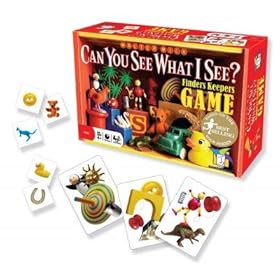 When you have children under the age of 9, card games take on a few distressing similarities. First, the chances of actually maintaining a complete deck of cards are approximately the same as keeping a red sock out of the white load. Second, the chances of the cards remaining in playable condition plummet in much the same trajectory as a car’s value once you drive it off the lot. Third, (and here’s where I roll my eyes) I hope you enjoy matching games. A lot. So in this spirit of trepidation and jaded-father cynicism, I considered Can You See What I See? Finders Keepers Game by Gamewright. It’s a matching card game that not only proved to be a hit with my girls and their scrum of free-range friends, but it cracked open my shell enough so that I enjoyed it too. A lot. Consider just the cards. Tiles might be a more accurate description. The game box contains 100 sturdy cards: 40 Find Me tiles and 60 Keep Me cards. Each Find Me tile has a single image—things like toy dinosaurs, plastic trucks, porcelain ballerinas, and dominoes. The Keep Me cards are larger and each card has four images that correspond to the Find Me tiles. Beautiful cards. Solid, colorful, laminated, and wonderfully textured cards. The instructions indicate the game is for ages 4 and up and I can believe it. These cards are made to be played. These cards will last.  Gameplay is simple, varied, and satisfying. The rules spell out two ways to play, but our kids were happy to come up with other variations. The game for younger children (4 and up) recommends dealing out 10 – 12 of the large Keep Me cards to each player (face-up). The Find Me tiles are shuffled and stacked. The players take turns revealing a Find Me tile and everyone looks to see if they have the matching image on their Keep Me cards. The winner… we didn’t pay much attention to winning in this game. The kids had a blast trying to find the images and trying to guess what would come next. The variation for ages 8 and up involves a bit more decision making. Nine of the Keeper Cards are revealed in the middle of the table. Each player has a pile of Finder Tiles that they are trying to match to the Keeper Cards in the middle. Players take cards that match their tiles and new Keeper Cards are revealed to fill the empty spaces. A bit of strategy comes in when players have to decide which matches will get them the most points and maybe make things difficult for their opponents. We played both variations with a group of kids aged 4 to 10. The very youngest needed a bit of help with the variation for older kids, but everyone remained engaged for the better part of an hour. I might not be able to keep all the cards from wandering away, but I know that the ones that remain will be sturdy and major fun! Can You See What I See? Finders Keepers Game is designed by Brian S. Spence, Garrett J. Donner, and Michael S. Steer, with contributions to the Expert Finders Keepers version by Walter Wick, author of the I Spy, and Can You See What I See book series. Will Bain, Games Taster Labels: Family Games, Kids Games
Friday, March 12, 2010
Dizios
 Dizios Dizios is a highly visual tile game that plays with color the way most tile games play with shape or number. The 70 thick, cardboard tiles are matched edge to edge. Some edges are all one color. Many more are two colors. Each tile is worth a certain number of points (indicated by dots in the center of the tile). Players get points, not for the tile they place, but for the tiles they connect to. Dizios can be played by 1-4 players, of a recommended age of 6 or older. There's very little strategy involved, so the game is easily accessible to younger children. To play with more than one player, the special "starter tile" is placed in the center of the table. The rest of the tiles are placed face down, mixed, and then set aside or built into draw piles. Each player selects 4 tiles. For the rest of the game, players take turns, matching a tile on to the expanding grid, if possible; taking score (by counting the dots that appear on the adjacent tiles), and then picking a new tile from the face-down tiles. If no match is possible, the player must forfeit his turn. The score pad is designed so any player who can count can keep score.  As a solitaire, Dizios offers a surprising variety of challenges. You can try to make a "vortex" (an array of connected tiles) of all one color, you can try for a vortex that is 8x8, 7x10, 5x14. Or, you can arrange try to arrange the tiles so they create the highest possible score. The solitaire versions greatly extend the fun of the game, and could easily lead a moderately creative player to develop more interesting variations of the competitive game. Dizios is an easy game to learn. The visual challenge is easy to understand, intriguing enough to entice a 6-year-old, attractive and complex to engage the full attention of adults. It is like dominoes only insofar as there are tiles that get matched - which makes the game that much easier to understand. But it is a very different game. Unique. Visually pleasing. Well made. Only lightly competitive. Intriguing (especially the solitaire versions) enough for serious adult contemplation. Inviting enough to engage the whole family. You can play in teams. You can play by yourself. You can make up your own challenge. Fun. Major FUN. Labels: Family Games, Puzzles
Monday, March 08, 2010
Q-bitz
 You get a wooden tray with 16 identical wooden cubes. One face of the cube is light, the opposite, dark. Another face shows a light circle on a dark background, the opposite, the opposite (a dark circle on a light background). The other two faces are half-and-half, diagonally divided. And with 16 of them, you can make at least 120 different, and often beautiful patterns. You can tell that, because there are 120 pattern cards, each different, each composed out of the simple shapes on the cubes. Mindware's Q-bitz is a game of visual perception for 2-4 players. A pattern card is revealed, and players race to be the first to echo the pattern on their own board. That's one way to play. The designers suggest that you play in three rounds (or not), each round a variation. The second round, you have to roll the dice, use what you can, then roll the remainder, then use what you can, then continue rolling, using what you can, until you've made the pattern, and, hopefully, are the first to have done so, correctly. Finally, the third round: After the pattern card is revealed, and everyone has an agreed-on time to look at it, it's turned over. Face-down. And then everyone tries to replicate the pattern, from memory! Q-Bitz turns out to be a remarkably challenging game, no matter how you play it. I, in the fullness of my 68-year-old maturity was able to win the first card. We tried the second with the rolling variation, but quickly decided to continue the way we played the first round. It was difficult enough. I won the second card. Then we played the third round - the one where you were supposed to be able to remember the pattern. Looked easy until we tried it. So we tried it again. And then continued the way we started. And I los the next four. It was suggested we stop after that. I think out of compassion. We loved how challenging the game turned out to be - how simple it was, and yet how deeply it engaged our perceptual skills. It was as fun losing as it was winning. We didn't play long. Maybe 20 minutes. But that was about all we could ask from our perceptual skills. At least for this time. Easy to learn, well-made, cleverly designed, for 2-4 players, 8 and up. Major FUN. Labels: Family Games, Puzzle
Thursday, February 25, 2010
Piece o' Cake
 They call the game Piece o' Cake, though any mildly discerning eye would immediately perceive that what we're playing with here is plainly cheesecake, with clearly graham-cracker crust. Before we go into details and rationale, let us pause for a moment of mutual assurance. Though it may not be apparent at first taste, Piece o' Cake is Major FUN. In fact, once you have whetted your appetite with a preliminary round or two, everything about it becomes fun, from beginning to end. For 2-5 players of strategic playing ages, Piece o' Cake is cunningly designed by Jeffrey D. Allers to provide the aforementioned players with 30 minutes of sometimes excruciatingly delicious conceptual glee. Allow me to reiterate and perhaps repeat - a preliminary round or two, despite the apparent clarity of the rules and this review, is everso wholeheartedly recommended. There are 8 varieties of cheesecake. A whole cake, is made of 11 pieces - very nice, thick, well-finished, brightly colored cardboard pieces, which look quite delicious, actually, while remaining firmly, and somewhat disappointingly inedible. There are two attributes of strategic note about each variety of cake: the number of each variety (plainly inscribed thereon), and the number of whipped-cream-like dollops). To prepare for the game, the 57 pieces are turned face-down, mixed (but not beaten), and assembled into 5 stacks of 11. The two extra pieces are returned to the box. The 5 stacks are then assembled, still face-down, in pie-like fashion. The first player then prepares the first cake, turning over the pieces of one stack, carefully maintaining the randomness in which those pieces have been ordered, to create a whole, multi-pieced cake, appearing, should one require more tempting vividness, much like one of those sampler cheesecakes one sometimes acquires at the fancier of cheesecake stores. That same player then divides the completed cake into slices, each slice containing one or a multiple of adjacent pieces. This slicing is not in the least arbitrary, but chock full of tastily strategic implications. Here, we require a bit of elaboration. The point value of each slice is determined by two different factors - the number of dollops, and the number of that particular variety. Chocolate cheesecake slices, for example, are the most tempting. Each has three dollops, and hence, when eaten, is worth three points. Should one choose to collect, rather than eat one's chocolate cheesecake slices, and, should one manage to have, by game's end, collected a majority of said slices, one would have gained 11 calorie-free points. Thus, though perhaps not immediately apparent upon the first foray into the goodiness of it all, the very first stage of each round of the game - the division of the cake into pieces (as many as there are players) - is crammed full of deliciously strategic implications, and evermore crammed every round of the game as it becomes evermore vivid which varieties of cake each player is hoping to collect. The slicing player, as tradition has it, gets the last piece, making this process of division tinged with a taste of abstract agony.  Once a piece is selected, that player may choose to eat (turn over and collect the dollop-score) any of the slices in that piece, or keep those pieces face-up in hopes of collecting more of the like kind. The game continues with each player getting a turn to be slicer. With each turn, what each player is hoping to collect becomes evermore obvious, and the significance of the slicing similarly evermore strategic. When it becomes clear that you have no hope of collecting a majority of a given slice, you may choose to forgo a turn, and eat (turn over) one or many of your pieces, thus collecting dollop-score for each. O, the choices, the yummy, yummy strategy-filled choices. The palatable pleasure. The luscious, mouthwatering, delectable, ambrosial, toothsome delight. The appetizing, scrumptiously finger-licking, lip-smackingingly melt-in-your-mouth-and-mind fun of it all. Should you need to further whet your theoretical appetite, you can always download the complete rules, thoughtfully provided as a further customer service by Rio Grande Games. Labels: Family Games, Thinking Games
Tuesday, December 08, 2009
Super Circles
 Super Circles Super Circles is another easy-to-learn, quick (and I mean quick) card game from Out of the Box (in this instance, a lovely metal box) that will challenge the speed, spatial and color perception skills of 2 to 4 players, pretty much extremely. Each of the 73 cards shows 4 concentric rings, each of a different color. The rings are numbered (to guide the mind as well as the eye), but the game has nothing to do with numbers and everything to do with your ability to perceive which of the 4 rings on any given card matches the same ring on another. The game begins with the distribution of the cards. The first card is turned over and placed in the center of the table, face-up, starting the target pile (the cards looking everso graphically target-like). The rest of the cards are distributed evenly, face down, between the players, forming their play pile. At a signal from the dealer, players begin to draw cards from their deck, competing to be the first to find a card whose ring matches the corresponding ring on the card on the top of the target pile. At each turn, players must match a ring that is different than the last ring matched. If the first player matches, for example, the second ring of the current target card, players then compete to match the first, third or fourth ring of the new card. The first player to run out of all but one cards wins the game.  The visual challenge, combined with the need for speed, can easily become so intense that, from time to time, your mind just refuses to keep up. This feels better than it sounds - like a shiatsu massage for your perceptual skills. Super Circles is an elegant, challenging little card game, demanding brief spurts of very intense focus. Designed by Maureen Hiron and Ron and Caron Bodkin, with art by John Kovalic and Cathleen Quinn-Kinney, it turns out to provide a unique challenge, one that will prove as engaging to a seven-year-old (no arithmetic, no spelling, no knowledge required other than color and the numbers 1-4) as to a parent or grandparent of renown visual acuity and acknowledged color-discrimination skills. It is difficult to avoid comparing Super Circles to 7 ate 9 - another Major Fun Award-winning card game, also from Out of the Box, also designed by Maureen Hiron. The only significant difference between the two games is the part of the brain they tease into action. 7 ate 9 plays with numbers, so it leans left on the brainscape. Super Circles plays with colors, so it feels more rightwards leaning. For this reason, Super Circles can be played successfully by slightly younger children. But by no measure can we say that one game is better or more fun than the other. Though we might not play both of them in the same game session, our family games collection would certainly be richer for having both of these games. Labels: Family Games
Monday, December 07, 2009
7 ate 9
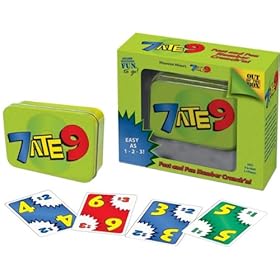 7 ate 9 7 ate 9 may be the traditional explanation for 6's profound fear of 7, but it most definitely doesn't explain why it is such a fun family game. The responsibility for this welcome transformation lies squarely on the shoulders of designer Maureen Hiron, the art of Cathleen Quinn-Kinney and John Kovalic, and the acumen of the once again inspiringly playful folk of Out of the Box. 7 ate 9 is a card game of speed and calculation, similar to Spit, but significantly more excruciating - in a good way. A very good way. Two to four players begin the game by taking the top card from the shuffled deck, placing it face-up in the center, and then distributing the rest of the deck evenly between players. Since there are 73 cards, after the first card is played on the table, the rest divide into satisfyingly even piles whether you're playing with 2, 3 or 4 players. The cards are numbered from 1-10. In addition (or subtraction), each card also has a number, from 1-3, in the corner. That number is added or subtracted, at the player's discretion, from the main number, which determines what number card can be played next. So, if the top card is a 7 and the small number is a 2, the next card can be either a 5 (7-2) or a 9 (7+2). The cards are also color-coded, to help direct your attention to the added (or subtracted) value - all plus-or-minus 1 cards being green, plus-or-minus 2 cards blue, plus-or-minus 3, red. No turns are taken. Players simply draw cards from their face down pile, one at a time, if they can play a card, they announce the number and place it on top of the center pile, if not, they draw another card until they have found a playable card or someone else has. In the latter event, they must now look for a new match. The first player to get rid of all but one of her cards wins. So it's like Spit - players playing simultaneously, as quickly as possible, trying everso assiduously to be the first to find the next playable card. And yet, it's not quite Spit. Not with there only being one pile, and the challenge of having to add or subtract in order to calculate what card is actually the next match. And then, say, you throw a 9, with a plus or minus, say, 2. Well, if you subtract 2, it's simple enough - you can match it with a 7. But if you don't have a 7, and you're fast enough, you can add the 2, which, arithmetically, would make 11, which is patently absurd since the highest card is a 10. If not for the "round the corner" rule, by which you can legitimately play a 1 (which, in a circular sequence, would be the next card). Similarly, if a 2, for example, is played, a 2 with a plus-or-minus 3, shall we say, you can play either a 4 or a 9. This logical bit of round-the-cornerness is wonderfully exasperating, making you have to think generally when you are least ready to. Yes, yes, people will tell you that it's an educational game because it uses numbers and arithmetical operations, and yes, children who are weak in these particular skills will most definitely find themselves hovering on the other side of exasperation. But no matter how good you are with numbers, and how mature and experienced you are in the ways of life and games, you can easily find yourself succumbing to the speed and flexibility of an 8-year-old opponent. Yes, there is a modicum of luck involved - just the modicum needed to keep hope alive, keep the game fun, and make you want to play again and again. Labels: Family Games
Monday, November 16, 2009
PitchCar
 PitchCar PitchCar is a puck-flicking, car-racing game of skill and cunning for people as young as six and as old as can still walk around a table. It can get as tense as the Indy 500 without ever getting too serious to laugh about. It can be played as a race against everybody or a race between teams, as a polite game of luck and skill or a cutthroat game of strategic blocking and violent crashing. And there are at least as many ways to build it as there are to play. The building part is wonderfully easy, though it just as easily can become a studied, exacting, and creative exploration. The tracks fit together with ease, like large jig-saw pieces. Grooves on the sides of the tracks easily accommodate flexible plastic rails. The basic set consists of 16 pieces of track: ten curving and six straight, 16 "safety barriers" - lengths of plastic railing, and eight cars (wooden pucks), each of a different color. There is also a sticker sheet used to decorate the pucks and create the start/finish line. This is enough for you to create ten different "circuits," each a serious twelve-feet long. The "cars" are propelled by any appropriate finger-flick - though some may prefer a finger push or slide.  With a little imagination, and the select incorporation of pieces of cardboard, Popsicle sticks and other household miscellany, many different kinds of tracks can be build. And, if you can find any loose checker pieces or bottle caps, you can significantly expand the fleet. If you need a little more than your collective imagination has to offer, we'd strongly recommend that you consider the additional purchase of, say, PitchCar Extension 1. Designed by Jean du Poël, PitchCar is what people call an "heirloom game" - a term frequently used to describe a game, the purchase of which approaches a serious investment, and the promise of which is generation-spanning. It is easy enough to build and play to prove of interest to most first-graders, yet it can just as easily be made complex and challenging enough to be taken quite seriously by the mature gamer. The designer also suggests two variations. One, called "The Pursuit," is played by two players or two teams of players. One team starts ahead, the other tries to catch up. Another variant, "The Trash Variation," players can try to knock each others' cars off the track (in the standard game, you would lose a turn). These two variations hint at another dimension of the game that can be readily explored, namely, the rules. What if we played in teams of two, one player always trying to position their puck to block other players? What if we played in two different teams, started at the starting line, but each team driving in the opposite direction? How about if we each had two moves per turn? What would happen, wondered a few of our Tasters, if we had fashioned special sticks for puck propulsion. Could we become yet even more skilled, our control even that much more precise, the distance covered in a single turn even that much greater? At a games party, PitchCar offers a welcome balance to the more serious and sedentary strategic entertainments. At the dining room table, it provides a rewarding after dinner, after homework opportunity for the whole family to relax and celebrate each other. Competitive without meaning anything important about anyone. Cooperation without becoming tedious. An invitation to experimentation and creativity. An opportunity for genuine, good-natured fun. Fun of just the right, as it were, pitch. Major FUN, that is. Labels: Dexterity, Family Games, Kids Games, Party Games
Thursday, November 12, 2009
The Caravan Game
 The HABA Caravan Game The HABA Caravan Game looks like a game for kids. Don't get me wrong, it really is a game that kids will play, and enjoy. The cards and thick, folding board with funny illustrations by Gabriela Silveira, the cute little wooden camel playing pieces (which are easier to play with when they're lying down)...all appeal to people who think of themselves as kids. But the game proves to be deep, engaging, and challenging enough to attract serious consideration from those who think of themselves as adults. Each of up to four players gets a set of 12 cards. The cards are the same for every player. You shuffle your cards, place your them, face-down, in a stack in front of you, and then draw three of them for your hand. From then on, you play one from your hand, discard, and select a new card from your pile. Seven of the cards show either one, two, three, or four palm trees. These are the Oasen-Karten. Oops, excuse me, I was reading the German rules. Oasis cards. These cards tell you how many spaces you can move a camel forward. Three of the cards are cartes de mirage. O, silly I, those are the French rules. Mirage cards. Each of the three depict one, two or three palm trees, shimmering in a mirage-like manner. These cards let you move any one of your opponent's camels backwards the corresponding number of board spots (not literally squares, but they function the same way). Then there's one Cameleer card, which allows you to move any one of your camels one board spot in front of the lead camel - anyone's lead camel. Unless, of course, that camel has already reached the oasis. Finally, and most interestingly, there's the carta della tempesta di sabbia (or, as the English say, "the Sandstorm Card"). When this is played, everyone must pick up all 12 of their cards, shuffle them, deal themselves three, and continue the trek. Since everyone has the same cards, you can, more or less, predict (depending on how good your memory is) what your opponent/s might play. Since you always have three cards to choose from, you can delay using your more powerful cards for a more strategically significant moment. If you can save the Sandstorm card for just the right moment, you can get what will hopefully prove a better hand, and prevent your opponent/s from using theirs. Hajo Bücken has designed a fascinating little game. It can be learned very quickly, and played in as few as ten minutes. One rule that significantly speeds up the game - when you're counting how many spots you can move, you don't count the camel-occupied spots. So, if there are, say, three camels in a row in front of you, and you play your one-palm Oasis card, you get, in one move, to move your camel 4 spots closer to the oasis. This is so much fun that we recommend that when you have only two players, you use two sets of camels each. Finally, there's getting to the oasis. There are only six oasis spots. The furthest forward is worth four points, the two behind that three points, and the three behind those, two points. Once your camel reaches any of those spots, it can no longer move. Probably because it just doesn't want to. I mean, after that long hot trek across the mirage-filled desert, getting to all that cool water and delicious dates.... Which means that, strategically, and perhaps metaphorically speaking, it's not always so good to be the first camel to reach the oasis. Especially when you take into account the jumping-over-camel-occupied spots rule. Fun of a surprisingly major kind for a surprisingly wide range of ages and abilities. Labels: Family Games, Kids Games, Thinking Games
Tuesday, November 10, 2009
24/7
 24/7 24/7 is an easy-to-learn game of strategy and chance for 2-4 players. There are 4 sets of 40 tiles, numbered from 1 to 10. The tiles look a little like dominoes, a little like playing cards. There's a folding board with a 7x7 grid. Each player fills her tile-holder with tiles drawn randomly from a bag. After one tile is placed anywhere on the board, players take turns adding adjacent tiles, diagonally, horizontally or vertically. The object of the game is to place a tile so that it, along with tiles already played, creates diagonals, horizontals or verticals of: - a sum (of 7 or 24)
- a run (a sequence of 3 or more numbers in, uh, sequential order)
- or a set (of 3 or 4 of the same number)
At first, the scoring for each is a little difficult to remember (sum of 7=20, run of 3=30, run of 4=40, sum of 24=40, run of 5=50, set of 3=50, run of 6=60, set of 4=60, bonus=60). A quick referral to a page from the thoughtfully-provided score pad resolves that issue quite nicely. You get the 60-point bonus if, on the same move, you get the sum of 7 on one line and the sum of 24 on another. You also get a bonus if you are able to use 7 tiles in creating the sum of 24. Forgive me. I said "points." The recommended term is "minutes." Even though minutes are actually points, it does give you the feeling that you're, so to speak, "playing for time" - which, clearly, is the theme of the game. There are a few other rules of note. Every, so to speak, "time" you create a 24 you place one of those red, jewel-like stones on the empty spaces on either end of the 24 line. This helps fill the board a little more quickly, remind players not to create a sum greater than 24 (which one must never, never do), and explains why that bag of gem-like splendor is included in the game. In addition to all these scoring considerations, there are "double time" spaces on the board (indicated by hour glasses), which, when occupied, double the value of the score for that play, and add further complexity to your strategic contemplations. There is always an element of chance (you have no control over what tiles you are given to play with), and an equal invitation to engage in much stratego-arithmetico thinking. The balance between the two is finely tuned, and combines just enough tension to keep the game engaging, with just enough sheer luck to keep you from taking it too seriously. Hence, it is close to the perfect family game. There are several variations to explore - just enough to encourage you to create your own. Some educators and parents will find themselves embracing the game because of the arithmetic calculations involved, but we found the strategic considerations far more interesting and challenging. Designed by Carey Grayson, the game is actually quite easy to learn. The whole game can be played in half-an-hour or less, so it will fit nicely with the attention spans of most casual game players. For a family whose kids enjoy games like Scrabble and rummy, 24/7 will quickly become a favorite. The tiles lovely to the touch, the wooden racks flawlessly functional. Because you can place a starting tile anywhere on the board, every game is different enough to engage your curiosity and challenge your reasoning. Fun whenever you have time (as it were) to play together, and I predict you will want to find the time (so to speak) to play this game! Labels: Family Games, Thinking Games
Friday, October 16, 2009
Le Pass Trappe
 Le Passe Trappe Le Passe Trappe is a fast, somewhat furious, slightly noisy, significantly fun action game for two. Note the elastic band on either end of the well-made, wood-framed board. Now cast your conceptual glance to the small, slightly-larger-than-a-puck opening in the center. Add to this the observation that there are 10 pucks. That's pretty much all you need to understand how the game is played. The two players each start out with 5 pucks apiece. They shake hands and then, simultaneously, use their elastic bands to try to shoot all the pucks that are on their side through the opening and on to the other player's side of the board. The first player to clear her side of the board is the winner.  That's the basic game. There's a 45-second sand-timer, pegs and scoring holes on either side of the board for those wishing to explore more formal, tournament-like versions, or perhaps even solitaire (can you get all 10 checkers through to the other side before the timer runs out). The basic game is most definitely fun. In fact, one could easily say that it is Major FUN. During the three or maybe five minutes of play, you are totally absorbed - the noise, the speed, the challenge all combine to keep you engrossed. You can play again and again, and get very competitive about the whole game, without even needing to keep score. When there are a bunch of people who want to play, you can make it the rule that the winner gets to play someone new. In the mean time, the rest of the players can spend their relatively short wait cheering and jeering with equally passionate intensity. Designed by Jean-Marie Albert, Le Passe Trappe is available in three different sizes. We Tasted the mid-size, because that's the way we are. But they all play alike and are sure to prove a good investment, for kids, for the family, at a games night or party, at a neighborhood event or sleep-over. Labels: Dexterity, Family Games, Kids Games
Tuesday, October 13, 2009
Tumblin' Dice
 When Randy Nash first developed Tumblin' Dice, he did what any game inventor would do - especially one who created a game that people really loved - he started his own company. Recently, the older/wiser Mr. Nash licensed his game to Fred Distribution - a company with a genuinely deep appreciation for really good games. And they honored his concept, and made it a little more attractive, and just as well-made, and just as much fun.  The game is called Tumblin' Dice, which is exactly what it was called when we first gave it our highest award - the Keeper. I am happy to say, this renewed version is at least as much of a Keeper as it was then. Think of it shuffleboard with dice. You'd be wrong, but you'd understand almost all you needed to know in order to start playing. There are four sets of dice, each a different colors (and lovely colors they are). Each set has four dice. Players take turns flick/slide/rolling their dice, starting on the top level, aiming towards one of the three platforms on the lowest levels. If your die reaches the third level, you get exactly as many points as are on the top of the die. If your die reaches the fourth level, you get twice as many points; the fifth level, three times as many, and if you reach the lowest level, you multiply the face of the die by four. Since players are taking turns, there's a good chance that someone will knock your high-scoring die off the board. So the game can get quite competitive. There's a lot of opportunity to develop skill. But there's enough chance (despite my desire to maintain the illusion, I don't think it's really possible to determine what face of the die will show up at the end of a roll) to keep things interesting, even for the poor-of-aim. The turns are very short, and a whole round can take only a few minutes. So everyone stays involved even when there are four players. And as soon as one round is over, and all the points are scored, people are ready and eager to play again. It's a perfect family game. For children who are still learning to add and multiply, it even has some educational value - not enough to spoil the fun, just enough to make their parents willing to let them play, too. If the multiplication is too hard, instead of multiplying you can just add extra points for dice that reach the scoring levels. Because of the skill required, and the competitiveness, adults can get intensely engaged. Because of the luck factor, anyone who can flick/slide/roll a die has a reasonable chance of winning. And, if you have some perverse need to make it even more challenging, you can try removing some or all of the pegs on the bottom two levels. I tried. I put them back. Tumbln' dice is a big game. Some assembly is required. But it's easy and takes maybe 90 seconds the first time. And just as easily disassembled and snuggled back into its box, in maybe 45. Of course, somebody who hasn't played it yet will probably come over shortly after you've finally put it away, and you'll find yourself gleefully putting it back together again. Tumblin' Dice is an investment in long-lasting, generation-spanning fun. The payoff is Major FUN. Labels: Dexterity, Family Games, Keeper, Senior-Worthy, Tops for 2009
Thursday, October 08, 2009
For Sale
 Stefan Dorra's auction game For Sale is another surprisingly engaging game from Fred Distribution. You get a set of 30, well-illustrated Property Cards (by artist Alvin Madden), another set of 30 Currency Cards, and a collection of 72 thick, cardboard coins, worth either one- or two-thousand conceptual dollars. Before we go into detail about the design and mechanics of the game, allow me to leap to a conclusion: This is a remarkable little game - easy to learn, sweetly short (maybe 15 minutes), engaging from beginning to end, bringing people (3-6 players, ages 8 and up) closely together, almost always surprising, almost always making people laugh. Play it between games, play it to open or cap a game session, play it after dinner, play it before bed. Play it once. Play it again and again all evening long. Play it with strangers or friends or family, even. And it's still fun. Aside from the elegance of the execution and cleverness of the design, what makes this game so successful is the interaction between players. It's all about learning each other: trying to predict what other people will do while remaining inscrutably unpredictable. Like a friendly game of poker, only friendlier, lighter-of-heart, and without any consequences other than fun, and getting to know each other a little better, and surprising each other a little more often. The game is played in two phases. In the first phase, Property Cards are dealt out (3-6, depending on the number of players), face-up. Players then take turns, bidding for the card of the highest value, unless, of course, they are so taken by the clever illustrations that they start bidding for the property that looks the most fun (ooh, a tree house!). Which may be counterproductive in terms of things like winning, but fun's fun, and who can put a value on that? The bidding process is unique and very efficient. After the first player makes her bid, the next either bids higher or passes. If you pass, you get the lowest-value Property Card. If you've already bid, take back half your bid (rounded down), and give the rest to the bank. If you continue, you must increase the bid. When all but one player have passed, that player gets the property of his choice and gives all his bid to the bank. This phase continues until all the Property Cards have been sold. If you're too enthusiastic of a bidder, you'll probably run out of coins before all the Property Cards are used up. Not to worry. You may not get the properties you want, but you'll still get something. Once all the Property Cards are sold, the "real" part of the game begins. Now, players use the values of their Property Cards to bid for Currency Cards, whose value ranges from zero to $15,000. Here, the bidding process is a bit more familiar. Again, as many Currency Cards as there are players are dealt face-up on to the table. All players select one of their Property Cards, place it face-down on the table, and then simultaneously reveal their bid. The player whose Property Card has the highest gets the first choice of Currency Cards. The next highest gets the next choice, etc. Property Cards that were bid are returned to the bank and the next group of Currency Cards is revealed. This continues until all Property Cards have been used. Players then add up the value of all their Currency Cards and any remaining money coins. The player with the highest score wins. It pays to conserve, it pays to observe, it pays to remember what cards have already been played, it pays to remember how risky or conservative people tend to be. It pays to play. Not in money, maybe. But in fun, most definitely. Major FUN. Labels: Family Games, Kids Games
Monday, October 05, 2009
Worm up!
 There's something gently lovable about Worm up! O, it's fun, all right. Major FUN, in actual fact. But it's funny, too. And so spare in its design that it's what you might call endearing. The colorful little game box contains 5 sets (each in a different color) of 7 wooden hemispheres. These are used to make worms - take a set, put the hemispheres, hemi-side down, in a column, and there you have it, your basic worm. Then there are 4 black cylinders. Also wooden. And some cardboard pieces. Thick, durable cardboard to be sure. One of these pieces serves as the finish line, and two of the cylinders fit on either end of it. The other two cylinders are placed about 2-feet away to create the starting line. The other cardboard pieces are also in 5 sets. Each set consists of 5 rectangular tokens, numbered 4, 5, 6, and 7, and one with an X on it. Once the goal and starting line are set up, players line-up their worms. Each of the 3 to 5 players selects one of the cardboard tokens, places that token face-down on the table, and turns their tokens over simultaneously. Players who have chosen the same number token don't get to move their worms. The others move their worms, one segment at a time, starting from the last segment, and sliding that segment to the head of the worm, the player who chose the lowest number going first. The X token allows you to either move your worm (any number that hasn't been already chosen) or move the goal (which takes on evermore strategic significance as the game progresses). To move the goal, you put your finger on one of the cylinders (anchoring it), and then, with your finger on the other cylinder, rotate the goal as far as you want to. You can move your worm in any manner you wish, positioning pieces so as to make it twist and turn to block your opponents, as long as each worm piece is placed adjacent to the piece most recently moved to the head of the worm. Even though you're just sliding these little wooden half-domes from the back to the font of the line, as the game progresses, the worms seem to move in a wonderfully wriggly, worm-like fashion. Because the pieces are so simple, the illusion is that much more powerful. And of course trying to predict what tile the other players might choose so you can choose differently is endlessly surprising, turn after turn. The game takes maybe 10 minutes to play, though we had to play it twice before we felt that the game was over, and then had to have a quite serious discussion about why we should really be playing it at least one more time. It's good for families whose kids are a precocious 7 or older. It's good for kids. It's a good game to play between more serious games. Gentle fun. A happy little diversion. If I were Alex Randolph, the designer of the game, I would consider it a minor masterwork. And I would take equal delight in the production quality. The packaging is very spare - very little space is wasted. The rules are brief and easy to learn. There's a quote by Randolph on the side of the box. I think it explains much about why his game is as fun, and as elegant as it is: "Somehow," he writes, "I feel that boardgames are the beginning of everything truly human, and so, ultimately, of the highest human endeavors, especially those which I find most precious, because they have no purpose outside themselves. They are, themselves, their purpose. Poetry, art, music, story telling, pure mathematics, pure science, philosophy...all are spiritual luxuries. Luxuries are things that delight us, that we long to possess, but that we can very well do without. They are not practical. They are not needed for our survival. And board games? Board games are luxuries, too, of course, albeit minor and marginal, but in the sense of non-utility, perhaps the purest." Labels: Family Games, Kids Games, Tops for 2009
Thursday, September 24, 2009
Consensus Junior Edition
 Consensus Junior Consensus Junior is the third and newest addition to the award-winning Consensus collection. As the name implies, this one's for the kids. The game follows the same, award-winning design as the other two versions. There's a large, colorful board, a deck of 200 noun cards, a deck of 75 adjective cards, a deck of voting cards (8 sets of cards, each with a unique border color, numbering 1-10) and a collection of 8 colored pawns, one for each of the sets of voting cards. The board has numbered spaces for 10 noun cards, a space for the adjective card, and a scoring track. The noun cards are drawn and placed face-up, one in each of the numbered spaces on the board. An adjective card is turned over. Players select the one noun they think most closely fits the adjective, place their vote face down on the table, and then take turns revealing their selection. The answer receiving the greatest number of votes is deemed the winning answer and the players who chose the winning answer move ahead one space. In a case where there is no clear majority, no one scores. Hence the name, Consensus. The key to the difference between the Junior Edition and the other editions of Consensus is the content of the noun and adjective cards. Given, for example, the following randomly selected noun cards: - Bee Hive
- Bed Bug
- My Daddy
- Nemo
- World Peace
Which would you vote for if the adjective were (also a random sample): - Rare
- Adorable
- Unforgettable
If the adjective were "rare," which do you think is, um, rarest: your daddy, world peace, Nemo? Which the most adorable? Which the most self-evidently unforgettable? Even as the mature person you most obviously are, you'd still have a somewhat clear and more or less patently obvious choice, regardless of which adjective was chosen. And, with an "opponent" of the unabashed certainty of an eight-year-old, you know there will be strong opinions about everything. This is what makes the Junior Edition so appealing: everyone counts, everyone in the family finds themselves personally invited, everyone has an opinion, everyone feels equally entitled, equally correct, and, with the Junior edition, pretty much equally informed. How many family games can you say that about? Labels: Family Games
Sunday, September 13, 2009
Circle Out
 It is a distinct pleasure to introduce you to a new card game called " Circle Out." Distinct, because it's unique, a pleasure because its most definitely fun. The closest approximation I can come up with is the Major FUN Award-winning card game Set. Like Set, Circle Out engages both logical and perceptual skills. It's called Circle Out because the object of the game is to find sequences of cards that can be connected, color to color, the first color matching the last in the sequence, making a circular chain. The longer the chain, the higher the score value (if score is what you're keeping). The game begins by laying out 12-16 cards. The first player to find a circular chain (using each color only once per circle), takes the cards from the array, places them in front of her, and then replaces those cards with the same number of cards from the deck. The game continues until the deck, or the players, are exhausted. If you need more graphic clarity, watch this demonstration of the game.  Joseph Lytle, the designer of Circle Out, has a deep appreciation for math and fun. In one of his Youtube videos, called "Splitting the Deck/ Circle Out as a Mathematical Curiosity," he gives us a taste of the some of the more hidden properties of the deck. For more background, here's Mr. Lytle expostulating on the inspiration for the game, which, oddly enough, has to do with a meditation on economics. Lytle describes another variation of the game, which, in turn, helps us realize that the game is elegant enough to invite yet more variations - always a sign of a game that will prove high in replay value. Recommended for 2-4 players, ages 8 and up, Circle Out can engage the entire family. Prepare to be surprised by who will prove better at the game. The skills required have little to do with education or maturity, which explains a lot about why Circle Out has earned a Major FUN Award. Labels: Family Games
Thursday, September 10, 2009
Run Wild
 It's a card game. It's a well-made card game, with exceptionally colorful cards in a convenient card-size tin. It's a card game for 2-4 players of any age, as long as they're old enough to know the difference between sequences of the same color and groups of the same number. It's Run Wild, a tense, heads-down card game, where everybody plays simultaneously and the first person to play all the cards in their hand wins. Lay down your sets and runs of three or four. Once a set or run is played, it belongs to everybody. You can add your cards to any set or run on the table. You can use cards from any set or run on the table (as long as there are at least three cards remaining). And there are wild cards, O yes, indeed there are wild cards. Lovely, colorfully wild, wild cards. Cards of two kinds of wildness: one of which can be used, as you would expect, in place of any card. The other, as you might not expect, a "draw-three" card, making the other players add three more cards to their hand - resulting in what some may see as sweet revenge, and others as just desserts. There are 72 cards in the deck. The deck is divided equally between all players, and placed in a face-down pile. Each player draws the top eight cards. At a mutually agreed upon signal, everyone starts laying down their sets and runs. If you have no cards to lay down, you can pick from the cards that remain in your portion of the deck. This is really not a thing you want to do, because it means that you have more cards that you'll have to get rid of. So you focus, with somewhat passionate intensity, on what everyone else has played. If you are trying to be exceptionally strategic, you might try to hold off on laying out any new sets or runs, because every new set or run is someone else's new opportunity. On the other hand, the longer you hold on to your cards, the less likely it is that you will win the round. At the end of the round, you are penalized five points for each card still in your hand, and ten points for each wild card. Hence the added incentive to get rid of your cards mingles somewhat acidly with the strategic value of waiting for the right moment to give that draw-three card to someone who is just about to go out. Ah, so sweet the desserts. Yet, wait one a minute too long, and O the bitterness and remorse of it all. Designed by Brad Carter, Run Wild is not frantic like the two-player solitaire game of Spit or Speed. It's a light-hearted game that will probably make you laugh, but it will also challenge you, pretty much entirely. Its rules are not only easy to understand, but also inviting to tinker with. For example, should the game prove too challenging for some players, all you need to do to level the playing field is give the player who won the last round an additional card or two when she starts the next, or play in teams, or see if you can get everyone to go out at the same time. Even untinkered-with, it's worthy of your most determinedly playful consideration. Labels: Family Games
Friday, August 28, 2009
Connect 4x4
 If you've ever played Connect Four, you'll immediately understand the attraction of playing with three or four players. With two players, you've got strategy. With three or four, you've got politics. Sometimes, you just have to cooperate with the very people you are competing against, just to keep someone else from winning. Such is the nature of playing with more than two.
And it's prettier - having four colors instead of two. Colored rings, even.
But that's just part of what makes this game so worthy of our collective consideration. The other part is the channels that accommodate the ex-checker rings. They're double-wide, double-sided. Which means that two rings fit where only one ring used to. And you win regardless of whether your ring is in the front or back of a channel - as long as there are four-in-a-row of your color.
There are also two "blocker" pieces for each color. Double-wide themselves, they fit into both sides of a channel. The blockers are powerful pieces, which is why you only have two of them, which is why you have to conserve them, which is what makes the game all the more inviting for people who like to ponder.
The strategic implications of all this are profound and subtle. Profound enough to make you have to rethink pretty-much everything you know about how to win Connect Four, subtle enough to make the game challenging enough to attract an adult audience, and perhaps too challenging for younger children. But, like Connect Four, the mechanics of dropping checkers into different columns, of being able to empty the entire board by moving the retaining wall on the bottom are still very much present, and at least fascinating enough to keep the toy-value of the game as playworthy as the game itself.
Hasbro has been full of gleeful surprises of late. Though they've been releasing new versions of their licensed products for a while, they have taken great efforts, in most cases, to make sure that the new releases are also new games - different enough from their predecessors to be worthy of serious consideration. Elegant enough to be easy to learn and to invite players to develop their own variations. Fun enough to sustain many hours of thought-provoking, deeply engaging play. Labels: Family Games, Kids Games, Thinking Games
| |


