|
Monday, April 19, 2010
Connect 4 revisited
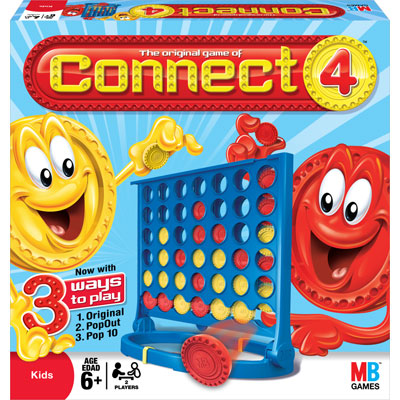
There's a new version of Connect 4. It's called Connect 4. But it's more. It's three different Connect 4 games. The first, you already know. It's the "original" Connect 4. The second is not. It's called "PopOut Connect 4." The third is also new. It's called "Pop Ten."
The bottom row of the Connect 4 grid has been changed. There's a sliding bar on the very bottom. If you slide it to the right, the checkers that are in the bottom row can be "popped" out. Well, pushed out. Which, in turn, will cause all the checkers that are in that column to fall down one space. Which results in a new alignment of checkers. Which could very well result in the sudden appearance of a line of 4 checkers, all ever so delightfully in a row.
You can only pop checkers of your own color. Which makes sense, considering. In PopOut Connect 4, you either add a checker, as in traditional Connect 4, or push one of your checkers out of the bottom row. In either event, if it results in 4-in-a-row (of your checkers, of course), you win. On the other hand, your pop could result in the very alignment your opponent was so sincerely wishing for. Thus, even though the game is very much like your traditional Connect 4, it's different enough for you to have to rethink everything you know about Connect 4 strategies.
 Then there's Pop 10, which, oddly enough, is a different game altogether, a figure-ground reversal, one might say, a shift in your basic Connect 4 gestalt. To game begins with a board-full of checkers. You take turns, dropping one checker at a time, until there are no more checker-accommodating spaces. A move consists of popping a checker out of the bottom row (again, you can only pop checkers of your own kind). You can pop any of your bottom-row checkers. But, if that checker happens to already be part of a 4-in-a-row alignment, you can pop again. Every time you do so, you get to keep that checker. When you can no longer pop, your turn is over. If the checker you pop is not part of a Connected 4, you return it to some other column.
Pop 10 is different from all other variations of Connect 4. And it is as much fun. Because there are three so very different versions, you have to decide which you want to play together. This is a decision that you have to make together. And, simply because you are both making that decision, the game takes its rightful place as a way to have fun together - not so much as a way to see who is the better thinker or player or person, but more to find a game that you both want to play, together.
The thing about all Connect 4 games, and so many of the best of Hasbro games, is that they're very much like toys - as much fun to play with as they are to play. The new Connect 4 is just that: fun to play, fun to play with. Easy to understand, but different enough from everything you know about traditional Connect 4 to have to think of it as something new. Easy to learn. Quick to play. A genuinely enjoyable invitation to logical and strategic thinking. Major FUN. Labels: Kids Games, Thinking Games

Monday, March 22, 2010
Zenith
 Triangles are cool. They invite choice in matters of symmetry and lead to all kinds of complex designs once you link more than a few of them together. I find there is something a bit unsettling about geometric patterns that are based on triangles if the pattern is left incomplete, but I experience a rush of satisfaction when the last piece is placed and the figure is finished. Zenith, a strategic tiling and stacking game by MindWare, tapped into this fascination I have with triangles. The game demonstrated how robust and fun a competition can be with only a few simple rules and some thoughtfully designed game-pieces. In keeping with the magic number, I’ll break game-play down into three parts: the goal, the tiling, and the stacking. The goal: Be the last player to place one of your triangular tiles.  The tiling: Each player has a set of colored, wooden triangles (58 in a 2-person game, 29 in the 3- or 4-person games). They take turns setting their triangles on the game board which is patterned with white triangles that indicate where players may place their pieces. The game comes with four boards, each with a slightly different pattern and named after a mountain (Mt. Fuji, Pikes Peak, Twin Peaks, and Krakatoa). The stacking: Moving up makes things interesting. A player can place a tile on top of three lower tiles IF the player’s color is one of the bottom tiles. Here’s where the triangle’s unique symmetry creates complexity and strategic choices. Players try to block their opponents, but they must also make sure that they leave plenty of options as lower levels fill up and the upper levels get smaller and smaller. Not only is Zenith a joy to play from a competitive point of view, I found a lot of satisfaction in simply handling game-pieces that are so thoughtfully crafted. The triangular game tiles are solid, colorful, double-sided, finished wood. They invite a lot of creative, careful manipulation and building while your opponents are debating their next move. (One of our Tasters was a little frustrated at how careful the manipulations had to be, in particular, how easy it was to dislodge pieces as they were stacked one on the other, but the game proved too absorbing for any of us to remain bothered by the extra care required.) The game-boards are double-sided and the edges are inscribed with interesting facts about the namesake mountains. For instance, I did not know that “Krakatoa continues to increase in height 16 feet (5m) every year...” I especially appreciate the efficient packaging and use of space that MindWare employed in the game’s design. Nothing is wasted and it’s all major fun. Zenith was designed by Nicholas Cravotta and Rebecca Bleu of BlueMatter Games. © 2009 MindWare. Will Bain, Game Taster Labels: Family Games, Thinking Games
Thursday, February 25, 2010
Piece o' Cake
 They call the game Piece o' Cake, though any mildly discerning eye would immediately perceive that what we're playing with here is plainly cheesecake, with clearly graham-cracker crust. Before we go into details and rationale, let us pause for a moment of mutual assurance. Though it may not be apparent at first taste, Piece o' Cake is Major FUN. In fact, once you have whetted your appetite with a preliminary round or two, everything about it becomes fun, from beginning to end. For 2-5 players of strategic playing ages, Piece o' Cake is cunningly designed by Jeffrey D. Allers to provide the aforementioned players with 30 minutes of sometimes excruciatingly delicious conceptual glee. Allow me to reiterate and perhaps repeat - a preliminary round or two, despite the apparent clarity of the rules and this review, is everso wholeheartedly recommended. There are 8 varieties of cheesecake. A whole cake, is made of 11 pieces - very nice, thick, well-finished, brightly colored cardboard pieces, which look quite delicious, actually, while remaining firmly, and somewhat disappointingly inedible. There are two attributes of strategic note about each variety of cake: the number of each variety (plainly inscribed thereon), and the number of whipped-cream-like dollops). To prepare for the game, the 57 pieces are turned face-down, mixed (but not beaten), and assembled into 5 stacks of 11. The two extra pieces are returned to the box. The 5 stacks are then assembled, still face-down, in pie-like fashion. The first player then prepares the first cake, turning over the pieces of one stack, carefully maintaining the randomness in which those pieces have been ordered, to create a whole, multi-pieced cake, appearing, should one require more tempting vividness, much like one of those sampler cheesecakes one sometimes acquires at the fancier of cheesecake stores. That same player then divides the completed cake into slices, each slice containing one or a multiple of adjacent pieces. This slicing is not in the least arbitrary, but chock full of tastily strategic implications. Here, we require a bit of elaboration. The point value of each slice is determined by two different factors - the number of dollops, and the number of that particular variety. Chocolate cheesecake slices, for example, are the most tempting. Each has three dollops, and hence, when eaten, is worth three points. Should one choose to collect, rather than eat one's chocolate cheesecake slices, and, should one manage to have, by game's end, collected a majority of said slices, one would have gained 11 calorie-free points. Thus, though perhaps not immediately apparent upon the first foray into the goodiness of it all, the very first stage of each round of the game - the division of the cake into pieces (as many as there are players) - is crammed full of deliciously strategic implications, and evermore crammed every round of the game as it becomes evermore vivid which varieties of cake each player is hoping to collect. The slicing player, as tradition has it, gets the last piece, making this process of division tinged with a taste of abstract agony.  Once a piece is selected, that player may choose to eat (turn over and collect the dollop-score) any of the slices in that piece, or keep those pieces face-up in hopes of collecting more of the like kind. The game continues with each player getting a turn to be slicer. With each turn, what each player is hoping to collect becomes evermore obvious, and the significance of the slicing similarly evermore strategic. When it becomes clear that you have no hope of collecting a majority of a given slice, you may choose to forgo a turn, and eat (turn over) one or many of your pieces, thus collecting dollop-score for each. O, the choices, the yummy, yummy strategy-filled choices. The palatable pleasure. The luscious, mouthwatering, delectable, ambrosial, toothsome delight. The appetizing, scrumptiously finger-licking, lip-smackingingly melt-in-your-mouth-and-mind fun of it all. Should you need to further whet your theoretical appetite, you can always download the complete rules, thoughtfully provided as a further customer service by Rio Grande Games. Labels: Family Games, Thinking Games
Friday, November 27, 2009
Siam
 Didier Dhorbait's abstract strategy game Siam is so beautifully crafted that you will treasure it even before you learn how to play it. Which is a good thing for two reasons: 1) the English translation of the rules is, well, very, shall we say, challenging, in a French kind of way; and 2) the rules are what some may call "unconventional," requiring you to exercise some conceptual effort before you fully appreciate the cleverness and complexity underlying their comparative simplicity. Fortunately, Arthur Reilly has written a satisfyingly clear English description of the rules - clear enough to help you through most of your preconceptions to a truly remarkable strategy game - one that you can play in ten minutes with anyone old enough to appreciate a good, abstract game. The lovely wooden board is inscribed with a 5x5 matrix. There are three kinds of pieces: the elephants and rhinoceros figures are beautifully rendered, the elephants rearing on their hind legs, the rhinoceros sitting and looking like something out of a collection of Victorian grotesquerie. The other pieces look vaguely like mountains. And since the mountains are as big as the elephants and rhinoceros, the whole set conveys a sense of the fantastic. One player plays the elephants (and moves first) the other, rhinoceroses. The game begins with the three mountain pieces in a line in the center of the board. Players take turns doing one of the following: bringing a piece on to the board, taking a piece off the board, reorienting a piece, moving a piece (one space horizontally or vertically, in the direction being faced), or pushing other pieces. The object of the game is to be the first player to push a mountain off the board.  The pushing is where the conventions begin to get un-. If one of your pieces is facing a mountain, it can push the mountain in the direction in which it is facing. If two opposing pieces are facing each other, they cancel each other out. So neither can push or be pushed. If one your opponent's piece is in line with yours, and you are not facing it, you can get pushed. If two of your opponent's pieces are facing yours, you can also get pushed, even if you're facing them. In fact, you can have a whole bunch of your pieces (well, up to 5) in a line, all facing the wrong way, and one of your opponent's pieces, facing the right way, can push them all. Then there are the rules about the edges of the board (all important, since that's where you're trying to push the mountains off of, as well as where your pieces can get pushed off and where they can be re-entered). Since they surround the board, it means that, unlike chess, checkers and the rest, you're not playing in any specific direction - a major convention-breaker, chock-full of strategic implications. And the subtle but significant consequences of being able to take pieces off the board and later bring them back into play on some other edge, add yet another chock-fullness to one's cup of strategic nuance. Remarkably deep for a ten minute game. Remarkably lovely. Major FUN. (Siam is available in the US via Fred Distribution, and in Europe through Ferti) Labels: Keeper, Thinking Games
Thursday, November 12, 2009
The Caravan Game
 The HABA Caravan Game The HABA Caravan Game looks like a game for kids. Don't get me wrong, it really is a game that kids will play, and enjoy. The cards and thick, folding board with funny illustrations by Gabriela Silveira, the cute little wooden camel playing pieces (which are easier to play with when they're lying down)...all appeal to people who think of themselves as kids. But the game proves to be deep, engaging, and challenging enough to attract serious consideration from those who think of themselves as adults. Each of up to four players gets a set of 12 cards. The cards are the same for every player. You shuffle your cards, place your them, face-down, in a stack in front of you, and then draw three of them for your hand. From then on, you play one from your hand, discard, and select a new card from your pile. Seven of the cards show either one, two, three, or four palm trees. These are the Oasen-Karten. Oops, excuse me, I was reading the German rules. Oasis cards. These cards tell you how many spaces you can move a camel forward. Three of the cards are cartes de mirage. O, silly I, those are the French rules. Mirage cards. Each of the three depict one, two or three palm trees, shimmering in a mirage-like manner. These cards let you move any one of your opponent's camels backwards the corresponding number of board spots (not literally squares, but they function the same way). Then there's one Cameleer card, which allows you to move any one of your camels one board spot in front of the lead camel - anyone's lead camel. Unless, of course, that camel has already reached the oasis. Finally, and most interestingly, there's the carta della tempesta di sabbia (or, as the English say, "the Sandstorm Card"). When this is played, everyone must pick up all 12 of their cards, shuffle them, deal themselves three, and continue the trek. Since everyone has the same cards, you can, more or less, predict (depending on how good your memory is) what your opponent/s might play. Since you always have three cards to choose from, you can delay using your more powerful cards for a more strategically significant moment. If you can save the Sandstorm card for just the right moment, you can get what will hopefully prove a better hand, and prevent your opponent/s from using theirs. Hajo Bücken has designed a fascinating little game. It can be learned very quickly, and played in as few as ten minutes. One rule that significantly speeds up the game - when you're counting how many spots you can move, you don't count the camel-occupied spots. So, if there are, say, three camels in a row in front of you, and you play your one-palm Oasis card, you get, in one move, to move your camel 4 spots closer to the oasis. This is so much fun that we recommend that when you have only two players, you use two sets of camels each. Finally, there's getting to the oasis. There are only six oasis spots. The furthest forward is worth four points, the two behind that three points, and the three behind those, two points. Once your camel reaches any of those spots, it can no longer move. Probably because it just doesn't want to. I mean, after that long hot trek across the mirage-filled desert, getting to all that cool water and delicious dates.... Which means that, strategically, and perhaps metaphorically speaking, it's not always so good to be the first camel to reach the oasis. Especially when you take into account the jumping-over-camel-occupied spots rule. Fun of a surprisingly major kind for a surprisingly wide range of ages and abilities. Labels: Family Games, Kids Games, Thinking Games
Tuesday, November 10, 2009
24/7
 24/7 24/7 is an easy-to-learn game of strategy and chance for 2-4 players. There are 4 sets of 40 tiles, numbered from 1 to 10. The tiles look a little like dominoes, a little like playing cards. There's a folding board with a 7x7 grid. Each player fills her tile-holder with tiles drawn randomly from a bag. After one tile is placed anywhere on the board, players take turns adding adjacent tiles, diagonally, horizontally or vertically. The object of the game is to place a tile so that it, along with tiles already played, creates diagonals, horizontals or verticals of: - a sum (of 7 or 24)
- a run (a sequence of 3 or more numbers in, uh, sequential order)
- or a set (of 3 or 4 of the same number)
At first, the scoring for each is a little difficult to remember (sum of 7=20, run of 3=30, run of 4=40, sum of 24=40, run of 5=50, set of 3=50, run of 6=60, set of 4=60, bonus=60). A quick referral to a page from the thoughtfully-provided score pad resolves that issue quite nicely. You get the 60-point bonus if, on the same move, you get the sum of 7 on one line and the sum of 24 on another. You also get a bonus if you are able to use 7 tiles in creating the sum of 24. Forgive me. I said "points." The recommended term is "minutes." Even though minutes are actually points, it does give you the feeling that you're, so to speak, "playing for time" - which, clearly, is the theme of the game. There are a few other rules of note. Every, so to speak, "time" you create a 24 you place one of those red, jewel-like stones on the empty spaces on either end of the 24 line. This helps fill the board a little more quickly, remind players not to create a sum greater than 24 (which one must never, never do), and explains why that bag of gem-like splendor is included in the game. In addition to all these scoring considerations, there are "double time" spaces on the board (indicated by hour glasses), which, when occupied, double the value of the score for that play, and add further complexity to your strategic contemplations. There is always an element of chance (you have no control over what tiles you are given to play with), and an equal invitation to engage in much stratego-arithmetico thinking. The balance between the two is finely tuned, and combines just enough tension to keep the game engaging, with just enough sheer luck to keep you from taking it too seriously. Hence, it is close to the perfect family game. There are several variations to explore - just enough to encourage you to create your own. Some educators and parents will find themselves embracing the game because of the arithmetic calculations involved, but we found the strategic considerations far more interesting and challenging. Designed by Carey Grayson, the game is actually quite easy to learn. The whole game can be played in half-an-hour or less, so it will fit nicely with the attention spans of most casual game players. For a family whose kids enjoy games like Scrabble and rummy, 24/7 will quickly become a favorite. The tiles lovely to the touch, the wooden racks flawlessly functional. Because you can place a starting tile anywhere on the board, every game is different enough to engage your curiosity and challenge your reasoning. Fun whenever you have time (as it were) to play together, and I predict you will want to find the time (so to speak) to play this game! Labels: Family Games, Thinking Games
Thursday, November 05, 2009
Kamisado
 Kamisado Kamisado is a strategy game for two players. There are basic rules. There are advanced rules. The basic rules can be explained in less than a minute: you can move a piece any number of squares in a straight line, either diagonally or vertically forward. After the first move, you can only move the piece whose color is the same as the square that your opponent's piece landed on. The first player to get a piece to her opponent's home row wins. Each player has eight pieces. Each piece is a different color, matching one of the colors on the board. Which explains why the game itself is so visually appealing. The board unfolds into quite a large playing field (20"x20"). The plastic pieces are also large (two inches wide). They look like castles, each with a dragon nesting on top. On one set of pieces the dragons are shiny black, on the other, gold. You can play a game in less than five minutes. Victory is satisfyingly sudden. Defeat, mercifully quick. You can play it with anyone old enough to understand checkers, and yet it is strategically deep enough to intrigue a chess player. At first glance, the eight-page instruction booklet (10" x 10" - the same size as the board when it is folded) looks forbidding. But all you need read to play the game are a few rules. Once you've played a few rounds of the game, you'll be more than motivated enough to read the rest of the booklet, as well as the accompanying eight-page booklet illustrating different moves. As you read more, you discover more possibilities and intricacies. You learn that a game can take many rounds to play. That the strange rings included in the game are used during these many-round games to crown a winning piece, and to give it extra powers for the next round. And on and on you go, discovering more and more nuances as your appreciation for the game, and your skills increase. Everything about the presentation and packaging of the game reveals a deep appreciation for its play value and uniqueness. The size of the board and the pieces, the packaging, the art. Conceived by Peter Burley, with artistic design by Peter Dennis, Kamisado exemplifies the kind of thinking game that the Major FUN program was developed for - elegant, well-executed, easy to earn, appealing to a wide range of players, deep enough to play again and again. Labels: Keeper, Thinking Games
Thursday, October 22, 2009
Tayu
 Tayu Tayu is an elegant strategy game in which players take turns laying "river tiles," competing to build connected waterways from one side of the board to the other. One player attempts to create as many channels as possible from north to the south of the board while the other tries to do the same from the east to the west sides of the board. Published by Goliath Games, designed by Niek Neuwahl, the game takes its name from the legendary emperor of China, Yu the Great, the founder of the Xia Dynasty, who, according to Wikipedia, taught his subjects how to control flooding along China's rivers and lakes. There are 84 rectangular tiles. Each tile is inscribed with a branching line. These two attributes - rectangular tiles and branching lines - help to make the game as unique as it is. There are three kinds of tiles. On some tiles, the line reaches three different sides. On others, only two. In most versions, players take turns drawing the tiles from a bag and placing each new tile adjacent to one that has already been played. The game continues until all the tiles have been played. Score is then calculated. To determine the score, count all the tiles whose rivers end on one side of the board, and then multiply that number by the sum of all the tiles whose rivers end on the other (so you score even if your river only reaches one side, but you score much more if your rivers reach both). There are four raised circles on each side of the board. Rivers that connect to those circles count double.  The game is very easy to learn - it takes only a few minutes to understand how to play. The whole game can be played in half an hour or less. Like any good game, understanding how to win is quite another undertaking - one that can keep you intrigued for many, many hours of deep play. The game is nicely made. The tiles have buttons on the bottom which fit nicely into depressions on the board, though some care has to be taken to prevent yourself from accidentally knocking a tile out of position once its placed on the board. The strong, plastic board comes in two halves that snap securely together. The large, hefty, drawstring bag filled with tiles and the disassembled board fit perfectly into the game box. Tayu is essentially a two-player game, though the three- and four-player versions are all worth playing. In the four-player version, players work as partners, one team playing East-West, the other North-South. Since all eight of our Tasters were interested in the game, we played it in teams, four on each side, sliding the board back and forth across the table. The board slid easily and the pieces stayed in place. It turned out to be fun and surprisingly absorbing for all players. Considering how many people were involved, it was a testimony to the visual and strategic attraction of the game. In the three-player version, the third player scores by trying to prevent each of the other players from succeeding. Players determine what constitutes success by a process of bidding, like in contract bridge, trying to guess ahead of time how many points they will score. There's an "advanced" variation where tiles are taken out of the bag and placed face down on the table. The tiles whose rivers reach three sides are distinguished by a concentric ring design on the center button on the reverse side. With all the tiles face-down on the table, you can easily see which have river segments that reach three sides, and be a bit more strategic in selecting the kind of tile that you bring into play. All of these refinements point to a game that has been carefully designed to provide its players with very good reasons to explore the game in depth, to share it with many friends, and to cherish it for many years. Labels: Thinking Games
Thursday, October 01, 2009
Cir*Kis
 Cir*Kis Cir*Kis is as much of a puzzle as it is a strategy game as it is an exploration of the geometry of the decagon (like an octagon, only with 10 sides). One of the interesting properties of a decagon is that it can surround a five-pointed star with satisfyingly geometric aplomb. Each of up to 4 players gets a collection of 9 different shapes of the same color. These shapes vary in size from the easy-to-find-but-difficult-to-position "big slice" to the easy-to-lose "sliver" which can only be placed in clearly demarcated spaces on the edges of the board. The board is covered with a raised pattern of circles (actually decagons) and stars and irregular shapes connecting them. The pieces fit into and over the design on the board. It requires a certain amount of dexterity and a significant amount of perceptual discrimination to figure out what fits where. The strategy, of course, is in understanding why.  After the first move (the rules suggest that the youngest player goes first), the next player has to place their piece so that it is adjacent to the last played. As soon as a player is able to complete a shape (a circle or star), she scores. If her color is in the majority, she scores 10 points. If not, only 5. You can also get a free turn, which means that you can take the lead, which can be of significant strategic import if you are significantly strategic. The opportunities are rather rare, which make them of even more strategic interest - you must either place one of your pieces in a space surrounded by other pieces, or complete the center star or be the first to place a sliver piece. Visually, Cir*Kis is as compelling as any other tessellation. The conceptual challenge of separating figure from ground adds significantly the strategic challenge of playing the game. For 2-4 players, aged 8 and up, Cir*Kis offers a unique challenge to the eye and mind. It might remind you of Blokus or Pentominoes, but there really is no other game quite like it - lovely to look at, visually challenging, strategically deep enough to be played again and again, Major FUN. Labels: Puzzles, Thinking Games
Friday, August 28, 2009
Connect 4x4
 If you've ever played Connect Four, you'll immediately understand the attraction of playing with three or four players. With two players, you've got strategy. With three or four, you've got politics. Sometimes, you just have to cooperate with the very people you are competing against, just to keep someone else from winning. Such is the nature of playing with more than two.
And it's prettier - having four colors instead of two. Colored rings, even.
But that's just part of what makes this game so worthy of our collective consideration. The other part is the channels that accommodate the ex-checker rings. They're double-wide, double-sided. Which means that two rings fit where only one ring used to. And you win regardless of whether your ring is in the front or back of a channel - as long as there are four-in-a-row of your color.
There are also two "blocker" pieces for each color. Double-wide themselves, they fit into both sides of a channel. The blockers are powerful pieces, which is why you only have two of them, which is why you have to conserve them, which is what makes the game all the more inviting for people who like to ponder.
The strategic implications of all this are profound and subtle. Profound enough to make you have to rethink pretty-much everything you know about how to win Connect Four, subtle enough to make the game challenging enough to attract an adult audience, and perhaps too challenging for younger children. But, like Connect Four, the mechanics of dropping checkers into different columns, of being able to empty the entire board by moving the retaining wall on the bottom are still very much present, and at least fascinating enough to keep the toy-value of the game as playworthy as the game itself.
Hasbro has been full of gleeful surprises of late. Though they've been releasing new versions of their licensed products for a while, they have taken great efforts, in most cases, to make sure that the new releases are also new games - different enough from their predecessors to be worthy of serious consideration. Elegant enough to be easy to learn and to invite players to develop their own variations. Fun enough to sustain many hours of thought-provoking, deeply engaging play. Labels: Family Games, Kids Games, Thinking Games
Wednesday, July 22, 2009
Quixo
 Quixo Classic Quixo Classic is well-made, well-conceived strategic game for 2 or 4 players, which, because it is related to tic-tac-toe, is easy enough for a 6-year-old to play, and, because of its use of the mechanics of sliding block puzzles, is subtle enough to challenge a 66-year-old. Well, 67, actually, but who's counting?
The game consists of 25, 1-inch wooden cubes, bevel edged, lovingly smoothed, warmly wooden cubes, which are packed in a cloth bag, and nestle comfortably in a wooden tray. Four sides of the cubes are left blank. You'll find an X pyrographed on one of the other sides, and, opposite that, similarly pyrographed, an O.
At the beginning of the game, all the cubes are placed on the board, on to any of their 4 blank sides, forming a 5x5 array. Only the cubes on the periphery are available for play.
The object of the game is to be the first player or team to get 5 of your symbols (an X or an 0) in a straight line. To do this, you pick any blank block on the edge of the board, remove it, and then slide the row or column of blocks so as to create a new blank space on one of the edges of the board. You then place the block you selected into that space, positioning it so that your symbol is showing.
The game continues in that manner, players or teams alternating turns, until someone gets 5 of their symbols in the proverbial row. Because each move results in moving part or all of a row or column, blocks are getting continually repositioned - and within there lies the rub, as well as the tickle. You have to see much further ahead, consider a copious complexity of cubic combinations in order to get your symbols (and not your opponent's) to line up in the appropriate array of your aspirations.
Designed by Thierry Chapeau, Quixo Classic is one in a series of similarly well-made games by the French game publisher Gigamic, available in the US from our much-appreciated Fundex. Easy to learn, as fun for kids as adults, well-made, played in 15 minutes or less, often surprising - as they all-too-rarely say amongst Major Fun Game Tasters, this one's a Keeper! Labels: Family Games, Keeper, Kids Games, Thinking Games
Monday, July 20, 2009
Quoridor Kid - as fun as it looks
 Whatever you can say about Mirko Marchesi's Quoridor, you can also say about Mirko Marchesi's Quoridor Kid. Except that Quoridor Kid is cuter. And takes less time to play. And the board is 7x7 instead of 9x9. And there are 16 instead of 20 fences. They play the same. They offer the same exercise in strategic maze-making. One is cute and short. The other is larger, darker, more brooding, more adult. But no matter which you are playing, Quoridor or the Kid, as child or adult, it's the same fun and fascination. Which is rather remarkable, come to think of it, that a kid's version of an adult game should prove as maturely playworthy as the adult version. Which makes this version a special gift to parents. Because here's a game in a version that will appeal to your child as it will to to you. Your child will be especially sensitive to the fun of it - to the fantasy, the remarkably skillful humor of the mouse-in-maze metaphor - and consequently, they might laugh more often than you will. It is a challenging game. You begin on the edges of a 7x7 grid. You, as a mouse whose nose is the same color as a piece of wooden cheese placed on the opposite side of the board. You take turns moving your mouse, horizontally or vertically, one space at a time. Your goal and purpose, as in much of life, is to get to your cheese first. You do that by moving forward, or by placing fences between your opponent and her cheese. Moving and fencing, the board begins to look like a maze, and the strategic depth is equally amazing. All that metaphorically-appropriate mouse-and-cheese cuteness aside, getting to your cheese first is something you can take seriously, beyond metaphor. And as a parent, it is a special thrill when, as you inevitably will, you lose a game to your own child - fair and square. You won't have to say things like "well, then, you're the second winner," or make just the mistake that will "accidentally" give your child the victory. Because playing Quoridor, Kid or not, can get as challenging to the grown-up as it can to the child - and still look fun! Which is what makes the Fun of Quoridor Kid so Major. What else would you call kind of fun can you get from a game that requires deep, logical thinking, that looks and plays as inviting to adults as it is to kids, as it is to kids without adults? Labels: Family Games, Kids Games, Thinking Games
Thursday, July 16, 2009
Six
 What would be a good name for a game played with six-sided hexagons (as if there were any other kind)? Just six-sided (I'm making a point here) hexagons? Not even a board? Where you try to be the first to make a shape out of...wait for it... six wooden black or red six-sided hexagons? What about a strategic game where you take turns adding a hexagon of your black or red color to any other hexagon already on the table, or floor, or blanket? Until all your lovely, smoothly wooden hexagons are played, and then you can move them from hexagon-adjoining place to any other hexagon-adjoinable place? And you win if you can get six of your own in a row, or triangle or in a six-sided circle? What do you think of " Six"? Sheer coincidence that the publishers also chose to call it Six? I think not. Even though you each have 19 hexagon-pieces. 19. Not the everso appropriately six-divisible 18 hexagon-pieces. You still get a, dare I say it, Major Fun experience, which, if Major Fun gave star-ratings, is clearly six-star-worthy. And then there's what one might think of as the "Advanced Major Fun" to be had by players of the advanced version, because, see, after you play for a while you discover how you change the entire mass of hexagons into two, and you begin to wonder, almost without reading the advanced rules, what doing so might do to your opponent, like, for example, put the entire smaller cluster (wherein a substantial majority of your opponent's pieces happen to reside) out of play for the rest of the game. Steffen Mühlhäuser's game of hexagons is newly made available in the U.S. through FoxMind, and still published in Europe by Steffen-Spiele. Most games can be played in from six to 36 minutes. Easy to learn for those of checker-playing persuasion. Easy to carry around, rules and all, in a conveniently included drawstring bag or its lovely six-sided box. Labels: Keeper, Thinking Games
Sunday, July 12, 2009
Abalone
 Let us begin our exploration of the game classic Abalone (recently re-released by Foxmind) by paying particular attention to the rule that: the winner is the first player to push a total of SIX of his opponent's marbles off the board. So, already you're intrigued - marbles, marble-pushing, pushing marbles off the board, a board you can push marbles off of into. And then there's the number six (6). I stress this number because, after thorough investigation, lasting conceptual days and actally maybe a couple entire hours, with fewer and fewer marbles and the way the game can go on and on and on, it stops being fun. Unless of course you remember that you're supposed to stop playing the game as soon as soneone has eliminated six of his opponent's lovely large, shiny, black or white marbles. Marble-pushing. Pushing one or two or three of your marbles in a line, to the next space. Marbles resting in hexagonal sections of a hexagonal board, with marble-size channels linking the hive-like cells. Making it possible to push even four, or possibly five marbles (three of yours and two of your opponent's, because to push your opponent's marbles you have to have more than he does, and since you can't push more than three of yours, it stands to reason. I think the game designers (Laurent Levi and Michel Lalet) wanted you to know that this one's going to be fun. Marble-pushing. What an interesting, fun thing to do especially with beautiful, large, glass marbles. So black and white. So back and forth. So tempting to make up your own variations in which you can push let's say up to five of your marbles, which would mean up to four of your opponents, because it's just so much fun to move all those marbles in a row. O there are rules. Surprisingly complex rules governing how many marbles you can move, when you can't, how far, each of which add yet another possible variation to explore, once variation-exploring is what you're into. In sum, don't forget: six pieces and the game's over! Maybe seven. Maybe three. Labels: Keeper, Thinking Games
Friday, July 10, 2009
Batik
 When I ask you to identify a board game that is a strategic puzzle game for two players that also involves dexterity, what game pops into your well-informed head? Would it, perhaps, be Batik?
You know, Batik, that lovely, wooden, puzzle-looking game in the Gigamic collection - yes, that collection of wooden strategic games available in the US from Fundex Games.
Batik, the puzzle game designed by Kris Burmin, in which two players take turns dropping two different colors of wooden, tangram-like pieces into a wood and plexiglass frame.
One of the most self-explanatory games around, especially for those who've played Connect Four. Even those who've played with Connect Four, just to see what happens, like a checker-dropping 3-year-old.
See, when it's your turn, especially in the beginning of the game, it's not just a question of dropping any old shape into the frame. First of all, you have to pick a strategically significant shape (big? pointy? tiny? smooth?), and you have to get it to land pretty much just where you want it to land, somewhere preferably snug, or not, 'cause you often win by taking up more, rather than less space. And there's just a tad of luck, too. Taking turns, using any piece you want (unless you're playing the official "use only your own piece" version), making sure that you're not the player whose piece doesn't fit ertirely within the frame.
 Not that I'm recommending you should, but nonetheless gleefully noting that Pete Hornburg figured out how to get all the pieces to fit perfectly inside the game frame, thereby demonstrating the puzzle-likeness of it all, while more than hinting at the possibility of the perfect game and the observation that you're playing in a game frame.
Lovely, the whole thing. Easy to learn. Short games (maybe 10 minutes). Fun for a remarkably wide range of players. There's the dexterity and luck part, so it's not necessarily the smartest who always wins. Which inevitably makes for more fun. Unless you get too serious about the game. On the other hand, it's good to know you can get serious about it if you have to - just in case. Labels: Dexterity, Keeper, Puzzles, Thinking Games
Thursday, July 09, 2009
Pylos
 At first glance, Pylos looks like a game where players race to have their color bead on top of the pyramid. Which is pretty much what the game is about. But if you try to do just exactly that, the game seems silly in deed. The second player always wins. Unless you read the rules.
If you find a square of beads already on the board, you can put one bead on top, either from your "reserve" (the troughs on your side of the board), or by moving a bead that is already on the board. If you build a new square of your beads (four adjacent to each other), you get to take one or two (the number being of great, yet subtle strategic significance) of your "free" beads (freedom being measured in terms of not having any other piece on top of you), and return them to your reserve. Which gives you an extra piece or two to play. Which makes it more likely that the other player will run of pieces before the top bead can be placed.
It helps if you understand the game of Nim, or the chess concept of opposition. It's about timing, about leaving the other player with one less move.
It especially helps if you read the rules carefully. Even though Pylos is an easy game to learn, and the rules are brief and succinct, they are also quite dense. The game looks so much like a simple race to the top that it's almost too easy to overlook what the game is really about. It's a strategic game, requiring planning and logic.
There are "advanced rules" when you're ready for them (if you get 4-in-a-row on the bottom level or 3-in-a-row on the next level, you also get to take back one or two of your beads). And of course you can simplify the game by eliminating one of the two square rules (the rules allowing you to move or take one or two beads from the board when you complete a square of your color or a square of mixed color).
Designed by David G. Royffe, Pylos is another well-made, wooden, aesthetically pleasing, casual strategy game in the Gigamic collection, available in the US from Fundex Games. Recommended for two players over the age of seven, it takes about 10-20 minutes to play, maybe 10 minutes to learn. For younger players, making a pyramid out of beads, especially when you have a base that keeps all the beads in one place, is so satisfying, and so much fun, that it might take them a while to get to the beauty of the game itself. When they're ready, they will learn. Labels: Thinking Games
Tuesday, June 30, 2009
Quarto
Quarto will remind you of Tic Tac Toe, until you actually play it. Like Tic Tac Toe, you're trying to get all your pieces in a row. And that's about it, Tic Tac Toe-wise.
There are 16 pieces. Eight blond pieces and eight dark pieces. But if you look a little closer, you'll notice that each piece is different. Nobody's a "color." Each has an attribute (size, color, shape, hollowness) that it shares with three other pieces. So your tall square blond solid piece is like the tall round dark piece that has a hole in it, because they are tall.
Your object is to add the piece that completes a row, column or diagonal of 4 pieces, all of which have the same attribute. Not necessarily all blond pieces or all short pieces, and certainly not all "your" pieces. Maybe all round pieces or all solid pieces. Or all pieces with a hole.
So things are not, as they say, merely black or white. To win, you have to continually change what attribute your looking for. Much more like life, strategically-speaking.
And then there's one more intriguingly life-like rule you should know about: You decide what piece your opponent will play next. Really. That's what you do. When your turn is over, you hand the piece of your choice to your opponent. And now that we're speaking about strategy, suddenly everything becomes much more subtle, even more interesting. Because you're trying everso hard to give your opponent the very piece she really wouldn't want. A piece, in fact, that might very well be the one piece that will make you win.
It's a unique concept in the world of strategy games - and uniquely welcome. Because you have to think even more closely about what your opponent might be thinking.
The designer, Blaise Müller, suggests a variation for those who need yet more strategic depth. How about counting 4-in-a-square as well as 4-in-a-row? Ah, how subtle. How challenging. Which makes you wonder about 4-in-an-L, or 4-in-a-zig-zag, even.
In other words, Quarto, like the majority of games in the Gigamic line, has just about all the elements that make a game Major FUN. It takes maybe 5 minutes to learn and maybe 5 minutes to play, and yet it's deep enough to be worth playing over and over. It's as easy to learn as it is because it's based on something familiar. It's as intriguing as it is, because it offers something unique. It's elemental enough to be easily modified to increase or decrease the challenge. It's made of wood. It's durable. It even has a drawstring bag to house the pieces. And, for a modest mailing fee, Fundex will replace any lost piece. Labels: Thinking Games
Wednesday, June 24, 2009
Gobblet Gobblers - cute and challenging
 Do not be misled by cuteness or the obvious similarity to tic tac toe, Gobblet Gobblers is an abstract game worthy of serious strategic contemplation. No, it's not chess. It's not even checkers. But it's not like any tic tac toe game you've ever played, unless you've already played the Major FUN Award-winning Gobblet Jr.  Repackaged and revisioned, Gobblet Gobblers plays the same as Gobblet Jr., but introduces a new level of whimsy and fantasy that invites children to view the often serious challenge of abstract reasoning with a light and playful heart. Players build the board out of four, brightly colored wood pieces. Using these pieces, instead of a solid board, gives the game a friendlier feeling - integrating the game a bit more with its environment (kitchen table, play table, carpet, floor). The pieces all have little felt feather-like things sticking out of their "heads," adding to the whimsy and offering a practical and compelling way to lift and move the pieces from place to place. There are two different color pieces - blue and orange (oddly, but probably not coincidentally reprising the name of the publisher). Both players get six pieces - two sets of three nesting cylinders. The game plays like tic tac toe (the object being to get three of your color pieces in a horizontal, vertical or diagonal row), but, unlike the traditional game, in Gobblet Gobblers you can move your pieces once they are placed, and, if your piece is larger than another, you can temporarily "gobble" it by placing your piece on top. Being able to move pieces is departure enough to make Gobblet Gobblers something more than your paper-and-pencil version of tic tac toe. But being able to cover a smaller piece takes the game to a new level of strategic complexity - new enough for it to become a unique invitation to abstract thinking - unique enough to invite serious attention from adults as well as children. And there's that added component of having to remember what gets covered. And the subsequent, sometimes delightfully agonizing experience of losing the game because of what lies beneath. Designed by Thierry Denoual, who designed all of the current Gobblet variations, Gobblet Gobbler, with its humorous design (and lower price), is Major FUN, at least - especially for kids who have already mastered the traditional versions of tic tac toe, and even more especially for their parents. Labels: Kids Games, Thinking Games
Thursday, June 18, 2009
Stixx
 Stixx Stixx is a strategy game. It's lovely to look at. Easy to understand. And yet, surprisingly subtle.
There are six different colors of Stixx (the game pieces). There are seven of each. To set up the game, players place the Stixx randomly (trying to keep the colors as far apart as possible) in the 42 grooves around the board. There's an extra Stixx. It's gray. It's used as a marker, replacing the Stixx that has just been collected, and indicating which Stixx are now collectable (those that are adjacent to either point of the marker).
Before the game begins, each player draws from a collection of six "hidden color tokens." This identifies the color of the Stixx the players are trying to collect. The object is to collect more of your Stixx than anybody has been able to collect of theirs.
There are many levels contemplation-worthy strategic complexities. Whenever you pick up a Stixx you determine which Stixx the next player can select from. If you're ahead, and you can isolate the grey Stixx so it's not touching any pieces, the game is over, and you win. If you try to collect too many Stixx of your color, your opponents will be able to guess what color you're trying to collect, and either keep you from collecting more, or take those colored Stixx themselves, just for spite.
Having to keep your goal secret while trying keep others from achieving theirs is an aspect of the game that adds greatly to the depth and humor of it all. If it gets too much for you, you can guess someone's color - forcing them to reveal it to everyone and, if you're correct, winning you two extra moves. If the possibility of taking those two extra moves becomes strategically attractive to you, and no one has yet guessed your color, you can reveal your secret color.
Stixx is easy enough to understand, and has a short enough playing-time, to meet the attention span of your average, gifted seven-year-old. It's also deep and intriguing enough to engage the serious-minded adult. And it often makes you laugh. Which is another way of saying Stixx is Major FUN.
Designed by Odet L' Homer and published by Goliath Games, Stixx can be played by two to six players, and, as good as it is, it seems to be just as good (if not better) when more than two want to play. Stixx is nicely packaged, very easy to store. It has a lot of colorful, irreplaceable plastic parts - 49 of them. But rest easy, wise Stixx-owner, Goliath will replace your losses for free. Labels: Family Games, Kids Games, Thinking Games
Thursday, June 11, 2009
Quoridor - an elegant game of strategic wall-building
 The rules for Quoridor are a paragraph long. You can understand everything you need to play the game in just a few minutes of watching someone play. The whole game takes five, maybe ten minutes. And yet it's completely absorbing, deeply challenging, often surprising, uniquely compelling. The game is played on a 9x9 grid. Deep channels separate the squares. These channels are deep enough to hold a "wall" - a thin wooden rectangle wide enough to span the border of two squares. Each player has a wooden pawn. The object of the game is to be the first player to advance her pawn to the opposite side of the board. Each player, in the two-player version, also gets ten walls. On your turn you can either move your pawn one square horizontally or vertically, or you can add a wall. These two choices seem remarkably familiar, elegantly embodying a fundamental political dynamic: to advance our own cause, or to prevent the opposition from advancing. The result of this debate is the creation of an evermore complex maze, again depicting something remarkably familiar to anyone engaged in political discourse. Republicans, democrats, lovers, parents, children. As Rob Solow reports, Quoridor is such an elegant game that it can be easily played (with some minor modifications) with a 5-year-old. And that is another important thing to note about Quoridor - because it is so easy to understand, because it's components are so few and so functional, it is also easy to modify. Like tic tac toe, Quoridor invites you to come up with new ways to play. Rob talks about giving the weaker player more walls. Since you can play several games in a half-hour, it is easy to create a handicapping system where the losing player gets two more fences for the next round. Quoridor comes with four different-color pawns. In the four-player version, each player gets five wall pieces, and the pawns start out in the center of the board rather than on the opposite ends. This points to yet another variable - the starting position of the pawns. Then there's the rule for what happens when two pawns meet. In the standard rules, they get to jump over each other. But that, clearly, is only the beginning. And one can't help but gleefully contemplate the implications of a two-player version with four pawns. Quoridor exemplifies the kind of thinking game that prompted the creation of the Major FUN award. It can be intensely competitive, but its elegance and brevity make playing the game itself fun, no matter who wins. Designed by Mirko Marchesi, Quoridor is another beautifully rendered wooden game from Gigamic, available in the US through the wise auspices of Fundex Games. Labels: Keeper, Thinking Games
| |