|
Tuesday, October 13, 2009
Tumblin' Dice
 When Randy Nash first developed Tumblin' Dice, he did what any game inventor would do - especially one who created a game that people really loved - he started his own company. Recently, the older/wiser Mr. Nash licensed his game to Fred Distribution - a company with a genuinely deep appreciation for really good games. And they honored his concept, and made it a little more attractive, and just as well-made, and just as much fun.  The game is called Tumblin' Dice, which is exactly what it was called when we first gave it our highest award - the Keeper. I am happy to say, this renewed version is at least as much of a Keeper as it was then. Think of it shuffleboard with dice. You'd be wrong, but you'd understand almost all you needed to know in order to start playing. There are four sets of dice, each a different colors (and lovely colors they are). Each set has four dice. Players take turns flick/slide/rolling their dice, starting on the top level, aiming towards one of the three platforms on the lowest levels. If your die reaches the third level, you get exactly as many points as are on the top of the die. If your die reaches the fourth level, you get twice as many points; the fifth level, three times as many, and if you reach the lowest level, you multiply the face of the die by four. Since players are taking turns, there's a good chance that someone will knock your high-scoring die off the board. So the game can get quite competitive. There's a lot of opportunity to develop skill. But there's enough chance (despite my desire to maintain the illusion, I don't think it's really possible to determine what face of the die will show up at the end of a roll) to keep things interesting, even for the poor-of-aim. The turns are very short, and a whole round can take only a few minutes. So everyone stays involved even when there are four players. And as soon as one round is over, and all the points are scored, people are ready and eager to play again. It's a perfect family game. For children who are still learning to add and multiply, it even has some educational value - not enough to spoil the fun, just enough to make their parents willing to let them play, too. If the multiplication is too hard, instead of multiplying you can just add extra points for dice that reach the scoring levels. Because of the skill required, and the competitiveness, adults can get intensely engaged. Because of the luck factor, anyone who can flick/slide/roll a die has a reasonable chance of winning. And, if you have some perverse need to make it even more challenging, you can try removing some or all of the pegs on the bottom two levels. I tried. I put them back. Tumbln' dice is a big game. Some assembly is required. But it's easy and takes maybe 90 seconds the first time. And just as easily disassembled and snuggled back into its box, in maybe 45. Of course, somebody who hasn't played it yet will probably come over shortly after you've finally put it away, and you'll find yourself gleefully putting it back together again. Tumblin' Dice is an investment in long-lasting, generation-spanning fun. The payoff is Major FUN. Labels: Dexterity, Family Games, Keeper, Senior-Worthy, Tops for 2009

Tuesday, September 25, 2007
10 Days in Asia
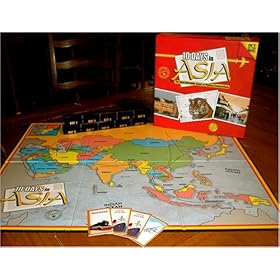 I began my world travels years ago, where I spent 10 thrill-filled days in Africa, and I recall, even now, remarking at how remarkable it all was, how much fun we were having learning about where Africa has all its countries. Even though that wasn't really the point of the game, as much as the delicious dialog between luck and logic that this game, like all good card games, seems to be all about.
 It's a card game, really - a tile game, even, for 2-4 players, maybe 9 to certainly adult. Not a board game at all even though you spend a lot of time looking at the board. You never really play on the board. You play on card holders, two of them, actually, one numbered 1-5, the other 6-10. You pick a card and place it into any slot in your card holder. And then another, and then other. Planning, all the while, to place each card so that when all ten are assembled onto your card holders, they will be in the right order, each country card leading to another, geographically adjacent country card, unless it's a boat card and the boat card is the same color as the ocean you share with that country card, and even, after that, if you get another country card of a country that happens to be on the same ocean, then you can probably take the train to that country, which is, in turn, a non-stop plane-ride away from Vladivostok, as the saying goes.
But, of course, it never goes that way, and you wind up having to discard and pick and replace and let me tell you the planning, the heights and clarity of logic one can manifest, only to be felled by something as stupid as luck, argh, it's enough to make you have fun. Sizable fun. Major FUN.
Anyhow, that was then. And that was Africa. There's been USA and Europe. And now there's Asia. And what does that mean? It means it's a whole new game, one that you know how to play, but with O so many, many Asian countries. And the board, isn't it subtly, and everso welcomely larger? And what about trains? Isn't this the first of the 10 Day series to have trains? But it's another 10 Days game, all right. You're on a trek as fun as your Africa ever was, or USA or Europe, even, but in yet another part of the world called "Asia," with so many Asian-sounding countries to learn about, and with such a fun way to do it, while you're having so much fun playing, thanks to the cleverly globe-spanning people who made these trips possible. Labels: Senior-Worthy, Thinking Games
Wednesday, May 16, 2007
Stack revisited
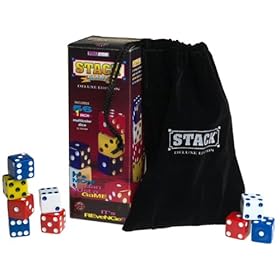 I am certain you recall that Stack received a Major Fun Award a little over 4 years ago. In fact, it was a recipient of several awards: the Party Games award, the Thinking Games award, the much-touted Keeper award, and even, oddly enough, it was found most Senior-Worthy. And you probably even recall why. I, on the other hand, have been exploring the game in greater depth, especially recently as I work more and more with various groups of seniors hereabouts. And what I have been exploring, actually, is the, shall we say, "Super Stack" set - two different sets of the Stack game (the deluxe, jumbo, of course), each set having different color dice, thereby enabling me to play a game with 8 people.  The large dice that come with the deluxe version prove to be especially comforting for senior eyes and hands. Easy to read, even at a distance, enjoyable to hold because of their greater heft, and easier to stack because of their larger size. Having enough for eight people makes the game ideal for building a sense of community and friendship. Because the group is larger, people don't can play at a safe distance from each other (psychologically safe), but because they're all sharing the same set of dice, they feel connected. If we need to, we can easily divide into smaller, more intimate groups. But having all those dice means that each player has twice as many options to consider. On the one hand, it makes the beginning of the game that much easier and more inviting. On the other, it makes the endgame that much more dramatic. Stacks get built, options constantly get fewer and fewer, the need to play strategically gets more and more vivid. Stack, even with only 4 colors, has never disappointed us as a game for almost all ages. But having twice as many dice turns out to be more than twice as flexible, twice as interesting, for at least twice as many people. Labels: Family Games, Keeper, Party Games, Senior-Worthy, Thinking Games
Thursday, March 15, 2007
Games Tasting at the Senior Center
 Our first meeting at the Veterans Park Senior Center in Redondo Beach began with a game of Tumblin-Dice. It was at least as effective, and fun, as I had thought it was going to be - easy to learn, challenging, and yet with enough luck to keep people from taking it too seriously. Especially, given that people had come into the center expecting to learn more about how to play Texas Hold 'em. Even older people, who had difficulty standing, were moving around, waiting for their turn with very apparent glee. The only obstacle was keeping score - doing the arithmetic calculations of adding and multiplying the spots on the dice - which, of course, is part of the challenge for children as well as seniors. Since this was the first game we played, I helped with the scorekeeping. Trying to slide the dice into the scoring areas was more than enough to keep people focused on fun. But the event really didn't become major fun, until we started playing  A to Z A to Z. At first, there were just enough players so we could have one for each of the 4 boards. There are two dice - one, the category die, determines which of 6 questions you are trying to answer, the other, the timer die, determines how much time you have (15 or 30 seconds), and two special events - one that allows you to cover up any empty space, and second which lets you take chips off the board of any other player. As I taught the game, I suggested that we ignore, for the time being, both of the dice. When it was someone's turn, that player would pick a card, select any one of the six categories, and start the timer (giving themselves 30 seconds). I think, because we knew we were ignoring some of the rules (cheating, perhaps?), the game became even more fun. Later, when more people came in, we had to share boards, so it became a game between teams. And this made the game even more fun. Individual players didn't feel so pressured because they were part of a team. We all knew we were kind of cheating (picking whatever item we wanted from the category cards, disregarding both dice), so the game became a shared thing, one that we had all adapted, for our own use, for our own fun. And major fun it was. from Bernie DeKoven, funsmithLabels: Senior-Worthy
Monday, February 12, 2007
Solitaire for seniors?
Dear Major Fun,
Do you have/know of any adaptive games for seniors to do on their own? My dear Auntie recently entered a nursing home at age 96 after having been independent her whole life. She now needs major assistance & can participate in very few group activities. Although they do have an activities director, that person does things like bring Auntie magazines. Auntie used to love to play Bridge; I was thinking that if she had a flannel board of some kind that could hold cards for Solitaire that would be one thing she could probably do in her wheelchair or in bed. I haven’t been able to think of other solo activities, nor have I been able to come up with anywhere to find a board like I’m describing for playing cards.
Major Fun replies:
 I've been Googling around. I think magnetic playing cards might be your best alternative. I found them fairly widely available. The most often recommended seem to be these.
However, since you asked, most seniors I know really crave people to play with, a lot more than things to play with by themselves. The real, life-restoring stimulation that they so much need comes from, well, living things.
from Bernie DeKoven, funsmithLabels: Senior-Worthy
Tuesday, August 01, 2006
Luck of the Draw
 Luck of the Draw Luck of the Draw is described as "a game for the artistically challenged." And I am happy to tell you that this turns out to be a remarkably accurate description of the very people who will have the most fun playing it: the people who don't like games that make them draw. Which is exactly what Luck of the Draw does. It makes you draw. Things like: a monkey or a space shuttle or a bad hair day; a piranha, a used car or a dream date (there are three things to draw on each card, see, and the roll of the die tells you which one).  But the part of the game that makes the drawing actually fun and the fun actually Major, comes from another deck of cards, called "categories." Categories like: "most over the top," "most dramatic," "stands out like a sore thumb." For it turns out that these cards, these "category" cards, serve as the criteria by which the drawings are judged, don't you know. So, pretty much despite my assiduous efforts at a 45-second 3-D rendering of the Eiffel Tower in perspective with enticing hints of a chiaroscoro-like Parisian dawn, if the category turns out to be "Best Example of Minimalism," I have no myopic critics to rail against, and nothing to show for my outstanding efforts but unrequited artistic angst. Whilst you, who only managed to draw a large, narrow, and somewhat crooked "A," bask in the applause of your peers. And for those players who have professional artistic aspirations, Luck of the Draw is a preternaturally poignant experience, capturing, with unavoidable clarity, the famously fickle fortunes of those who stake their livelihood on the currentmost definitions of "good art." Labels: Family Games, Party Games, Senior-Worthy, Top for 2006
Sunday, July 30, 2006
Cover Up
 Cover-up Cover-up is a tic-tac-toe-like game, for all the best reasons: easy to learn, quick to play, and different enough from tic-tac-toe to make you have to think. It's made of heavy plastic, also for all the best reasons: the pieces feel good in your hand, the playing board is 3-dimensional, and the base of the board serves as a storage compartment for the pieces. It's a two-player game, like its forebearers. Each player gets 12 discs: three large, four medium, and five small. The board is a 5x5 grid, but each space actually has three different levels. The lowest level accommodates the smallest pieces, the middle the medium, and the top level the largest. Players take turns placing discs in available spaces. Or moving the large discs. Once a smaller disc has been played, it remains in position until the end of the game.  Four-in-a-row wins. Not four-in-a-row-on-the-same-level. Just four-in-a-row. Of the same color. Now, as you move around your big guys ever so freely, covering what lies beneath with abandon (there only three of these pieces, so you need the smaller ones also in order to win), you do have to be alert to what you may uncover in the process - like one of your opponent's pieces, which happens, now that you notice, to be exactly the fourth piece in a row, which means, alas, the victory is hers. So it's strategy, and just enough memory to make you have to pay closer attention, and it's easy to learn, and it's fast, and it's well-made - everything you'd want in a majorly fun thinking game. Labels: Senior-Worthy, Thinking Games
Monday, July 24, 2006
Zig Zag
 Zig Zag Zig Zag is a strategy game for two players, though we played it with two teams. The goal of the game is to be the first to line up 4 pegs in a row. The pegs, however, can only be moved along certain "tracks." Tracks that each player has laid down, one turn at a time, patiently, o so patiently. And that's exactly what they were, our kids' games tasting group, playing Zig Zag: patient. Thoughtful. Focused. And often taken completely by surprise.  Zig Zag is a well-made and well-conceived strategy game that can be played in as little as 5 minutes or as much as a half hour. The sturdy plastic bridge pieces - a longer one to reach diagonally adjacent holes, and a shorter one for the orthagonally similarly adjacent and also holes - fit smoothly into slots alongside each raised peg hole. Storage trays help keep the pieces sorted. Any invitation for people to think together, kids, adults, is something you almost can't afford to turn down. Especially if it's fun. And challenging. And just complex enough to take people by surprise. And short enough so no one takes it seriously, this winning or losing thing, so everyone can focus, instead, on the fascination, the delight of the game. Labels: Senior-Worthy, Thinking Games
Friday, July 21, 2006
Combo King
 Combo King Combo King is, from time to time, a game that makes you laugh. Sadly, what you are laughing at is someone else's failure. A failure of very little significance in the scheme of things, mind you. Which, I believe, is precisely what makes this game as fun as it is. You have these dice. A significant number, actually. Eight, to be precise. And you have these cards. And on these cards are somewhat Yahtzee-like tasks. A remarkable array of significantly different Yahtzee-like tasks. Like "Use three dice and up to three rolls to get a multiple of five." And if you succeed in this task as described on a card that was in your hand and is now on the table, you get to get rid of the card, and you get chips. You get more chips, wouldn't you know, depending on the odds, you see, against your success. The first player who is out of cards wins.  Amazing how different some of the cards are from each other, and how compelling it is to try to figure out the odds. Similarly intriguing is the fact that the chips you win can be used, don't you see, to purchase things like, say, another roll, or perhaps get another entire turn, or make one of your opponents pickup another card or trade a card with you or, well, you see, here you get to experience, in all its fullness, the "screw" if you'll excuse the expression, "you effect." Again, the oppressed oppress the oppress giving themselves totally over to luck and vindication. It's great fun. Labels: Family Games, Party Games, Senior-Worthy
Tuesday, July 18, 2006
MixUp
 Let me tell you about MixUp, the game. It is a two-player, multi-kibbitzer kind of strategic-like game. If you've ever played or seen a game called " Connect Four," you'll figure out the game more or less immediately, until you begin to realize the implications. Ah, the implications. There's a board with chutes, you could say, and it stands up, and you take turns dropping pieces into any channel, even on top of your opponent's tiles, in a familiarly Connect-Four-like manner. Oh, your opponent's pieces, which are, actually, just like yours, except from the opponent's perspective they are mere shapes, while perhaps similarly from your perspecitive the tiles are mere colors, depending on who plays what. And you see, yes, of course, you are trying to get four-in-a-row of your what-have-you, but also, with all this color/shape craziness, you can get four-in-a-box. And then you win. And then you slide all the tiles back into their compartment on the back of the board. And you slide the legs off and use them for the lid. And there you have it. Well-made. Well-played. Yet another fascinatingly Major Fun experience, from designer Maureen Hiron. Labels: Kids Games, Senior-Worthy, Thinking Games
Monday, July 17, 2006
Tumblin-Dice
Think of perhaps shuffleboard with dice. Think, for example, of a shuffleboard that is on five levels, with, where there were once pucks to slide, dice to, well, slide perhaps or flick or shove. A shuffleboard looking pretty much exactly like this. Think further of the role, or roll, of luck - how the dice, even though you try to slide them everso carefully, tend to change faces when they descend a level. There's an intimation of the possibility that one could control all of this, making the die land 6-up even by the time it reaches the X4 level after having knocked all the opponents' dice to off-table oblivion. On the other hand, there's an unavoidable element of luck which makes a 7-year-old often as successful as a 57-year-old. Think of this, and you'll understand, almost immediately, why Tumblin' Dice has received a Major Fun Family Game award. If you know shuffleboard, you'll know how to play Tumblin' Dice. When I introduced the game at the Tasting, I asked my fellow Tasters to play the game without looking at the rules. With almost no discussion, they played almost exactly the way the designer had intended them to. Because the game was so easy to figure out, it is exceptionally welcome in a variety of settings, especially recreation centers, classrooms and my house. Speaking of classrooms, the game requires enough arithmetical calculations to make it actually useful in almost any elementary school setting. When a die lands in special scoring sections of the board, the face value of the die is multiplied by a given factor. So, in figuring out a total score players exercise both additional and multiplication, and, one might argue, even algebraic skills. But don't let its educational implications fool you. Tumblin-Dice is an invitation to minutes or hours of play, for kids, for adults, for the whole darn community. Did I mention adults? The kind of adults who might be interested in playing, um, professionally? It's made as well as it plays - a big, polished, two-piece all wood, table-worthy game that you might never put away. Ever. Labels: Dexterity, Family Games, Keeper, Kids Games, Senior-Worthy
Thursday, July 13, 2006
Knowbody Knows
 Knowbody Knows Knowbody Knows, for example, exactly how many hours Tom Hanks sleeps in a week. Probably not even Mr. Hanks knows that. So, OK, so you don't know. You can still guess. Now, can you also guess what everybody else is going to guess? Can you guess if your guess will be, heaven forfend, highest or lowest? Actually, you can. Because, see, it's only a guess, and, as the designers of the game are so ready to remind us, Knowbody, actually, Knows. Everybody gets a different pad of paper - each pad color-coordinated with the player's peg-like playing piece. Each sheet of each pad perforated to easily be torn into slips. Why do I go to such great lengths to describe a score pad? Because it's a devilishly clever way to make the game work as well as it does. See, that way, all you have to do is write down your guess (did I tell you that all the questions can be answered with numbers?) so all the answers are on different slips of paper, that can be sorted from highest to lowest, and you take off the highest and lowest and everybody can tell, at a glance, whose guesses are in the middle (and hence scoreworthy). And not a negilgible bit of deviltry is added by the design of the question cards them very selves. Each question is framed with a blank, like: "How much would ____ pay for a pill that: A) Improves Memory Two-fold, B) Doubles the Power of Sleep, C) Eliminates Unwanted Hair Forever, D) You Pick." When it's your turn to read the question, you fill in the blank with the name (did I tell you about the list of 12 names, the one everyone makes at the beginning of the game, using their own names if they want, filling in the extra blanks with any name they think would be fun thinking about?) that is selected by the roll of a 12-sided die. This keeps the questions interesting and potentially open-ended. It also made us comment, separately and collectively, when discussing a particular answer and the significance thereof, "It really doesn't matter. Knowbody Knows." We played. We laughed. We experienced the kind of fun the Major Fun award was designed to be awarded for. Labels: Party Games, Senior-Worthy, Top for 2006
Monday, May 22, 2006
Bonkers
 "Bonkers "Bonkers," you ask? Yes, say I, Bonkers, the game. A word game, actually. Not, as you might think from all that trivia-sized box of little cards, a trivia game. But a word game, in deed. And a funny one, too. First, let's look at a card. Any card will do. This one has the word "HOUSE" on the top. Below that are four answers, marked "A", "B", "C", etc. The answers here are, no, wait. I'll tell you in a minute. First you tell me. Four words. Each beginning with HOUSE. I'll get back to explaining the card in a minute. Then there's a racetrack board. There are also 4 spots on the board, marked A, B, C, and so forth. Now, somebody, or some team, gets together and decides how likely it is that the otherbody or team will guess which. And then distribute playing chips on the 4 spots, appropriately - most chips on the word that the person/team thinks the other/s will least likely say. Oh. The words on the HOUSE card? Housefly, for example. There are different kinds of question cards. Some ask you to list 4 things, like countries, beginning with a letter, like H, or maybe two letters, like ME. Some ask you for words that rhymewith something. Some for words that end or start with other words (as in the above example of the HOUSE card.)  Did you figure out the HOUSE word? Housewarming? Which one did you think was the hardest to guess? Housebroken? I dunno. Housewife, maybe. When you're the person or team reading the question, you've got to listen very, very hard. Because answers come as fast as the other person/team can think of them, and if you say that they didn't say what they said they said, well, things can border on the less-light-hearted. This requires the maturity, minimally, of a 12-year old. But a party game it is. And it's not trivia. And it's Major FUN. Labels: Party Games, Senior-Worthy, Word Games
Monday, May 01, 2006
Nerdy Wordy
 Nerdy Wordy Nerdy Wordy is a challenging word game for two players, based on the traditional children's paper-and-pencil game of " Word Square." Based, but better. Each player has a tray and a collection of letter cubes. The letter cubes cover the whole alphabet, and are designed in alphabetic order. Thus, there are cubes with letters A-F, J-L, M-R, S-W, X and Y. There are also two blank (wild) cubes. Players take turns selecting letters. A selected letter can be dropped anywhere within the 5x5 matrix. Thus, though each player is using the same letter, what they end up with on their boards will be different. Though the two trays make you think of Battleship, Nerdy Wordy is a completely different game. Players get points for each word they make (from 2-5 letters long) and get extra points if they are able to make five-letter words on all 4 sides of the grid. Though the cubes store nicely in their respective trays, it's not really a car game - as you need a surface on which to hold and sort your cubes.  The game can get very challenging. Especially if you count 2- and 3-letter words. And even more especially if you happen to be playing against a Scrabble player. The game can be made easier (scoring only 5- and/or 4-letter words), without disturbing the strategic interest. The letter cubes, because they limit the letters that can be used, and because of the addition of two blank cubes, add great depth and interest to the game. For two word-loving players of equal skill, age 8 and up, the game will undoubtedly prove to be Major FUN. Labels: Kids Games, Senior-Worthy, Word Games
Sunday, March 12, 2006
Isolate
 Isolate Isolate is an elegant little strategy game from Educational Insights (makers of the award-winning games Rumis, Blokus, and Space Faces) for 2 or 4 players, from first grade to adult. It can take from 20 minutes to an hour for a game. The two-player version is as good as the four, and the strategy different enough to make it worth trying both. There are 4 tiles (housed more or less conveniently in the inside of the board) of each of 4 different colors. Each player selects a color. Players then take turns adding tiles to the board - the only rule being that a new tile must be adjacent to one already played. After all the tiles are placed, the object becomes to move columns of tiles so as to isolate your color tile from other tiles on the board. As soon as your color tile is isolated, it is removed from the board, and added to your wins collection. The game continues, each player sliding a column of adjacent tiles. If more than one, or a cluster of tiles is isolated from the main group, all those tiles are returned to their owners. This adds to the strategic depth of the game as you have to constantly be on the lookout to make sure that your move doesn't inadvertently help other players (unless you find yourself in the thrall of self-defeating magnanimity). The perceptual challenge is often as deep as the strategic - just being able to envision the consequences of a move requires you to perceive the entire array of tiles, in each permutation, as each possible move is considered. Just the kind of task that children are often better able to accomplish than adults - making the game of interest to the whole family. All in all, we found Isolate to be well-made, challenging and inviting. Labels: Senior-Worthy, Thinking Games
Tuesday, August 02, 2005
Columns - a game of strategic stacking
 Columns Columns is another beautifully crafted game "PIN" from Out-of-the-Box's Masterpiece collection. The two-player "stacking game" involves building on a matrix of 3x4 wooden pins. Each player has a collection of wooden pieces: "L"-shaped, rectangular and square "blockers" and disk-shaped "roundels." There are 12 roundels, and they are the only pieces that can score, and they only score when they are placed on top of a column. Columns are built in five layers. A roundel can not be placed on top of an opponent's blocker. Rule-wise, that's pretty much it. Well, you also can't put two of the same kind of blockers on top of each other. And you can't leave any gaps. Other than that, the game is one of careful anticipation as you try to build a foundation that will be topped by your roundels and not your opponent's. At first, it's almost impossible to understand the implications of the different kinds of pieces. You place something in the matrix. You build. You are surprised. As you play repeatedly you get a growing appreciation for the strategic value of each different piece. If you are evenly matched, the subtleties continue to reveal themselves game after game. And you still get surprised. For people who like 3-D puzzles and games of strategy, Major FUN, in deed. Labels: Senior-Worthy, Thinking Games
Monday, February 28, 2005
Siege Stones
 Siege Stones Siege Stones is a lovingly crafted strategy game for 2-4 players. Elegant and subtle, the game is easy to learn and the strategy deep enough to make it worth playing again and again. It is difficult not to be impressed by the quality of the game components - beautiful glass markers add sparkling color to the wooden board and playing pieces. After a few turns, however, it quickly becomes apparent that the game is every bit as attractive as its components. The object of the game is to lay claim to 4 of the 9 wooden "towers." To do so, you must surround a tower with pieces of your color. However, proximity to a tower weakens the value of your pieces. Thus, while you're engaged in a battle for a tower, another tower placed near your pieces weakens your claim. This makes the game strategically subtle - enough to give it a high replay value. Variations, including Siege Stones Charge, further extend the replay value, and invite players to create yet more versions of this challenging, subtle, and fast-paced game. Siege Stones is one of the few strategy games that is as fun for 3 players as it is for 2 or 4. That discovery was the proverbial tipping point for us - making Siege Stones a most definitely Major FUN Award-worthy strategy game. Labels: Senior-Worthy, Thinking Games
Monday, January 24, 2005
Rumis
 Rumis Rumis is a genuinely deep strategy game for 2-4 players brought to you by Educational Insights. "Educational Insights," you probably ask, in potentially reverse discrimination, "how could an educational game, recommended for kids first grade and older, be of any interest to my mature self?" (A painfully parallel question to teachers who voice similar concerns about games like Apples to Apples and Ten Days in the USA). Perhaps it will somewhat clarify issues when you take into account that these are the same people who brought us the very Major FUN-award winning Blokus. Though the game can be played by 2-4 players, it works best with 4. Each player uses a set of 11 3-dimensional blocks. There's one shape made of two cubes, two shapes out of 3 cubes, and the remaining shapes are each permutations of 4 cubes. Players alternate turns laying setting blocks on the board (you can use any of 4 different boards), the rule being that, after the first round, each piece (called "stone") must be placed so that it touches at least one face of any stone of your color that you already played. You do have to stay within the perimeter of the board, and you can't stack stones above the height limitation (which differs, depending on which board you use.  The base is a turntable, which becomes increasingly appreciated as more and more pieces are placed, and the configuration becomes more complicated. When the game ends, you look at the structure from top down, scoring a point for every face of your color that you can see. The concept is strategically deep enough to keep even veteran gamers challenged throughout the game. At the Tasting, we had two different teams of players who wanted to try it, and each team wanted to play it again and again with different boards. The only complaint was that maybe a little too much dexterity is required for precise piece placement. This could have something to do with the age of the players and the amount of coffee consumed. Labels: Senior-Worthy, Thinking Games
Sunday, September 26, 2004
Blokus Beauteous
 We knew the first time we played this, it was love at first sight. The rules are easy to learn....so easy that you don't expect it to play as well as it does. There are complex decisions to make, figuring what your opponents might do and how to counter them and stake out some territory for yourself. I must admit - since receiving my copy of Blokus (Educational Insights) I have brought it to every gaming event I've attended and nobody's had a bad thing to say about it. My interest was first peaked when rather than setting the board up squarely (with a side facing each player) we set it up to look like a diamond (with a corner near each of the four players). Even this little touch alerted us to something special. Blokus is a beautiful game full of excellent, dramatic situations. Blokus simplus: The board, a 20X20 square. Each of 4 players (best) gets 21 pieces (blue, red, yellow, green). These pieces represent every combination of 1-5 blocks, touching orthogonally (I love this word! Never knew about it until I started playing serious boardgames...it's the [compliment] of diagonally). Your goal, starting in your corner, is to play all your pieces to the board and try to block your opponents from doing the same. And the only legal way to play a piece is diagonally touching another of your pieces. It may NOT touch any pieces of the same color along a side (here's that word again... "orthogonally".) Your play may, however, put your piece in contact with your opponent's pieces any way at all. Note: Don't try picturing what I've just written. Look at this:  And the pieces are two-sided, so you can turn one over if it fits your needs better that way. Players now take turns playing until no one can make a legal play. Everyone then counts up the total 'area' of their remaining tiles (I have one five tile, a four, and a three...my score is 12; you have a three and a four for 7.) Because of its short play-time, Blokus fits easily into a gaming session. The entire game takes only 20 or so minutes. Heck. Many of the games we play take longer than that to read the rules! But, if you're anything like the folks I've played it with, you'll want to play it again. If you start to feel you are a blockus expertus, there's a website where an obliging 'bot will kickus your behindus. Our only concern was being slightly mislead about the age range of the game. The Blokus folks indicate that it's "suitable for 5 and up." We played with a very bright 7 1/2 year-old who couldn't quite grasp the game's strategy We say Major FUN for 8 and up!" Blokus Keepus! Marc Gilutin Gamestaster Labels: Senior-Worthy, Thinking Games
Friday, March 26, 2004
Wildwords
 On first glance, it could be easily mistaken for that highly popular word/board game, SCRA*LE. And, in truth, the similarities are close enough to make any SCRA*LE player to feel right at home. Of course, it's the differences that make it interesting - differences that are different enough to make it a completely new, and disturbingly compelling game. Here is one play, illustrating the various possibilities inherent in a single turn of WildWords. You will note the SCRA*LE-like board. On closer inspection, you will note that despite the apparent SCRA*LE-likeness, there are differences - like the squares that say "Lose 20 on Play." Omigosh, you mean there are squares you don't want to cover? And the surprisingly many squares that say "Turn to Wild." Which brings me to what may be the most clearly unSCRA*LE-like concept of "Wild" you'll ever encounter. A wild tile, indicated either by the * or by it's turned-overness, can be any string of consecutive letters. Not just any one letter. But any one or many letters. This change is radical. It's what makes WildWords into a unique word/board game. Uniquely profound. Uniquely challenging. Uniquely fun. Then there's the whole thing about challenging another player - you know, when you think someone's spelling a word that isn't in the dictionary. That has also been most discerningly enwilded. First of all, with the possibility of a single wild tile standing for maybe seven letters, it's a lot harder to know whether or not there's a challengable word. Which makes it all the more inviting to bluff. Which makes it all the more necessary to challenge. But in WildWords, when one player challenges another, all the other players (SCRA*BLElikely, WildWords can be played by 2-4 players), must also agree or disagree. In either event, if they are wrong, they each lose 20 points. Harsh. In a beautiful kind of way. Also, I gotta tell you, the tile holders are probably the best tile holders ever to hold a game tile. Smooth. Cool. Hefty. With wood-protectors, even. And the easy-to-read tiles are all packaged in a plastic bag inside a drawstring bag. With six extra tiles, just in case. In sum, WildWords is the newest to receive the coveted Major FUN Award. Labels: Keeper, Senior-Worthy, Thinking Games, Word Games
| |


