|
Wednesday, May 28, 2008
Triagonal
 Triagonal Triagonal will remind you a paper-and-pencil game you played when you were a kid. Maybe you called it " Dots and Boxes." You'll probably be at least somewhat enlighten-upped to discover that there are several fascinating variations like, for example, a game that combines Dots and Boxes with chess. All of which demonstrates that the strategic delight of our childhood memories has the capacity to delight us even whilst we revel in the throes of our grown-uphood. But enough about Dots and Boxes. Because today we are talking about Triagonal, a new Dots and Boxes like game, only it's about triangles, and it's played on a molded plastic board with 120 plastic triangles (4 sets of 30, each of a different color), 84 Section Formers (little plastic rectangles that serve as the lines you would use to connect the dots, if there were dots to connect), and, oddly enough, two dice. Players take turns (unless you're playing the solitaire version), placing Section Formers and hoping to complete a triangle, and claim territory. You can, of course, play the game with no dice at all, much in the manner of how you'd play Dots and Boxes if you had a lovely board upon which to play. There are a couple Triagonal-specific rules which add to the complexity and challenge of the game: you get extra points if you complete a hexagon, and if you complete a large triangle (made of nine of your markers) you win the game right then and there. But that, you see, is only the beginning. There are 4 more optional ways to play, plus two meta-options (e.g.: play several games, using any of the 5 options, the player with the highest overall score being the winner). And that's just the options on the box. You can download an additional passel of options, for, of course, free (with registration).  Now these are not variations, but actually different ways to play, depending on your mood and on the people you're playing with. Some people need a certain element of luck in order to have fun - so you play the options that use one or both of the dice. So you have an already interesting game, with the added interest of a collection of options that allow you to add or reduce the elements of luck and complexity. (For more about the social and psychological implications of being able to change elements of complexity, see this). There are many game designers who include alternate rules and modifications, but these are usually presented as afterthoughts to the "real" game. Triagonal takes a different approach, giving each different way of playing its place as yet another aspect of the "real game." This makes for a unique playing experience - one, given the alternate rules, that can be shared with anyone older than 4, and that can only be called " Major FUN." Labels: Family Games, Kids Games, Thinking Games

Key Largo
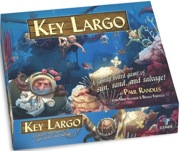 Searching for gold in the oceans is something many of us dream of doing, while few of us actually follow up on it. Key Largo is a game that allows players to simulate this in a silly, entertaining way. Players take turns simultaneously selecting what their divers are going to do during the ten day timeline of the game. Divers can purchase equipment, earn cash by taking tourists out to see the dolphins, dive for treasure, sell treasures, or hang out at the local tavern. Each of these actions is affected by the number of players who partake in them; for example, if two players both go to the store to buy equipment, the prices are higher. This adds an element of guessing and interaction to the game that keeps players intrigued with their opponent's choices. Diving for treasure requires equipment, but divers must also beware of random monsters that may appear. Preparing to fight the monsters takes time and money, but a player attempting to skirt the costs may find themselves looking for a new diver! Players only have a few choices to make each turn, but everything fits into a nice, thematic framework that makes complete sense. The illustrations are outrageously ridiculous, the components are of high quality, and the development of the game keeps things moving at a quick clip.  The game offers a nice variety of strategic choices, but it really shines as a family game. Children will delight in searching through the stacks of cards for treasure, and watching their parents get gobbled by a monster (a large octopus). Outguessing opponents, trying to maximize one's money, and simply laughing at the funny pictures make Key Largo a tremendous family activity. Younger players will learn how to count money and how to make a profit when selling, although they may need some help with the mathematics. At the same time, they can remain competitive with their parents due to the vagaries of treasure finding. This treasure hunting is a great draw to the game and is one that will appeal to many new gamers. A game that looks more complicated than it is, with a ton of Major FUN packed in the box, Key Largo is a great choice for casual gaming, with stunning components and simple, laughing game play. I'll be diving for treasure in Key Largo for quite some time - it might very well be one of the best games of 2008. Tom Vasel "Real men play board games" The Dice TowerLabels: Family Games
Wednesday, May 21, 2008
Go Nuts!
 Have you ever seen anyone go crazy when playing a game? Go Nuts!, a new entry in Gamewright's 12-Minute Games series, certainly seems to encourage this in the title alone! The frenzied activities of the game add a level of wackiness and fun not often found in dice games, and the "push-your-luck" aspect will keep players on the edge of their seat for the few minutes this game takes to complete. On a player's turn, they simply roll five dice that have squirrels, acorns, and cars on their faces. Each acorn a player rolls scores the player one point, while cars are placed out of play. Players are allowed to re-roll all dice with squirrels and/or nuts on them; but they can stop at any time, taking the sum of points they have accumulated. Continuing to roll presents a level of danger. Because if the player ever rolls all cars at one time, their turn ends immediately; and any points gained that turn are lost. If the player rolls all squirrels, pandemonium breaks out. The player shouts, "Go Nuts!", and starts rolling the dice as fast as they can, attempting to score as many points as they gather. All the other players roll one special die that has a dog picture on a single face. When another player rolls a dog, they scream out "Woof, woof, woof!" and the player whose turn it is tallies up their points and passes the dice to the next player. To add an even spicier element to the game, a player who has only a single die remaining gets all five dice back if they roll an acorn. Since the chance of causing a "nutty" round or losing all the dice because of cars is high, players have to assess the risks of doing this, although it may allow a player to come back into the competition.  Whenever "Go Nuts!" is shouted, it's hilarious to watch everyone rolling dice as fast as they can, trying to stop the player from gaining any more points. Rapid-fire dice rolling is amazingly fun; and when added to the simple probability choices, it gives the game a most definitely Major FUN feeling. I've seen groups of people literally shrieking in fun as they tossed the dice at the table, trying desperately to get a dog before Uncle Bob scores any more points; and no one is ever out of competition until the game ends. Add the fact that the game takes less than 12 minutes to play to the mix, and you have a wonderful choice for families and parties. Tom Vasel "Real men play board games" The Dice TowerLabels: Family Games, Kids Games, Party Games
Monday, May 05, 2008
Boochie
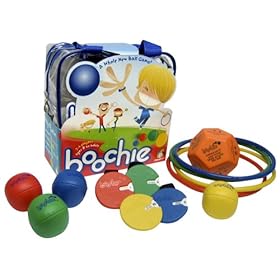 Boochie Boochie, by Gamewright Games, is an obvious play and variation on the popular game Bocce. But while Bocce can become an intense affair, especially for adults, Boochie is more of a silly, fun game for the family. Really - can you even say "Boochie" without smiling? Additionally, the Boochie ball itself is not a sphere, but a foam dodecahedron that bounces in odd directions and feels like one of those items that every household should have. To play the game, each player takes a large plastic ring and beanbag ball of their color, placing a matching scoring device on their wrist. One player tosses the Boochie ball a distance away, and then players take turns throwing their beanbag balls and/or rings towards it. The player who has the closest object scores two points, and the player with the second closest object receives one point. Players also score points for "ringing" another player's bean bag or the Boochie ball itself. Finally, the Boochie ball lists another requirement ("+2 for the players with hoops closest together", "+1 for the object farthest away", etc.) that gives out bonus points. Players mark their points on the dial, which is on their wrist, and begin another round. But that's where things become deliciously interesting. As players gain points, they suddenly have to toss the ball in strange and unusual ways. One player may be forced to make loud noises as they throw, while another must toss objects backwards, between their legs. This accomplishes two things - it increases the silliness (and therefore, fun) factor of the game, while it allows players who are behind to catch up. The more points a player has; the more difficult their throw is. And therein lies the joy of the game, as families with a wide range of players can effectively play a fairly competitive game and remain close in competition. Little Johnny may throw his ring in a completely different direction and yet gain a point for being the farthest away. Young Tisha might laugh at Dad, as he has to jump while throwing, which results in hilarious contortions. Boochie is simply a fun, entertaining game that can be played outdoors or in large, open rooms. The fact that any group of four players can play this game designed by Forrest-Pruzan Creative means that it is Major FUN. Boochie Boochie Boochie Boochie. See, I told you it was fun to say! Tom Vasel "Real men play board games" The Dice TowerLabels: Dexterity, Family Games, Kids Games
| |


