|
Wednesday, July 29, 2009
A Book of Lenses, A Game of Lenses, and Jesse Schell, conceptual optician
Dear Jesse Schell,
I know, I know, you sent me a copy of your book and your card deck. Me. That was no business card. It was a sizable gift. And by it, I am honored you thought my opinion worth the investment. And I’ve been honored now for maybe a half year and I still have written barely anything about your work. Not about how deep it is, how thorough, how it touches the very same things I would hope to touch upon if I were writing about the art of game design. How it goes further, even, instantiating and substantiating, almost tangibly building the sensibilities that are central to the art of designing for fun.
The Art of Game Design, a Book of Lenses. Exactly. A book of ways to look at games, through different perspectives, through different paradigms, like, for example, fun.
 If I hadn’t been so busy with moving and traveling and redefining my pschyo-ecological niche, I’d have told everyone about what you have accomplished here, how even the “game” you made up, with that beautifully rendered deck of cards, each acting as a “lens” (very deep concept here, lens) through which you can see and even judge the nature of the game, as it were. How you actually made an genuine game that can truly be played for fun. And yet, with serious import and surprising value…A game that can be fun to play and still border everso closely on what one would call “serious” – full of purpose and significance and learning objectives and messages, even – fun of a very useful kind.
This in itself is an accomplishment that would send especially me into paroxysms of praise and public cavorting. And yet, until now, I remained silent.
Alas for the exigencies that kept me from this for so long. I embrace thee, Jesse Schell, with gleeful noise, and hereby, for as long as the connection lasts, bestow on you the Defendership itself.
Jesse Schell. Author of the Art of Game Design, a Book of Lenses. Designer of The Art of Game Design: a Deck of Lenses. Industry veteran. Leader of a "highly talented group of artists, programmers, and game designers." Defender of the Playful. Labels: Defender of the Playful

Tuesday, July 28, 2009
Helena Kling - Defender of the Playful
 I only met Helena Kling a few years ago, though we've been corresponding for what seems to be at least a lifetime. Each time we've managed to get together (she's in Tel Aviv), I've been astounded at her energy, her vision, her generosity, her passion for play. There's very little about her work on the Internet. That makes a lot of sense, given that Helen is so completely focused on participating in the experience of play. Not just writing about it or teaching it, but living it. Luckily, someone thought to write a Internet-accessible article about her. Which, at last, gave me this opportunity to learn more about her work, and a very good excuse to sing her praises, at last. The article, written by Mel Bezalel for the Jerusalem Post, must have been a real challenge to put together. Helena is so vibrant, so enthusiastic, has such a wealth of knowledge, and is so completely playful that it's almost impossible to convey the breadth and depth of her delightful gifts. The reporter notes: "Kling's mantra is that 'play is important for families' and increasingly, this goes well and beyond childhood." All the way to grandparenting. The reporter notes: "'Buy something you like that you'd like to play with" is her recommendation, as parents and grandparents should be a part of the child's play. This idea of a shared experience motivated Kling's introduction of English storytelling at the center five years ago for grandparents and their grandchildren." Kling is outspoken and unafraid. Especially when it comes to educational games. "If it's got 'educational' on the box," she says, "don't buy it...There is so much other stuff you can buy and have fun with, why have a piece of cardboard where a child throws dice and goes round a board and doesn't get anywhere? Besides...'educational' games are the first to be ejected from game collections." Helena Kling. Defender of the Playful. Labels: Defender of the Playful
Wednesday, July 22, 2009
The Bilibo Game Box - a child's tool kit for game invention
The Bilibo Game Box is not just a toy. It is a tool kit for the very young game designer (age 4 and up) and an invitation to inventiveness for the rest of us.
The Game Box contains a die with interchangeable faces and six sets of differently-colored discs that fit in each face. There's also a set of six, plastic, hand-sized "mini-Bilibos," in each of the six colors corresponding to the colors of the discs.
Bilibos are shaped something like pregnant plastic Pringles, with holes that look almost like eyes. Full-sized Bilibos are big enough for a kid to sit, spin, rock, float, climb in or on, or pretend with. The simple, friendly, colorful design invites creativity, exploration, and invention, and nurtures playfulness. No moving parts. Just a funny shape to explore, define, redefine, shape your dreams on. Mini-Bilibos are just as strange, just as funny, just as fun to play with. And, as son-in-law Tom observed, function quite satisfactorily as doll helmets.
The die is called a Bilibo Pixel. It is made of some surprisingly bouncy and slightly stretchy plastic. The corners are so wonderfully rounded that it rolls as well as bounces almost as well as a rubber ball. Button-like pieces fit in each of the faces of the die where there are cavities deep enough not only to accommodate any of the discs, but also to fit little messages or prizes, or, if you are so inclined, weights. So you can play around with fate, as it were, making some of the faces the same color or all of the faces different, adding and removing things behind the colored buttons to influence where the die might fall and add further elements of surprise.
The Bilibo Game Box gives your child a set of almost infinitely enticing properties and relationships to explore. Without even reading anything even closely approximating rules, the child will find herself using the die in some way to indicate which mini-Bilibo she should aim for. Aim what, you might ask. Any of those color-coded, button-like discs which can be slid or juggled or tossed or tiddled under or over or through. Or strung together, for that matter, or strung together with a mini-Bilibo.
As children continue to explore the properties and relationships of the Bilibo Game Box, they will inevitably discover that the elements can be used in conjunction with a surprisingly varied array of other objects in their environment - chairs and steps, tables, counter-tops, floors. They can make targets and game boards with sheets of paper, ramps and obstacles out of paper plates and sheets of cardboard, die-launchers and Bilibo-flippers out of spoons and rulers.
 Alex Hochstrasser, designer of the Bilibo Game Box and associated products, has created a work of playful genius. The simplicity of the components belie the elegance of design and the depth of understanding of the nature of creative play.
There are several delightful videos https://www.youtube.com/bilibo on Youtube that illustrate a few of the plethora of possibilities contained in the Bilibo Game Box, and a well-illustrated booklet that accompanies each Game Box for yet more ideas, and, soon, even more will be on the Bilibo website.
Despite all these resources, please, consider this: the more you and your children play together with this, openly, inventing games from scratch, without any guidance other than that which comes from your collectively playful hearts, the greater the value of your experiences with this remarkable toy. If you want ideas, let your children be your guide. The Bilibo Game Box is remarkably innovative and brilliantly designed, but the real value of it only becomes apparent when it is used as a tool for playful, inspired invention. Labels: Kids Games, Tops for 2009, Toys
Quixo
 Quixo Classic Quixo Classic is well-made, well-conceived strategic game for 2 or 4 players, which, because it is related to tic-tac-toe, is easy enough for a 6-year-old to play, and, because of its use of the mechanics of sliding block puzzles, is subtle enough to challenge a 66-year-old. Well, 67, actually, but who's counting?
The game consists of 25, 1-inch wooden cubes, bevel edged, lovingly smoothed, warmly wooden cubes, which are packed in a cloth bag, and nestle comfortably in a wooden tray. Four sides of the cubes are left blank. You'll find an X pyrographed on one of the other sides, and, opposite that, similarly pyrographed, an O.
At the beginning of the game, all the cubes are placed on the board, on to any of their 4 blank sides, forming a 5x5 array. Only the cubes on the periphery are available for play.
The object of the game is to be the first player or team to get 5 of your symbols (an X or an 0) in a straight line. To do this, you pick any blank block on the edge of the board, remove it, and then slide the row or column of blocks so as to create a new blank space on one of the edges of the board. You then place the block you selected into that space, positioning it so that your symbol is showing.
The game continues in that manner, players or teams alternating turns, until someone gets 5 of their symbols in the proverbial row. Because each move results in moving part or all of a row or column, blocks are getting continually repositioned - and within there lies the rub, as well as the tickle. You have to see much further ahead, consider a copious complexity of cubic combinations in order to get your symbols (and not your opponent's) to line up in the appropriate array of your aspirations.
Designed by Thierry Chapeau, Quixo Classic is one in a series of similarly well-made games by the French game publisher Gigamic, available in the US from our much-appreciated Fundex. Easy to learn, as fun for kids as adults, well-made, played in 15 minutes or less, often surprising - as they all-too-rarely say amongst Major Fun Game Tasters, this one's a Keeper! Labels: Family Games, Keeper, Kids Games, Thinking Games
Monday, July 20, 2009
Quoridor Kid - as fun as it looks
 Whatever you can say about Mirko Marchesi's Quoridor, you can also say about Mirko Marchesi's Quoridor Kid. Except that Quoridor Kid is cuter. And takes less time to play. And the board is 7x7 instead of 9x9. And there are 16 instead of 20 fences. They play the same. They offer the same exercise in strategic maze-making. One is cute and short. The other is larger, darker, more brooding, more adult. But no matter which you are playing, Quoridor or the Kid, as child or adult, it's the same fun and fascination.  Which is rather remarkable, come to think of it, that a kid's version of an adult game should prove as maturely playworthy as the adult version. Which makes this version a special gift to parents. Because here's a game in a version that will appeal to your child as it will to to you. Your child will be especially sensitive to the fun of it - to the fantasy, the remarkably skillful humor of the mouse-in-maze metaphor - and consequently, they might laugh more often than you will. It is a challenging game. You begin on the edges of a 7x7 grid. You, as a mouse whose nose is the same color as a piece of wooden cheese placed on the opposite side of the board. You take turns moving your mouse, horizontally or vertically, one space at a time. Your goal and purpose, as in much of life, is to get to your cheese first. You do that by moving forward, or by placing fences between your opponent and her cheese. Moving and fencing, the board begins to look like a maze, and the strategic depth is equally amazing. All that metaphorically-appropriate mouse-and-cheese cuteness aside, getting to your cheese first is something you can take seriously, beyond metaphor. And as a parent, it is a special thrill when, as you inevitably will, you lose a game to your own child - fair and square. You won't have to say things like "well, then, you're the second winner," or make just the mistake that will "accidentally" give your child the victory. Because playing Quoridor, Kid or not, can get as challenging to the grown-up as it can to the child - and still look fun! Which is what makes the Fun of Quoridor Kid so Major. What else would you call kind of fun can you get from a game that requires deep, logical thinking, that looks and plays as inviting to adults as it is to kids, as it is to kids without adults? Labels: Family Games, Kids Games, Thinking Games
Thursday, July 16, 2009
Six
 What would be a good name for a game played with six-sided hexagons (as if there were any other kind)? Just six-sided (I'm making a point here) hexagons? Not even a board? Where you try to be the first to make a shape out of...wait for it... six wooden black or red six-sided hexagons? What about a strategic game where you take turns adding a hexagon of your black or red color to any other hexagon already on the table, or floor, or blanket? Until all your lovely, smoothly wooden hexagons are played, and then you can move them from hexagon-adjoining place to any other hexagon-adjoinable place? And you win if you can get six of your own in a row, or triangle or in a six-sided circle? What do you think of " Six"? Sheer coincidence that the publishers also chose to call it Six? I think not. Even though you each have 19 hexagon-pieces. 19. Not the everso appropriately six-divisible 18 hexagon-pieces. You still get a, dare I say it, Major Fun experience, which, if Major Fun gave star-ratings, is clearly six-star-worthy. And then there's what one might think of as the "Advanced Major Fun" to be had by players of the advanced version, because, see, after you play for a while you discover how you change the entire mass of hexagons into two, and you begin to wonder, almost without reading the advanced rules, what doing so might do to your opponent, like, for example, put the entire smaller cluster (wherein a substantial majority of your opponent's pieces happen to reside) out of play for the rest of the game. Steffen Mühlhäuser's game of hexagons is newly made available in the U.S. through FoxMind, and still published in Europe by Steffen-Spiele. Most games can be played in from six to 36 minutes. Easy to learn for those of checker-playing persuasion. Easy to carry around, rules and all, in a conveniently included drawstring bag or its lovely six-sided box. Labels: Keeper, Thinking Games
Wednesday, July 15, 2009
Olga Jarrett
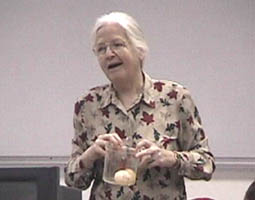 You remember my article Where have all the players gone. That was the last time I wrote about Olga Jarrett. The last time I met Dr. Jarrett was in a hotel lobby in Atlanta. She brought an oscilloscope. One that she had made. Out of a can, a mirror, some rubber bands, and a toy laser-pointer. She was radiating delight, not just because her junk-built toy oscilloscope really and truly worked, but because of the sheer fun of it all. [Olga comments: "The "oscilloscope" was really mostly invented by Bob (my husband). I was looking for a way to show how sound vibrations can be shown as light and had picked up the idea somewhere to make an "oscilloscope" that could be used in the sun. But since I taught evening classes I was looking for something that could be used at night. Bob came up with the idea of attaching a laser. We really had fun making it and it is a great experience for my students. We also made them as Christmas presents for family and friends one year."] And that moment of meeting her, was, more than any of her many accomplishments, what it finally took, maybe two years later, for me to recognize her as a true and genuine Defender of the Playful. Experiencing her unabashed playfulness was all I needed. Here, from her manuscript "Drawing on the Child's World: Science Made Relevant" is another example of how Olga plays: "Science textbooks often emphasize such concepts as the parts of a flower, the difference between igneous, sedimentary and metaphoric rocks. Teachers instructing from such textbooks often stress vocabilary and facts...My first son failed a test on spiders without ever having looked at a spider in school...Make science relevant by drawing on the child's experience. Encourage curiosity. Make learning challenging and fun, and children may be more likely to take elective science courses in high school." "Counting takes on new meaning when children count the spots on ladybugs to determine if they all have the same number..." "(use) measuring sticks, thermometers, scales and timers (to) determine without guesswork who has he longest hair, how long a worm is when stretched out/scrunched up, how fast a pumpkin grows...." "see how many drops of water you can drip onto the face of a coin before it runs off. Then flip over the coin and try the other side." And here, from the Georgia State University, an all-too-abbreviated summary of her work`: "Dr. Jarrett teaches science methods in the Early Childhood Education's Urban Alternative Preparation Program. She is a University Fellow in the Urban Atlanta Coalition Compact, an Annenberg funded project whose purpose is excellence in education for African American students. She also serves as a project coordinator of Project DOVE (Drop-out, Violence Elimination), a systematic prevention/intervention program which includes mentoring and a curriculum on empathy, impulse control, and bully prevention. Dr. Jarrett's research has focused on recess and playground behavior, bully prevention, effective teaching in urban schools, and effective methods of teaching science (pre-k to fifth grade). Her most recent research was published in School Science and Mathematics, and The Journal of Educational Research." Former president of The Association for the Study of Play, currently president of the American Association for the Child's Right to Play (IPA/USA), U.S. affiliate of the International Play Association, Promoting the Child's Right to Play, Dr. Jarrett is, in every sense of the word, a Defender of the Playful. Labels: Defender of the Playful
Sunday, July 12, 2009
Abalone
 Let us begin our exploration of the game classic Abalone (recently re-released by Foxmind) by paying particular attention to the rule that: the winner is the first player to push a total of SIX of his opponent's marbles off the board. So, already you're intrigued - marbles, marble-pushing, pushing marbles off the board, a board you can push marbles off of into. And then there's the number six (6). I stress this number because, after thorough investigation, lasting conceptual days and actally maybe a couple entire hours, with fewer and fewer marbles and the way the game can go on and on and on, it stops being fun. Unless of course you remember that you're supposed to stop playing the game as soon as soneone has eliminated six of his opponent's lovely large, shiny, black or white marbles. Marble-pushing. Pushing one or two or three of your marbles in a line, to the next space. Marbles resting in hexagonal sections of a hexagonal board, with marble-size channels linking the hive-like cells. Making it possible to push even four, or possibly five marbles (three of yours and two of your opponent's, because to push your opponent's marbles you have to have more than he does, and since you can't push more than three of yours, it stands to reason. I think the game designers (Laurent Levi and Michel Lalet) wanted you to know that this one's going to be fun. Marble-pushing. What an interesting, fun thing to do especially with beautiful, large, glass marbles. So black and white. So back and forth. So tempting to make up your own variations in which you can push let's say up to five of your marbles, which would mean up to four of your opponents, because it's just so much fun to move all those marbles in a row. O there are rules. Surprisingly complex rules governing how many marbles you can move, when you can't, how far, each of which add yet another possible variation to explore, once variation-exploring is what you're into. In sum, don't forget: six pieces and the game's over! Maybe seven. Maybe three. Labels: Keeper, Thinking Games
Friday, July 10, 2009
Batik
 When I ask you to identify a board game that is a strategic puzzle game for two players that also involves dexterity, what game pops into your well-informed head? Would it, perhaps, be Batik?
You know, Batik, that lovely, wooden, puzzle-looking game in the Gigamic collection - yes, that collection of wooden strategic games available in the US from Fundex Games.
Batik, the puzzle game designed by Kris Burmin, in which two players take turns dropping two different colors of wooden, tangram-like pieces into a wood and plexiglass frame.
One of the most self-explanatory games around, especially for those who've played Connect Four. Even those who've played with Connect Four, just to see what happens, like a checker-dropping 3-year-old.
See, when it's your turn, especially in the beginning of the game, it's not just a question of dropping any old shape into the frame. First of all, you have to pick a strategically significant shape (big? pointy? tiny? smooth?), and you have to get it to land pretty much just where you want it to land, somewhere preferably snug, or not, 'cause you often win by taking up more, rather than less space. And there's just a tad of luck, too. Taking turns, using any piece you want (unless you're playing the official "use only your own piece" version), making sure that you're not the player whose piece doesn't fit ertirely within the frame.
 Not that I'm recommending you should, but nonetheless gleefully noting that Pete Hornburg figured out how to get all the pieces to fit perfectly inside the game frame, thereby demonstrating the puzzle-likeness of it all, while more than hinting at the possibility of the perfect game and the observation that you're playing in a game frame.
Lovely, the whole thing. Easy to learn. Short games (maybe 10 minutes). Fun for a remarkably wide range of players. There's the dexterity and luck part, so it's not necessarily the smartest who always wins. Which inevitably makes for more fun. Unless you get too serious about the game. On the other hand, it's good to know you can get serious about it if you have to - just in case. Labels: Dexterity, Keeper, Puzzles, Thinking Games
Thursday, July 09, 2009
Garry Shirts - Defender of the Playful
 I've known Garry Shirts for at least 35 years. I first became familiar with his presence in my particular universe when I was running the Games Preserve and writing for a rather esoteric publication called Simulation/Gaming/News. When I was early in the process of gathering a rich enough collection of games to give people a direct experience of the scope of all things gameful, Garry was kind enough to send me two of his simulation games: BaFa' BaFa' and Star Power. These games added a playfully profound dimension to the entire collection and purpose of the Games Preserve. I and the people who came to play with me learned so much from experiencing each of these games - not only about a very important genre of games (now known as Serious Games), but also about the depth and truths that can be revealed in a well-designed invitation to reflective fun. So Garry became a valued resource and friend. And later, when I moved to California, even more valued. Very recently, Garry happened to be in Indianapolis. He was here as part of a multi-leg tour, teaching his Ba'Fa Ba'Fa game to help people understand a little more about the underlying dynamics of diversity. He invited us (my wife and myself) to breakfast, and our meeting was delicious in every sense. I brought him a copy of Junkyard Sports, as a gift, a token, a tribute to our long-standing friendship. He thumbed through it for a few minutes, and then looked at me with such love and understanding, and said: "You know, Bernie, the person who learns the most from a game is the designer." And in that one sentence summed up pretty much everything I've been teaching about games and play for the last 40 years. This insight and understanding suddenly coalesced for me. I was able to put all those years of knowing him together, and give his remarkable presence in my life a title. Garry has been, and is, in every sense, a Defender of the Playful. He plays from the heart. He teaches from the heart. He is as wise as he is loving. His games have taught and touched the hearts of thousands of students and teachers and business leaders - vividly, playfully. His presence is a gift to all who receive it. Labels: Defender of the Playful
Pylos
 At first glance, Pylos looks like a game where players race to have their color bead on top of the pyramid. Which is pretty much what the game is about. But if you try to do just exactly that, the game seems silly in deed. The second player always wins. Unless you read the rules.
 If you find a square of beads already on the board, you can put one bead on top, either from your "reserve" (the troughs on your side of the board), or by moving a bead that is already on the board. If you build a new square of your beads (four adjacent to each other), you get to take one or two (the number being of great, yet subtle strategic significance) of your "free" beads (freedom being measured in terms of not having any other piece on top of you), and return them to your reserve. Which gives you an extra piece or two to play. Which makes it more likely that the other player will run of pieces before the top bead can be placed.
It helps if you understand the game of Nim, or the chess concept of opposition. It's about timing, about leaving the other player with one less move.
It especially helps if you read the rules carefully. Even though Pylos is an easy game to learn, and the rules are brief and succinct, they are also quite dense. The game looks so much like a simple race to the top that it's almost too easy to overlook what the game is really about. It's a strategic game, requiring planning and logic.
There are "advanced rules" when you're ready for them (if you get 4-in-a-row on the bottom level or 3-in-a-row on the next level, you also get to take back one or two of your beads). And of course you can simplify the game by eliminating one of the two square rules (the rules allowing you to move or take one or two beads from the board when you complete a square of your color or a square of mixed color).
Designed by David G. Royffe, Pylos is another well-made, wooden, aesthetically pleasing, casual strategy game in the Gigamic collection, available in the US from Fundex Games. Recommended for two players over the age of seven, it takes about 10-20 minutes to play, maybe 10 minutes to learn. For younger players, making a pyramid out of beads, especially when you have a base that keeps all the beads in one place, is so satisfying, and so much fun, that it might take them a while to get to the beauty of the game itself. When they're ready, they will learn. Labels: Thinking Games
Wednesday, July 08, 2009
Ninety-Nine or Bust
 There are some times very good reasons for repackaging a traditional game. 99 is one such traditional game, and the people who brought us Pocket Farkel are just the people to demonstrate how good those reasons can be.
Though the traditional game of 99 can be played with a standard deck of cards, the publishers of Ninety-Nine or Bust have taken a extra step, creating a unique set of cards that supports all the standard rules of the game without changing any of the elements that make the game as fun as it is.
In the traditional game players take turns adding a card to a discard pile. And I really mean "add." Whenever a card is played, it's numerical value is added to the total. The only rule is that the total can't exceed 99. There are certain cards that have special functions, which, of course, is what keeps the game interesting. Aces count as a 1 or as 11. Fours reverse the direction of play without adding anything to the total. Nines also don't anything. Tens increase or decrease the total value of the pile by ten. And kings reset the value of the deck to 99.  In Ninety Nine or Bust there are still 52 cards. And the object is still not to exceed 99. The cards are numbered from 1-10. There are no 9s. There are only four special cards: "subtract 10," "stays the same," "reverse direction," and "99." Because their functions are actually written on the cards, the game is much easier to learn. There's also a little less to think about, fewer choices to make. And the special cards don't look at all like normal playing cards, so the game itself seems special, which it is.
There's a wonderful balance between chance and the illusion of choice. There aren't any winning strategies. But it feels like there are. You get to make other people lose. But again, only if you're lucky and they're not. The odds are unpredictable enough so that, even if you lose three games in a row, you can still win. And even if you do win, it's not really because of anything you are or did or should have done. Just like losing isn't. It all adds up, as they say, to a perfect little party game - an invitation to easy going fun, for 2 to 8 players, for 10 minutes or maybe an hour.
Labels: Family Games
Tuesday, July 07, 2009
Funny Business - funny in deed
 The people at Gamewright call their Funny Business game "The Hilarious Game of Mismatched Mergers." And by golly, they're right! Funny Business is a family game that engaged our particular family, ranging in age from just 12 to significantly 67, in verifiable moments of hilarious, helpless laughter. You get a deck of very big "Business Cards." These are not your traditional business cards, they're cards that identify kinds of business - like "Bakery" and "Barber Shop" - 200 different businesses. Each card also has a list of 20 words associated with that business - like bread and doughnut and bangs and curls. Everybody gets a write-on-wipe-off naming card, a voting wheel, a marker (with write-on-wipe-offing eraser), and until the timer runs out to write down what you might call a, for example, Barber Shop and Bakery. You know, like Snips 'n Crumpets, and The Coiffed Bagel, and maybe Feed and Groom. When time's up, one player reads all the answers on their naming cards. The cards, by the way, each have a different color border which in turn correspond to one of the colors on the voting wheel, all of which add to the ease and the fun of voting. You get 2 points if you get the most votes, and 1 point if you vote for the winner. If you tie - somehow two or more players become so attuned to each other and the underlying silliness of the game that they all write the same thing - both players get points if they get voted for, and if they vote for the winner. The fact that such ties occur a testimony to the kind of closeness this silly game engenders. We played all 6 rounds, and by the 3rd or 4th we started having ties, and by the 5th or 6th, we were still having ties. A lot of the laughter is at yourself - in a very fun sort of way. From time to time you amaze yourself at your cleverness, or your ability to think of a name that's too, shall we say, personal to share, while simultaneously nothing short of genius. We kept score. But by the last round we were too tired from laughing to care who won. The older folk spent the most time laughing. For the 12-year-old, much of the hilarious subtlety seemed other. Designed by Jack Degnan for Gamewright, Funny Business proves to be a Major FUN party-like game, for friends or families of up to 8 players whose kids are in their teens or beyond. Labels: Family Games, Keeper, Party Games
Sunday, July 05, 2009
Monopoly Deal
 Before I go into too much detail, let me tell you this: Hasbro's Monopoly Deal is fun. It's a card game that gives you that Monopoly feeling. You build monopolies and even put houses and hotels on them, and pay for them, in the millions of dollars - all with a deck of cards. But it's faster, and shorter, and easier, and at least just as much fun. But a different, shall we say, "flavor" of Monopoly-making-like-fun. Because it's shorter and easier and faster, you don't have time to get really invested in the game, you don't even have to spend time setting it up. And because Monopoly Deal still gives you a lot of the kind of fun of the board game, you take it more lightly. Playing Monopoly Deal is more about fun than winning, more about that Monopoly-kind of, taking-someone-elses's property-kind of fun in particular, which makes it such a Major FUN family game, par, pretty much excellence. The rules are simple and clear enough to keep it a good game, good enough to withstand the inevitable creation of many a monopoly-like "house rules" version for many a different age group and be often even more fun. "Quick Start" rule cards handily summarize everything you need to know to play the game. In addition to the Quick Start cards there are Property cards, Money cards, Action Cards, Property Wildcards, and Rent cards - giving your Monopoly Deal deck a nice fat total of 110 cards. The Money cards are numbered in the millions - 1 Million, 2 Million, 3, 4, 10 Million - just to give the game a more realistically modern financial scale. Action cards include the "Sly Deal" which allows you to steal any property that has not been completed (making property-completion an even more valuable goal) from another player, whereas the Deal Breaker let's you steal completed properties. The Forced Deal lets you swap any of your less desirable properties with the hugely more desirable properties of your chosen opponent. There's a Pass Go card, of course, which lets you take 2 extra cards from the draw pile. And on and on - a wonderful complexity of luck and strategic potential, explaned in detail on each card. Easy to learn. Fifteen, maybe 20 minutes to play a round - just short enough to make you want to play again and again. Simple enough for children of gin-playing age. Complex enough for adults of gin-drinking age. All in all a remarkably effective and significantly fun translation of a very long, often agozingly complex family board game into a comparatively brief, frequently delightful, easy to learn family card game. Labels: Family Games, Tops for 2009
Friday, July 03, 2009
Brian Sutton-Smith - Defender of the Playful
 Brian Sutton-Smith Brian Sutton-Smith (shown here with a passel of his playful progeny) - the same guy who said: "The opposite of play is not work, it's depression" - has been a friend of mine for 35-some years. I first came across his name in a book called The Study of Games that he and Elliot Avedon had co-authored. I was at the time working on my Interplay Games Curriculum, and was in the heat of searching for everything I could find out about games and the study thereof, and this particular book turned out to be a godsend. The next godsend occurred a few years later when I discovered that he was teaching at the University of Pennsylvania. I don't remember exactly what the next steps were, but for several years he brought his classes to my play study retreat center, the Games Preserve, and he, his students and I shared some wonderfully deep play together.

Dr. Brian Sutton Smith, author of The Ambiguity of Play, Professor Emeritus of the University of Pennsylvania where he taught in the Graduate School of Education and the Program of Folklore and Folklife, had this to say about himself:
"first of all I don't consider myself just an academic. I have reached that point in life where my initial pretenses of being a scholar and of being impersonal no longer serve as a convincing dis guise for myself. I've come to believe that a central issue in understanding life or social science or gaining wis dom about anything that is significant is to determine the way in which one's own internal narrative interacts with their personal scholarship. In New Zealand where I was born, I was deeply influenced by my aggressive and physically active older brother into considering play largely as a matter of power. My father was the Wellington chief postmaster who longed to be a university professor and was active as a storyteller and amateur actor. From him I got my academic interests in drama and in stories. These individuals certainly have influenced much of my life. I wish it was sufficient simply to announce that I have been persistently interested in play and that I think it's important." (from an interview with Dr Stuart Brown). Dr. Brian Sutton-Smith, "...persistently interested in play and...its importan(ce)," Defender of the Playful. Labels: Defender of the Playful
Thursday, July 02, 2009
The Bubble Thing
 Making big bubbles - and I mean really big bubbles - is at least as much a technology as it is an art. David Stein, inventor of The Bubble Thing, has created a really-big-bubble-blowing technology that works well enough for you to make really big bubbles now, and develop the art later.
His Bubble Thing has two components: a really-big-bubble-making wand, and a bottle of the mysterious "Bubble Mix." (David says: "If you run out of mix, baking powder will tide you over and work good too.") ("Tide" you over? Is that Freudian product placement?) The really-big-bubble-making wand (a.k.a. "the Bubble Thing") is a very large open-and-closeable fabric loop on a tubular handle. You dip the closed loop in a bucket of soap suds, raise it, open it, wave it sideways and it makes really, really big bubbles. And then there's a bottle of bubble mix which, when added to water and dish soap, provides, shall we say, the "ultimate solution" for your really-big-bubble-blowing needs. Yes, it can get a bit messy and slimy and soapy. But even more yes, it will astonish you with your suddenly-acquired really-big-bubble-blowing powers.
 The instructions even include, bless them, a game called the "Popping Game." You "win one point for popping little bubbles (smaller than a basketball)." But you lose five points when you pop a big bubble. Squirt-gun, frisbee- and finger-popping are all recommended. Ah, a bubble game. Surely there must be a myriad of such.
As a matter of no coincidence at all, bubble-maven Stein has teamed up with the editors at Klutz Press to produce a handy guide to really-big-bubble-making called How to Make Monstrous, Huge, Unbelievably Big Bubbles. The Bubble Wand you get with the book, Stein explains, is the same size as his own version.
It's most definitely an outdoor toy. It's most clearly designed to be used by people old enough to be sensitive to things like a shifting wind and the soap-in-the-eye potential, and young enough to want to make really, really big bubbles. And the fun, the fun, is like totally major. Labels: Toys
Wednesday, July 01, 2009
Pocket Farkel
 The name of the game is Farkel. You could easily confuse it with Farkle, which wouldn't be a major mistake. In fact, you could just as easily confuse it with 10000, 5000, Buzzball, Greed, Hot Dice, Oh Crap, Squelch, Wimp Out, Zilch, or Zonk. And you'd be perfectly entitled, insofar as they are each and all names for basically the same game - a dice game, played with six dice, that is most definitely not Yahtzee.
However, the subject of this review is not Farkel, but Pocket Farkel, as a matter of fact. (One of my very favorite game names, that I find myself obliged to repeat in rapid succession many times each time I open the game box).
Speaking of boxes, that's perhaps the key to what makes Pocket Farkel so fun-worthy. It's a handy little box, with the dice fitting snugly into their little foam niches, and the scoring rules (which are difficult to remember for the novice Farkeler) so clearly printed on the inside of the lid. And, as you would assume, it fits tidily into your pocket. Yes, all you really need are six dice. But the package here is the product. Its elegance, its accessibility all invite play, making the game into something unique.
The rules of Pocket Farkel are slightly different than those of your regular Farkle - simpler, more scoring possibilities, more engaging. On your turn, you first roll all six dice. You then set aside any of dice that score (see the ever-so handy scoring combination chart on the box lid), and then you roll the rest of the dice. But you have to have to score to go on. If you don't score, you Farkel. And to Farkel is to lose all those conceptually hard-earned points you thought you were getting for that round. As in, "O, Farkel!" Which is another way of saying, no matter how disappointed you get, you just can't take it seriously.
And so the game goes, people scoring. People Farkeling. There's laughing. There's muttering. And then there's more laughing. For a family with kids who can keep score - and not care too much about it - it's something you might want to take with you everywhere.
The Pocket Farkel people make an astounding variety of Farkel sets - there's Pirate Farkel and Froggy Farkel and Moose Farkel, Bear Farkel and Equine Farkel and Gator Farkel. There's Glow-in-the-Dark Farkel and Full Contact Farkel, Fat Free Lo Carb Farkel, and no matter what they're called, they're all Farkel. The dice might look different, but the game's the same. Enticing. Engaging. Major FUN.
Labels: Family Games
Bananagrams - a crossword tile game you can play everywhere with anyone
 Bananagrams Bananagrams is a word game that uses letter tiles - 144 unusally finger-friendly, bakelite letter tiles. It will remind you of other letter-tile word games, many other letter-tile word games, until you actually read the rules (which are simple enough to summarize on the 1x2-inch tag that is attached to the banana-like zippable package). Basically, you draw a bunch of tiles and try to assemble all of them into a crossword array. If you succeed, you draw more. That's about it, basically-wise. The full rules are a bit more complex. Players all get the same number of letter tiles, the exact number depending on the how many are playing. They race to assemble all their letters into a crossword. As soon as one player succeeds, she calls "peel," at which time every player has to take a another letter tile. And so it goes, on and on, until almost all the letter tiles are used up. Naturally, the first player to have used all her tiles shouts "bananas" (if she still has the presence of mind to remember), and wins the game. Everything about Bananagrams is Major FUN, the quality of the tiles, the portability and storability, the adaptability and flexibility. Because the game is so simple to explain, it is also simple to change - to adapt to different skill levels, different environments and time constraints. Read, for example, Lance Hampton's exemplary story of how he plays Bananagrams with his kids. We're working on variations for teams, and maybe even cooperative versions. The Nathanson family, Bannanagram designers, comment: "Obsessed by all the word games that could be found, we all hankered after something a bit more fluid than the classics we all love and wanted a game that the family could play together – ALL ages at the same time. We sought something portable, that we could take with us on our various travels and simple enough (with no superfluous pieces or packaging) that we could play in restaurants while waiting for our food. We love that one hand can be played in as little as five minutes, but as it’s so addictive, it’s often hard to put away!" If you like playing with words, it's very likely that you'll be taking a banana-case full of Bananagrams with you everywhere. Labels: Family Games, Keeper, Tops for 2009, Word Games
| |


