MajorFun
The MAJOR FUN AWARDS go to games and people that bring people fun, and to any organization managing to make the world more fun through its own personal contributions, and through the products it has managed to bring to the market.


Contact Major Fun

Categories

Features

Categories

Subscribe to the Major Fun Game Blog Feed

Games that make you laugh!

Major Fun Award WinnersMajor Fun KEEPER Award WinnersMajor Fun's Defender of the Playful Award Winners

BlogWho is Major FunAward ProgramGame Development


Loading


Great American Puzzles from Fundex

One of our favorite puzzle companies has merged with one of our favorite game companies. The result is a wonderfully comprehensive offering of invitations to play.

The art of a good puzzle depends on two things - OK, maybe three: the graphics, the cut of the pieces, and the quality of the construction (of pieces and box). Classic American Fire Trucks is exemplary of all the above, and of the kinds of puzzles you can almost always expect from The Great American Puzzle Factory collection.

Classic American Fire Trucks is, first of all, shaped like a fire truck. This is cute. What's even cuter about the fire truck shape is that the borders of the puzzle (you know, the part of the puzzle you generally do first, because they're the easiest to find) are irregular. So, to find an edge piece, you frequently discover yourself turning it in every possible direction before you finally find the fit. Then the pieces seem to be somewhat deviously cut - often ending, as if on purpose, just at the edge of a line that you had hoped would prove instrumental in helping you find the piece it's connected to. And sometimes, a space you'd be absolutely sure can only be completed by a piece with a straightish edge turns out to need a curvey-edged piece.

Then there's the image - a brightly colored collage of eleven different fire trucks, each beautifully rendered and intricately detailed - in itself a kind of puzzle. And the box, which includes information about all the trucks in the illustration - adds yet another level of interest and engagement.

It's not a puzzle for little kids. It's significantly challenging, visually and intellectually absorbing, and often deeply satisfying. All 730 pieces of it.

Labels:


Super Circles

Super Circles is another easy-to-learn, quick (and I mean quick) card game from Out of the Box (in this instance, a lovely metal box) that will challenge the speed, spatial and color perception skills of 2 to 4 players, pretty much extremely.

Each of the 73 cards shows 4 concentric rings, each of a different color. The rings are numbered (to guide the mind as well as the eye), but the game has nothing to do with numbers and everything to do with your ability to perceive which of the 4 rings on any given card matches the same ring on another.

The game begins with the distribution of the cards. The first card is turned over and placed in the center of the table, face-up, starting the target pile (the cards looking everso graphically target-like). The rest of the cards are distributed evenly, face down, between the players, forming their play pile. At a signal from the dealer, players begin to draw cards from their deck, competing to be the first to find a card whose ring matches the corresponding ring on the card on the top of the target pile. At each turn, players must match a ring that is different than the last ring matched. If the first player matches, for example, the second ring of the current target card, players then compete to match the first, third or fourth ring of the new card.

The first player to run out of all but one cards wins the game.

The visual challenge, combined with the need for speed, can easily become so intense that, from time to time, your mind just refuses to keep up. This feels better than it sounds - like a shiatsu massage for your perceptual skills.

Super Circles is an elegant, challenging little card game, demanding brief spurts of very intense focus. Designed by Maureen Hiron and Ron and Caron Bodkin, with art by John Kovalic and Cathleen Quinn-Kinney, it turns out to provide a unique challenge, one that will prove as engaging to a seven-year-old (no arithmetic, no spelling, no knowledge required other than color and the numbers 1-4) as to a parent or grandparent of renown visual acuity and acknowledged color-discrimination skills.

It is difficult to avoid comparing Super Circles to 7 ate 9 - another Major Fun Award-winning card game, also from Out of the Box, also designed by Maureen Hiron. The only significant difference between the two games is the part of the brain they tease into action. 7 ate 9 plays with numbers, so it leans left on the brainscape. Super Circles plays with colors, so it feels more rightwards leaning. For this reason, Super Circles can be played successfully by slightly younger children. But by no measure can we say that one game is better or more fun than the other. Though we might not play both of them in the same game session, our family games collection would certainly be richer for having both of these games.

Labels:


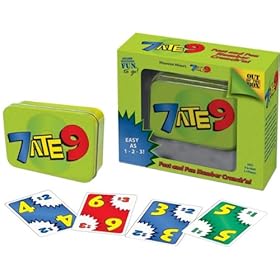
7 ate 9

7 ate 9 may be the traditional explanation for 6's profound fear of 7, but it most definitely doesn't explain why it is such a fun family game. The responsibility for this welcome transformation lies squarely on the shoulders of designer Maureen Hiron, the art of Cathleen Quinn-Kinney and John Kovalic, and the acumen of the once again inspiringly playful folk of Out of the Box.

7 ate 9 is a card game of speed and calculation, similar to Spit, but significantly more excruciating - in a good way. A very good way.

Two to four players begin the game by taking the top card from the shuffled deck, placing it face-up in the center, and then distributing the rest of the deck evenly between players. Since there are 73 cards, after the first card is played on the table, the rest divide into satisfyingly even piles whether you're playing with 2, 3 or 4 players.

The cards are numbered from 1-10. In addition (or subtraction), each card also has a number, from 1-3, in the corner. That number is added or subtracted, at the player's discretion, from the main number, which determines what number card can be played next. So, if the top card is a 7 and the small number is a 2, the next card can be either a 5 (7-2) or a 9 (7+2).

The cards are also color-coded, to help direct your attention to the added (or subtracted) value - all plus-or-minus 1 cards being green, plus-or-minus 2 cards blue, plus-or-minus 3, red.

No turns are taken. Players simply draw cards from their face down pile, one at a time, if they can play a card, they announce the number and place it on top of the center pile, if not, they draw another card until they have found a playable card or someone else has. In the latter event, they must now look for a new match. The first player to get rid of all but one of her cards wins.

So it's like Spit - players playing simultaneously, as quickly as possible, trying everso assiduously to be the first to find the next playable card. And yet, it's not quite Spit. Not with there only being one pile, and the challenge of having to add or subtract in order to calculate what card is actually the next match. And then, say, you throw a 9, with a plus or minus, say, 2. Well, if you subtract 2, it's simple enough - you can match it with a 7. But if you don't have a 7, and you're fast enough, you can add the 2, which, arithmetically, would make 11, which is patently absurd since the highest card is a 10. If not for the "round the corner" rule, by which you can legitimately play a 1 (which, in a circular sequence, would be the next card). Similarly, if a 2, for example, is played, a 2 with a plus-or-minus 3, shall we say, you can play either a 4 or a 9. This logical bit of round-the-cornerness is wonderfully exasperating, making you have to think generally when you are least ready to.

Yes, yes, people will tell you that it's an educational game because it uses numbers and arithmetical operations, and yes, children who are weak in these particular skills will most definitely find themselves hovering on the other side of exasperation. But no matter how good you are with numbers, and how mature and experienced you are in the ways of life and games, you can easily find yourself succumbing to the speed and flexibility of an 8-year-old opponent. Yes, there is a modicum of luck involved - just the modicum needed to keep hope alive, keep the game fun, and make you want to play again and again.

Labels:


Powered by Blogger