|
Monday, March 22, 2010
Zenith
 Triangles are cool. They invite choice in matters of symmetry and lead to all kinds of complex designs once you link more than a few of them together. I find there is something a bit unsettling about geometric patterns that are based on triangles if the pattern is left incomplete, but I experience a rush of satisfaction when the last piece is placed and the figure is finished. Zenith, a strategic tiling and stacking game by MindWare, tapped into this fascination I have with triangles. The game demonstrated how robust and fun a competition can be with only a few simple rules and some thoughtfully designed game-pieces. In keeping with the magic number, I’ll break game-play down into three parts: the goal, the tiling, and the stacking. The goal: Be the last player to place one of your triangular tiles.  The tiling: Each player has a set of colored, wooden triangles (58 in a 2-person game, 29 in the 3- or 4-person games). They take turns setting their triangles on the game board which is patterned with white triangles that indicate where players may place their pieces. The game comes with four boards, each with a slightly different pattern and named after a mountain (Mt. Fuji, Pikes Peak, Twin Peaks, and Krakatoa). The stacking: Moving up makes things interesting. A player can place a tile on top of three lower tiles IF the player’s color is one of the bottom tiles. Here’s where the triangle’s unique symmetry creates complexity and strategic choices. Players try to block their opponents, but they must also make sure that they leave plenty of options as lower levels fill up and the upper levels get smaller and smaller. Not only is Zenith a joy to play from a competitive point of view, I found a lot of satisfaction in simply handling game-pieces that are so thoughtfully crafted. The triangular game tiles are solid, colorful, double-sided, finished wood. They invite a lot of creative, careful manipulation and building while your opponents are debating their next move. (One of our Tasters was a little frustrated at how careful the manipulations had to be, in particular, how easy it was to dislodge pieces as they were stacked one on the other, but the game proved too absorbing for any of us to remain bothered by the extra care required.) The game-boards are double-sided and the edges are inscribed with interesting facts about the namesake mountains. For instance, I did not know that “Krakatoa continues to increase in height 16 feet (5m) every year...” I especially appreciate the efficient packaging and use of space that MindWare employed in the game’s design. Nothing is wasted and it’s all major fun. Zenith was designed by Nicholas Cravotta and Rebecca Bleu of BlueMatter Games. © 2009 MindWare. Will Bain, Game Taster Labels: Family Games, Thinking Games

Friday, March 19, 2010
Can You See What I Seee? Finders Keepers Game
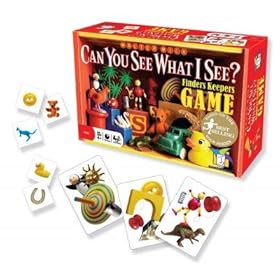 When you have children under the age of 9, card games take on a few distressing similarities. First, the chances of actually maintaining a complete deck of cards are approximately the same as keeping a red sock out of the white load. Second, the chances of the cards remaining in playable condition plummet in much the same trajectory as a car’s value once you drive it off the lot. Third, (and here’s where I roll my eyes) I hope you enjoy matching games. A lot. So in this spirit of trepidation and jaded-father cynicism, I considered Can You See What I See? Finders Keepers Game by Gamewright. It’s a matching card game that not only proved to be a hit with my girls and their scrum of free-range friends, but it cracked open my shell enough so that I enjoyed it too. A lot. Consider just the cards. Tiles might be a more accurate description. The game box contains 100 sturdy cards: 40 Find Me tiles and 60 Keep Me cards. Each Find Me tile has a single image—things like toy dinosaurs, plastic trucks, porcelain ballerinas, and dominoes. The Keep Me cards are larger and each card has four images that correspond to the Find Me tiles. Beautiful cards. Solid, colorful, laminated, and wonderfully textured cards. The instructions indicate the game is for ages 4 and up and I can believe it. These cards are made to be played. These cards will last.  Gameplay is simple, varied, and satisfying. The rules spell out two ways to play, but our kids were happy to come up with other variations. The game for younger children (4 and up) recommends dealing out 10 – 12 of the large Keep Me cards to each player (face-up). The Find Me tiles are shuffled and stacked. The players take turns revealing a Find Me tile and everyone looks to see if they have the matching image on their Keep Me cards. The winner… we didn’t pay much attention to winning in this game. The kids had a blast trying to find the images and trying to guess what would come next. The variation for ages 8 and up involves a bit more decision making. Nine of the Keeper Cards are revealed in the middle of the table. Each player has a pile of Finder Tiles that they are trying to match to the Keeper Cards in the middle. Players take cards that match their tiles and new Keeper Cards are revealed to fill the empty spaces. A bit of strategy comes in when players have to decide which matches will get them the most points and maybe make things difficult for their opponents. We played both variations with a group of kids aged 4 to 10. The very youngest needed a bit of help with the variation for older kids, but everyone remained engaged for the better part of an hour. I might not be able to keep all the cards from wandering away, but I know that the ones that remain will be sturdy and major fun! Can You See What I See? Finders Keepers Game is designed by Brian S. Spence, Garrett J. Donner, and Michael S. Steer, with contributions to the Expert Finders Keepers version by Walter Wick, author of the I Spy, and Can You See What I See book series. Will Bain, Games Taster Labels: Family Games, Kids Games
Tuesday, March 16, 2010
The Parsons Effect - Perturbation
Further exploration of the Parsons Effect demonstrates what happens when you spin a hexagon-shaped magnet-cluster near similar hexagon-shaped magnet-clusters.
Parsons comments: "It's like, when the one that is spinning is in full spin, the other, more stayed hexagon-shaped magnet clusters choose to ignore all that frenzied enthusiasm. But as it slows down, the others start noticing, and, with a wiggle and perhaps even a spin of their own, acknowledge the whirl."
Labels: magnetic, Neodymium, Toys
Monday, March 15, 2010
Hexaspin - The Parsons Effect
Discovered by Charles Parsons, behold - a whole new world of hexagon spinning. The center ball is pushed just a teeny bit lower than the rest so that the hexagon rests on one point. Labels: Neodymium, Toys
Friday, March 12, 2010
Dizios
 Dizios Dizios is a highly visual tile game that plays with color the way most tile games play with shape or number. The 70 thick, cardboard tiles are matched edge to edge. Some edges are all one color. Many more are two colors. Each tile is worth a certain number of points (indicated by dots in the center of the tile). Players get points, not for the tile they place, but for the tiles they connect to. Dizios can be played by 1-4 players, of a recommended age of 6 or older. There's very little strategy involved, so the game is easily accessible to younger children. To play with more than one player, the special "starter tile" is placed in the center of the table. The rest of the tiles are placed face down, mixed, and then set aside or built into draw piles. Each player selects 4 tiles. For the rest of the game, players take turns, matching a tile on to the expanding grid, if possible; taking score (by counting the dots that appear on the adjacent tiles), and then picking a new tile from the face-down tiles. If no match is possible, the player must forfeit his turn. The score pad is designed so any player who can count can keep score.  As a solitaire, Dizios offers a surprising variety of challenges. You can try to make a "vortex" (an array of connected tiles) of all one color, you can try for a vortex that is 8x8, 7x10, 5x14. Or, you can arrange try to arrange the tiles so they create the highest possible score. The solitaire versions greatly extend the fun of the game, and could easily lead a moderately creative player to develop more interesting variations of the competitive game. Dizios is an easy game to learn. The visual challenge is easy to understand, intriguing enough to entice a 6-year-old, attractive and complex to engage the full attention of adults. It is like dominoes only insofar as there are tiles that get matched - which makes the game that much easier to understand. But it is a very different game. Unique. Visually pleasing. Well made. Only lightly competitive. Intriguing (especially the solitaire versions) enough for serious adult contemplation. Inviting enough to engage the whole family. You can play in teams. You can play by yourself. You can make up your own challenge. Fun. Major FUN. Labels: Family Games, Puzzles
Wednesday, March 10, 2010
Imaginets
 Think Colorforms - thick, bright, hefty, magnetic, geometrically-shaped colorforms. Imagine these thick, bright, hefty, geometrically-shaped colorform-like pieces that you carry around in a wood-framed suitcase. Now, while you're at it, think Tangrams. That would explain the deck of large, two-sided cards, printed with colorful designs of varying complexity - each of which can be made with some or all of the thick, bright, hefty, colorful, geometrically-shaped pieces. OK. We're getting close.
 Now, add a dry-erase marker or two. Note how you can draw, and of course, erase on the inside of both panels of the suitcase. Which means, if you want, you could make any shape out of any combination of pieces, outline the shape with a marker, and make your own puzzle. Can you take all the pieces off and put them back on?
Imagine all the things you could do with this set, all the places you could play with it, the puzzles you can try to solve, the puzzles you can create, the designs you can make. If your imagination is good enough, you'll understand why this toy is called Imaginets, and why it was given a Major FUN award.
Imaginets is a toy that can engage children in a wide variety of creative and intellectual play experiences. It is easily shared (lay it flat and you have two, clearly de-marked play surfaces), and just as easily something that your child can play with by herself. It's roughly the same size and feel of a briefcase or laptop computer, and thus lends itself to dramatic play. The ability to draw on the surfaces (no, the dry-erase markers are not included, and yes, it'd be neat if they were) adds a unique dimension to this activity, increasing the invitation to play, to exploration, to creativity and interaction. Labels: Puzzles, Toys
Tuesday, March 09, 2010
Mini Weapons of Mass Destruction
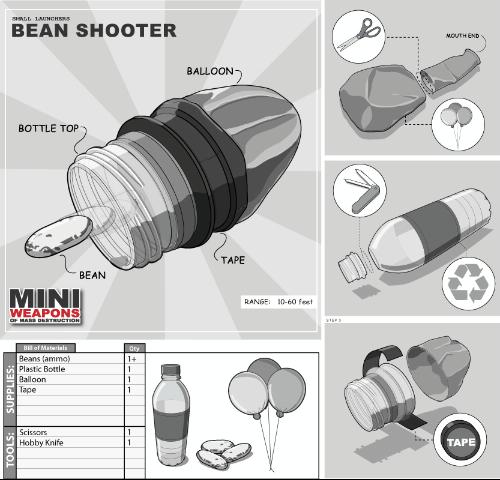
 If I could travel back in time and give my early adolescent self a gift of potentiation and portends of power, it would be a copy of John Austin's Mini Weapons of Mass Destruction. If I were my father, on the other hand, I'd take that book away from me in a most timely and uncompromising manner, hide it in a place where only I could find it, and read it from cover to cover.
On yet another hand, my going on 8-, going on 21-year old granddaughter loves this book.
Mini Weapons of Mass Destruction contains 241 pages of detailed, painstakingly illustrated instructions for making (and here I read from the table of contents) launchers and bows, slingshots, darts, catapults, combustion shooters (combustion shooters!), minibombs and claymore mines, and, finally, concealing books and targets.
Did I mention combustion shooters? Like the famous match rocket which you can make out of paper or wooden matches, with nothing more than aluminum foil, a needle or pin, a medium binder clip (Austin loves those binder clips), a toothpick and a large paper clip? O, there are warnings. "Eye protection and a safe firing range are musts" declares the ever-pragmatic Austin. "Match rocketry is not an exact science," he cautions, "misfires and modifications will be needed to find the perfect balance." Match rockets! How inexorably cool is that?
There are two things that make Mini Weapons of Mass Destruction such a fun read: 1) every "weapon" is made out of common household objects, and 2) the instructions are exceptionally clear and well-illustrated. OK. There are three things: 3) the sheer ingenuity of the designs. It's the very kind of book MacGuyver might have read during his training course. For fun. Of course.
Want more? Visit John's site. Learn a little about him. Print out a few targets. Get instructions for building more. Meditate on the nuances of "implements of spitball warfare."
from Bernie DeKoven, funsmithLabels: Toys
Monday, March 08, 2010
Q-bitz
 You get a wooden tray with 16 identical wooden cubes. One face of the cube is light, the opposite, dark. Another face shows a light circle on a dark background, the opposite, the opposite (a dark circle on a light background). The other two faces are half-and-half, diagonally divided. And with 16 of them, you can make at least 120 different, and often beautiful patterns. You can tell that, because there are 120 pattern cards, each different, each composed out of the simple shapes on the cubes. Mindware's Q-bitz is a game of visual perception for 2-4 players. A pattern card is revealed, and players race to be the first to echo the pattern on their own board. That's one way to play. The designers suggest that you play in three rounds (or not), each round a variation. The second round, you have to roll the dice, use what you can, then roll the remainder, then use what you can, then continue rolling, using what you can, until you've made the pattern, and, hopefully, are the first to have done so, correctly. Finally, the third round: After the pattern card is revealed, and everyone has an agreed-on time to look at it, it's turned over. Face-down. And then everyone tries to replicate the pattern, from memory! Q-Bitz turns out to be a remarkably challenging game, no matter how you play it. I, in the fullness of my 68-year-old maturity was able to win the first card. We tried the second with the rolling variation, but quickly decided to continue the way we played the first round. It was difficult enough. I won the second card. Then we played the third round - the one where you were supposed to be able to remember the pattern. Looked easy until we tried it. So we tried it again. And then continued the way we started. And I los the next four. It was suggested we stop after that. I think out of compassion. We loved how challenging the game turned out to be - how simple it was, and yet how deeply it engaged our perceptual skills. It was as fun losing as it was winning. We didn't play long. Maybe 20 minutes. But that was about all we could ask from our perceptual skills. At least for this time. Easy to learn, well-made, cleverly designed, for 2-4 players, 8 and up. Major FUN. Labels: Family Games, Puzzle
Sunday, March 07, 2010
An introduction to the Neodymium magnet executive puzzle toy
 The four following reviews are almost identical, each featuring a different rendition of the same magnetic puzzle/toy concept. There are minor differences, and, depending the player's preferences, one might prove definitely more, shall we say, "attractive," than the rest. But comparing them to each in any effort to determine which was truly best only led us to the kinds of thinking that this website is not designed to support.
When we find an exceptional toy or game, one of sustainable play value, our goal is simply to add our bit of recognition and support, to recommend them as something worthy of your playtime. Our goal is not to tell you which is, for example, the best chess set you can buy, because chess is chess. And though the look and feel of different chess sets may appeal to different people, the fact is, if you want to play chess, it's still a good game, even if you're playing in with bits of paper. Rarely, we find a newly invented toy or game available, almost simultaneously, from 4 different sources. Given our mission here, the only solution we could arrive at was to create 4 different reviews, awarding each the Major Fun seal.
We think you'll enjoy this toy a great deal. Read the reviews. Check out the websites. It really doesn't matter which you end up buying. Each will bring you hours of challenging, engaging, and, hopefully, major fun. Labels: magnetic, Neodymium, Puzzles, Toys
Wednesday, March 03, 2010
Neocubes
 We've been taking a very close look at a puzzling phenomenon, known as The Neo Cube. The website alone is sufficiently filled with invitations and incentives for purchasing these extremely attractive technical marvels to explain why we've been looking so closely.
Attractive indeed. Attracting curiosity, creativity, dexterity, ingenuity. Visually and tactually engaging. They are executive wonder toys. Moderately expensive investments, that payoff in hours of meditative, and sometimes significantly aggravating play.
Neocubes are made of Neodymium magnets - the strongest, longest lasting of rare earth magnets. These magnets really, really want to stick together. Assembling them into any of the amazingly attractive configurations shown on the web or featured in their documentation sometimes requires very strong fingers and deep, abiding dedication. Assembling the 6x6x6 cube (a challenge so fundamental that it has become a magnetic-ball-puzzle industry standard to include at least 216 - or 6-cubed balls) can get significantly frustrating, not because it is conceptually difficult, but rather because the balls can offer surprisingly strong resistance to being pulled apart or forced together in any way other than that which seems to appeal to them at the moment.
Neocubes comes in a blister pack that includes 8 extra magnets, instructions and a drawstring bag. The back of the pack contains ample warnings about the dangers of swallowing, heating, or handling these magnets should their coatings be compromised. The manufacturers strongly and understandably advise that these magnets should not be played with by children younger 12.
The spectacular variety of sculptural puzzles that these magnetic balls lend themselves to can be found everywhere on the web. On flickr you can find image after image of Neocubes. On Youtube you can watch a minor myriad of people making mini-metal-marble magnetic magic with Neocubes. As you watch, it is clear that making these extremely attractive configurations is as much a performance art as it is an act of conceptual mastery.
Until this review, the story of these amazing magnet balls has been uniformly focused on the many marvelous puzzle-like activities available to the magnet-ball-empowered few. Our explorations have revealed equally marvelous toy-potential. Here is a very simple example - showing what happens when you roll one ball at another, with appropriate speed and something like aim, on a plate. Turn up your sound to appreciate the fullness of the inherent glee.
With this very preliminary foray into the "toyetic" qualities of it all, we hereby invite your contributions of similarly jolly, playworthy discoveries. This first is but a taste. (Actually, more of a hint than a taste as the frame speed of the video doesn't show the full spinning glories we experienced. But a tasty hint, nonetheless.) image by Frans (3Djavu.nl)Labels: magnetic, Neodymium, Puzzles, Toys
Buckyballs
 We've been taking a very close look at a puzzling phenomenon, known, in this particular instantiation, as Buckyballs - a puzzle made of 216 (count 'em) extremely attractive (read "magnetic") balls.
Attractive indeed. Attracting curiosity, creativity, dexterity, ingenuity. Visually and hapticly engaging. They are executive wonder toys. Moderately expensive investments, that payoff in hours of meditative, and sometimes intensely aggravating play.
Buckyballs are made of Neodymium magnets - the strongest, longest lasting of rare earth magnets. These magnets really, really want to stick together. Assembling them into any of the amazingly attractive configurations shown on the web or featured in their documentation sometimes requires very strong fingers and deep, abiding dedication. Assembling the 6x6x6 cube (a challenge so fundamental that it has become a magnetic-ball-puzzle industry standard to include at least 216 - or 6-cubed balls) can get profoundly frustrating, not because it is conceptually difficult, but rather because the balls can offer surprisingly strong resistance to being pulled apart or forced together in any way other than that which seems to appeal to them at the moment.
Buckyballs comes with ample warnings about the dangers of swallowing, heating, or handling these magnets should their coatings be compromised. Noting quite clearly that the minimum recommended age is 13.
The spectacular variety of sculptural puzzles that these magnetic balls lend themselves to can be found everywhere on the web. On flickr you can find image after image of Buckyballs. On Youtube you can watch a minor myriad of people making mini-metal-marble magnetic magic with Buckyballs. As you watch, it is clear that making these extremely attractive configurations is as much a performance art as it is an act of conceptual mastery.
Until this review, the story of these amazing magnet balls has been uniformly focused on the many marvelous puzzle-like activities available to the magnet-ball-empowered few. Our explorations have revealed equally marvelous toy-potential. Here is a very simple example - showing what happens when you roll one ball at another, with appropriate speed and something like aim, on a plate. Turn up your sound to appreciate the fullness of the inherent glee.
With this very preliminary foray into the "toyetic" qualities of it all, we hereby invite your contributions of similarly jolly, playworthy discoveries. This first is but a taste. (Actually, more of a hint than a taste as the frame speed of the video doesn't show the full spinning glories we experienced. But a tasty hint, nonetheless.)
Labels: magnetic, Neodymium, Puzzles, Toys
Tuesday, March 02, 2010
Cybercube
 We've been taking a very close look at a puzzling phenomenon, known as CyberCube. We tried to look no further than their amazing, lovely to look at website, filled with invitations and incentives for purchasing these extremely attractive magnetic marvels, but couldn't stop there. We had to have one, at least. The very shiny silver one. Though the gold one looked at least as attractive, and the nickel and black at least as playworthy as the others.
Attractive indeed. Attracting curiosity, creativity, dexterity, ingenuity. Visually and haptically engaging. They are executive wonder toys. Moderately expensive investments, that payoff in hours of meditative, and sometimes moderately aggravating play.
Made of Neodymium magnets - the strongest, longest lasting of rare earth magnets, the Cybercube magnets really, really want to stick together. Assembling them into any of the amazingly attractive configurations shown on the web or featured in their documentation sometimes requires very strong fingers and deep, abiding dedication. Assembling the 6x6x6 cube (a challenge so fundamental that it has become a magnetic-ball-puzzle industry standard to include at least 216 - or 6-cubed balls) can get profoundly frustrating, not because it is conceptually difficult, but rather because the balls can offer surprisingly strong resistance to being pulled apart or forced together in any way other than that which seems to appeal to them at the moment.
They also all come with ample warnings about the dangers of swallowing, heating, or handling these magnets should their coatings be compromised. CyberCube recommends that they most definitely should not be played with by children aged 8 or under.
The spectacular variety of sculptural puzzles that these magnetic balls lend themselves to can be found everywhere on the web. On flickr you can find image after image of CyberCube. On Youtube you can watch a minor myriad of people making mini-metal-marble magnetic magic with CyberCube. As you watch, it is clear that making these extremely attractive configurations is as much a performance art as it is an act of conceptual mastery.
CyberCube come in a variety of packages and colors. You can get them in tins - which are fun to build on and, when the balls are stored inside the tin, helps eliminate the magnetic field. You can get them in boxes. You can get them in boxes (the magnets are a little smaller and cost a little less). You can get enough to make a 6x6x6 cube (with a few extras) or a 7x7x7 cube.
Until this review, the story of these amazing magnet balls has been uniformly focused on the many marvelous puzzle-like activities available to the magnet-ball-empowered few. Our explorations have revealed equally marvelous toy-potential. Here is a very simple example - showing what happens when you roll one ball at another, with appropriate speed and something like aim, on a plate. Turn up your sound to appreciate the fullness of the inherent glee.
With this very preliminary foray into the "toyetic" qualities of it all, we hereby invite your contributions of similarly jolly, playworthy discoveries. This first is but a taste. (Actually, more of a hint than a taste as the frame speed of the video doesn't show the full spinning glories we experienced. But a tasty hint, nonetheless.)
Labels: magnetic, Neodymium Puzzles, Toys
Monday, March 01, 2010
Zen Magnets
 We've been taking a very close look at a puzzling phenomenon, known as Zen Magnets. Actually, you need look no further than their website to be delighted and enticed by a myriad invitations and incentives for purchasing these extremely attractive technical marvels.
Attractive indeed. Attracting curiosity, creativity, dexterity, ingenuity. Visually and haptically engaging. They are executive wonder toys. Moderately expensive investments, that payoff in hours of meditative, and sometimes moderately aggravating play.
Zen Magnets are made of Neodymium magnets - the strongest, longest lasting of rare earth magnets. They are also exceptionally lovely to behold in all their reflective, mirror-polished glory. These magnets really, really want to stick together. Assembling them into any of the amazingly attractive configurations shown on the web or featured in their documentation sometimes requires very strong fingers and deep, abiding dedication. Assembling the 6x6x6 cube (a challenge so fundamental that it has become a magnetic-ball-puzzle industry standard to include at least 216 - or 6-cubed balls) can get significantly frustrating, not because it is conceptually difficult, but rather because the balls can offer surprisingly strong resistance to being pulled apart or forced together in any way other than that which seems to appeal to them at the moment. Which explains why Zen Magnets comes with a plastic card that can be used as a prying tool.
They also come with ample warnings about the dangers of swallowing, heating, or handling these magnets should their coatings be compromised, advising, in no uncertain terms, that these magnets should not be played with by children younger than 12. The spectacular variety of sculptural puzzles that these magnetic balls lend themselves to can be found everywhere on the web. On flickr you can find image after image of Zen Magnets. On Youtube you can watch a minor myriad of people making mini-metal-marble magnetic magic with Zen Magnets. As you watch, it is clear that making these extremely attractive configurations is as much a performance art as it is an act of conceptual mastery. Zen Magnets also comes with a drawstring velvet bag (which is especially useful when you don't have the time or wish to make the effort to get them into any particular formation) and six extra magnet balls.
Until this review, the story of these amazing magnet balls has been uniformly focused on the many marvelous puzzle-like activities available to the magnet-ball-empowered few. Our explorations have revealed equally marvelous toy-potential. Here is a very simple example - showing what happens when you roll one ball at another, with appropriate speed and something like aim, on a plate. Turn up your sound to appreciate the fullness of the inherent glee.
With this very preliminary foray into the "toyetic" qualities of it all, we hereby invite your contributions of similarly jolly, playworthy discoveries. This first is but a taste. (Actually, more of a hint than a taste as the frame speed of the video doesn't show the full spinning glories we experienced. But a tasty hint, nonetheless.)
Labels: magnetic, Neodymium, Puzzles, Toys
| |