|
Sunday, April 25, 2010
Jenga Max
 Out of the box, the components of Jenga Max do not bear any resemblance to the by now iconic rectangular blocks that made up the original game. But do not let the bright colors and strange plastic pieces scare you away! Jenga Max retains the same tension and thrill of Jenga, with the addition of a unique visual flair.
It’s still a stacking game. Manual dexterity is a must. Unlike the original which unnerved players by slowly destabilizing the base of a tower, Jenga Max challenges players to load colorful plastic pieces onto a ring that is held above the table by a magnet. In the end, the effect is the same. Unbalance the structure, mishandle a piece, or just be the sorry sap to overload the magnet’s attraction and (say it with me) JENGA!! It all comes crashing down.
Building stuff up is fun but bringing it to ruins is satisfying on a disturbingly universal level.
 As you’ve probably noticed if you have visited this site more than once, visual design is an important component of Major Fun games. Jenga Max not only works as a great stacking game, but it also attracts your attention with the way the pieces fit together. The game comes with 36 plastic blocks in three colors: yellow, orange, and red. Each block has two holes on one end and a rectangular notch on the opposite side. Players stack the pieces by hooking the notch into the holes. By virtue of the piece design, the resulting chains form intriguing arcs and surprising angles. As players add more and more pieces, the entire contraption looks like a translucent, alien flower or sea creature.
Jenga Max captivates children and adults. The unique patterns and designs that arise through play give players reason to pause before each move, just to admire the beautiful principles of the lever and counter-balance. From the experience of my family, my eight-year-old loved the more competitive side of the game while my five-year-old just wanted to see if we could get all the pieces off the ground.
And there are few things that evoke the spirit of Major Fun more than yelling JENGA when your work of art smashes into the table and you have to gather the pieces up for round two.
Jenga Max is a product of Parker Brothers and Hasbro Games, © 2009. You can find more pictures, a video and an animated demo of the game in action on their site.
Will Bain, Games Taster Labels: Dexterity, Family Games, Party Games

Thursday, April 22, 2010
This blog has moved
This blog is now located at http://therealmajorfun.blogspot.com/. You will be automatically redirected in 30 seconds, or you may click here. For feed subscribers, please update your feed subscriptions to http://therealmajorfun.blogspot.com/feeds/posts/default.
Monday, April 19, 2010
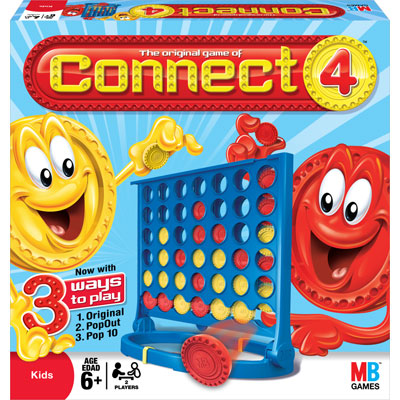
Connect 4 revisited
There's a new version of Connect 4. It's called Connect 4. But it's more. It's three different Connect 4 games. The first, you already know. It's the "original" Connect 4. The second is not. It's called "PopOut Connect 4." The third is also new. It's called "Pop Ten."
The bottom row of the Connect 4 grid has been changed. There's a sliding bar on the very bottom. If you slide it to the right, the checkers that are in the bottom row can be "popped" out. Well, pushed out. Which, in turn, will cause all the checkers that are in that column to fall down one space. Which results in a new alignment of checkers. Which could very well result in the sudden appearance of a line of 4 checkers, all ever so delightfully in a row.
You can only pop checkers of your own color. Which makes sense, considering. In PopOut Connect 4, you either add a checker, as in traditional Connect 4, or push one of your checkers out of the bottom row. In either event, if it results in 4-in-a-row (of your checkers, of course), you win. On the other hand, your pop could result in the very alignment your opponent was so sincerely wishing for. Thus, even though the game is very much like your traditional Connect 4, it's different enough for you to have to rethink everything you know about Connect 4 strategies.
 Then there's Pop 10, which, oddly enough, is a different game altogether, a figure-ground reversal, one might say, a shift in your basic Connect 4 gestalt. To game begins with a board-full of checkers. You take turns, dropping one checker at a time, until there are no more checker-accommodating spaces. A move consists of popping a checker out of the bottom row (again, you can only pop checkers of your own kind). You can pop any of your bottom-row checkers. But, if that checker happens to already be part of a 4-in-a-row alignment, you can pop again. Every time you do so, you get to keep that checker. When you can no longer pop, your turn is over. If the checker you pop is not part of a Connected 4, you return it to some other column.
Pop 10 is different from all other variations of Connect 4. And it is as much fun. Because there are three so very different versions, you have to decide which you want to play together. This is a decision that you have to make together. And, simply because you are both making that decision, the game takes its rightful place as a way to have fun together - not so much as a way to see who is the better thinker or player or person, but more to find a game that you both want to play, together.
The thing about all Connect 4 games, and so many of the best of Hasbro games, is that they're very much like toys - as much fun to play with as they are to play. The new Connect 4 is just that: fun to play, fun to play with. Easy to understand, but different enough from everything you know about traditional Connect 4 to have to think of it as something new. Easy to learn. Quick to play. A genuinely enjoyable invitation to logical and strategic thinking. Major FUN. Labels: Kids Games, Thinking Games
Friday, April 16, 2010
Dig It and Oops!
 Dig It Dig It and Oops! are two of the new puzzle sets recently released by Foxmind. They both use an ingeniously designed carrying/storing/playing case, and are each collections of 50 puzzles involving a set of pieces which have to be moved from the starting position to the solution.
Dig It is a bit like Pentominoes, using pieces of different shapes and size. In addition to these pieces (made of satisfyingly weighty, pleasingly colorful, translucent plastic), there are pieces shaped like bones. In each puzzle, the pieces are positioned over a bone or two. The puzzle is to figure out how to move the pieces around so as to reveal the bone(s). It's a bit like being a dog, digging for a bone. Hence the doggy graphics on the cover. In addition to the collection of pieces, there's a puzzle book, spiral bound, with its own stand. It's designed so that the solution to one puzzle is on the back of the previous puzzle, so all you have to do to get a hint or check your result is turn the book around. The puzzles are graded, one-paw puzzles being significantly easier to solve than four-paw puzzles.
Oops has a magician theme. There are 9 pieces. One is shaped like a hat. Another like a magician's head. The rest look a bit like sailor hats. There are 4 colors of sailor hat pieces: blue, red, green, and yellow. Pieces are set up according to a diagram - a different piece (or two) on each space - a different set up on each page in the puzzle book. You can move a piece one space either vertically or horizontally, as long as it lands on top of another piece. Which makes it a stack of two pieces. Which can only move two spaces, horizontally or vertically, as long as that stack lands on top of yet another piece. And so on and so on, a three-stack moving three spaces, a four-stack four, until, with your final move, the hat is on the bottom, the rest of the pieces are on top of the hat, and the head is on top of them all.
 The carrying/storage/playing case for both puzzle/games is in itself magical. You slide the cover to the left or right, revealing a compartment. And, once the cover has been repositioned, you can turn it over to become the playing board. It's sturdily built of brightly colored plastic.
Each of these puzzles is an investment in fun. They're fun to touch, fun to try to solve. The more challenging puzzles are usually ingeniously so - offering unexpected variations that sometimes redefine your whole understanding of what this puzzle is about. You can cheat as often as you need to (just turn the book around for the answer). You can skip to more difficult puzzles, essentially designing your own curriculum of challenge.
Don't be fooled by the child-appealing design. As you progress through the puzzle booklet, even the mature puzzler will discover most definitely adult-worthy challenge.
As a teacher, these puzzles are a paradigm of good curriculum design - always inviting further and deeper exploration, always just as challenging as the student is ready for. As a player, they are invitations to mastery and delight. Well-made, cleverly-designed, continually fascinating, engaging the eye and mind, providing intelligent, functional fun. Labels: Puzzles
Sunday, April 04, 2010
Smart Toss: Math Sport
 Tossing beanbags into a target is fun for almost any reason you can think of. It's what you might call "just plain fun." For kids. For grownups. You can play by yourself. You can play in teams. You can get competitive about it if you want. You can play it just for fun. You can increase the challenge (stand further away from the target). You can make it easy enough for a three-year-old.
From the pure fun perspective, Learning Resources Smart Toss has everything you'd want in a bean bag tossing game. And more. It has your bean bags. It has your target board. The bean bags are made out of canvas, for durability and feel. They are just the right size for a child's hand. They are also numbered, from 1 to 10. Hmmm. Numbered bean bags. Already you have something a little different, a little more interesting to play with. The target board is light enough to carry around easily. It's vinyl, so it's easy to keep clean. It's reinforced, so it can withstand childish enthusiasm. There are bean bag storage pockets, and, depending on how you set it up, there are 4 different game boards to choose from.
 Hmm. Numbered bean bags, 4 different boards. Perfect for reinforcing different kinds of elementary math skills, not only without spoiling the fun, but also making the games more, well, interesting.
Consider the basketball-like game. You use only three of the bean bags - the 3, 4 and 5. There are 6 targets (pockets). Two of the targets are worth the number on the bean bag. Two are worth twice as much. And the remaining two are worth three times the number on the bean bag. So, see, you have to multiply, and add, in order to determine your actual score.
Then there's a kind of bowling game. You choose two bags whose numbers add to 10. You toss them one at a time into any of the 4 pockets. One pocket counts as a strike (which in this game is worth 20 points). Another as a spare (10 points). And the other two are worth the number on the bean bag.
So now you're adding, and maybe even strategizing (do I take the number 6 and 4 bean bags so I can relatively good score no matter what pocket I land in, or do I take the 9 and 1 so, just in case my 1 doesn't make a strike or a spare, my 9 might at least make it to one of the other pockets.
Each of the 4 games offers not only a playworthy opportunity to exercise some basic math skills, but also another inspiration for making up your own game. Which means, in addition to the quality of the device - its portability, durability, storability and colorfulness - and the essential playability of the beanbag tossing game, and the incentives the 4 games provide for children to exercise their basic math skills; Smart Toss: Math Sport offers children the inspiration to invent their own games - games which can be even more challenging to more skills, which will undoubtedly prove to lead to even more fun, of the frequently major kind. Labels: Kids Games
| |


 As you’ve probably noticed if you have visited this site more than once, visual design is an important component of Major Fun games. Jenga Max not only works as a great stacking game, but it also attracts your attention with the way the pieces fit together. The game comes with 36 plastic blocks in three colors: yellow, orange, and red. Each block has two holes on one end and a rectangular notch on the opposite side. Players stack the pieces by hooking the notch into the holes. By virtue of the piece design, the resulting chains form intriguing arcs and surprising angles. As players add more and more pieces, the entire contraption looks like a translucent, alien flower or sea creature.