|
Friday, November 28, 2008
The Eight Funnest Games for 2008
Eight games, representing a broad spectrum of party-like playfulness, have been selected for your holiday delights. Check them out here. Labels: Funnest for 2008

Thursday, November 20, 2008
Katamino
 Katamino Katamino is based on a geometric puzzle called " Pentominoes." "Pentominoes," reports the Association of Teachers of Mathematics, "can be used to develop children’s understanding of the concepts of area and perimeter, transformational geometry including enlargement, congruence and symmetry, nets, volume and classification." Katamino takes the concept further, into a series of games and puzzles that can absorb the spatial reasoning faculties of children as young as three, and adults as old as they want to think they are.  The multi-language instruction booklet includes illustrations for hundreds of puzzles and several challenging games. At its simplest level, it is a building toy, which, like all good building toys, can become very challenging. Then it becomes a puzzle. The it becomes a more and more challenging as players attempt to put more of the pentomino pieces together in larger and larger rectangles. There's a very useful bar that gets placed in different positions on the board to limit the playing area. This same bar is also used to divide the board into two different halves so that two players can race each other to complete a rectangle. Another game variation involves using an 8x8 board (printed on the back of the instruction booklet). Players take turns placing the pentominoes on the board. The last player able to play wins. To make the game easier, or the constructions more complex, the manufacturers include one- and two-unit blocks. The pieces and frame are all made out of wood. Though the colors of the wooden pieces don't precisely match those in the instructions, their shapes are easily discernible and the colors are close enough for players to figure out all the rules and variations as well as the two- and three-dimensional puzzles. Don't be misled by its similarity to other games. Fundex's Katamino is a unique invitation to a lifetime of challenging fun. Labels: Family Games, Puzzles, Thinking Games, Toys
Wednesday, November 19, 2008
One Word
 Quick, think of a word, one word, that is both a season and a type of guy. Did you say "fall"? Cute. You're right. Grab a Scoring Marker. OK. How about something you do with a pencil that is also a kind of bridge. "Draw." Prexactly. Grab another Scoring Marker. Quick now. And I mean really quick. Because as soon as the top stops spinning, your team's turn is over, what's one word that's both a unit of measurement and a kind of stone. Never mind. It's too late. The top stopped. Well, it's not exactly a top. It's more like a large, plastic jack. But it spins - very sweetly in its special, concave spinning spot. And though one doesn't generally think of using a large plastic jack as a timer, this one works really well, and actually adds a most delicious modicum of fun to the game, and challenge to one's spinning dexterity.  Designed by Garrett J. Donner, Michael S. Steer, and Wendy L. Harris, and brought to by the fun people at Fundex, One Word is a Majorly FUN party game for two teams. It comes with 100, two-sided clue cards, each with 5 different puzzles; 5 Scoring Markers, which prove to be a significantly satisfying mechanism for making one's cleverness manifest; and, as advertised, a wacky jack-like Spin Timer, that somehow manages to makes a fun party game funner. Labels: Party Games
Tuesday, November 18, 2008
A to Z Electronic
 Those of you astute enough to have read our review of the majorly Major FUN-award-winning A to Z might easily assume Fundex's new electronic version would prove as unabashedly praiseworthy. On the one hand, you would be entirely correct in your assumptions. A to Z Electronic is attractive, engaging, and far more convenient. No chips to lose. No boards to keep track of. You don't even need to keep the box. The category cards fit nicely into a compartment on the back of the game. And everything else is integrated into the device.  If you already own a pre-electronic copy of A to Z, and are reading this review online, you'll probably find that even though it is far more convenient and compelling. you should expect to spend some time figuring everything out, and, frankly, the original, non-electronic version plays just as well - some might say even better. Though it's all quite logical, and all the lighted buttons are lovely and alluring, and the accompanying sounds meaningfully amusing, there are certain things you just have to figure out. For example, the six buttons on the top of the device are used to indicate both who goes next, and what the category is. There are lights on the left and right to help you (which most ostensibly say "player" or "category"). But you have to remember to look for them. And when it's your turn to "Steal," you have to remember to hold your victim's number button down for several seconds. But it won't take long to learn, and it's clearly worth the effort. The game is so portable, so well-packaged, so attractive and, as you already know, so much fun, that you'll want to take it with you wherever there's the slightest possibility that there'll be people to play with. A to Z, in any form, is a wonderfully adaptable and fun game. Because there are so few components (the device and the cards) and so many lights, the electronic version most definitely adds the convenience, the attraction, and the sheer delight of it all. Labels: Funnest for 2008, Word Games
Monday, November 10, 2008
Partini
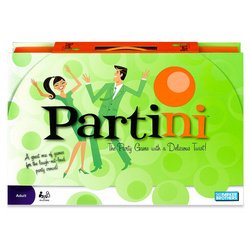 If variety were the spice of fun, Hasbro's Partini would be the paprika of play. Or maybe the garam masala of games. Partini is a collection of 6 different party games. The key words here are "different" and "party games." For example, there's "Clay Smoothie" - a familiar party game, like Pictionary, only with something like Play Doh (oddly enough, all products of Hasbro), except your team has to figure out two out of three of your sculptures, all of which share a common (announced) property (e.g. "green"). And then there's Mime Twist, a charades-like game, similar to the "Star Performer" games in Cranium, which, perhaps not-so-coincidentally, is also manufactured by Hasbro. And then there's Hum Punch, in which, like in Cranium's Humdinger, the object is to get your team to identify the song you are humming. But then there are also the non-Cranium gamelets, Shooters (which turned out to be one of our favorites) - a game involving cups and balls and small variety of cup-and-ball-based challenges, and What Nots in which you try to describe something by saying what it isn't, and Straight-Up - a most party-like "familiarity" game in which players write something true or funny about a team mate (we were worried about this, because this is a game of an ilk that requires a certain amount of sensitivity - which can not always be counted on - yet the game proved well-enough structured to keep things safe, fun and funny). And, totally unlike Cranium, there's no board - just a bunch of coaster-like disks which determine what game you are to play, and act as score counters. Hasbro has gone to great lengths to make this Partini as attractive as it is fun to play. It comes in a large, sturdy, suitcase-like box. There are 500 game cards - all well-made and attractively-illustrated; cups and balls, pencils and paper, and a special Straight-Up die. Designer Chris Nelson has made praiseworthy efforts to make the game fun, unpredictable, and elegant. The coaster scoring- and game-selection mechanic works brilliantly. The balance of games keeps everyone involved. Familiar enough to be easy to learn (especially for Cranium players). Different enough to be an valuable addition to any party for involving 4 or more adult-aged, but not too adult-like people. Labels: Party Games
Tuesday, November 04, 2008
Sorry Sliders
 Sorry Sliders Sorry Sliders is what might happen if Parker Brothers hired a game designer who had a profound appreciation for how kids play, a deep understanding of the tongue-and-cheekily joys of the Sorry game franchise, and an equal amount of appreciation for games like shuffleboard and Crokinole. Craig Van Ness is that designer, and Parker Bros. Sorry Sliders is, as one would expect, Major FUN. The game comes with a lot of parts, and a similar lot of rules. But it turns out that the parts are relatively easy to assemble, and the rules similarly relatively easy to understand. Both require a certain amount of care, and young children (the game is recommended for kids 6 and up) would definitely benefit from adult partnership. There are 4 shuffleboard-like tracks and plastic reflector rails that need to be installed. The tracks can be joined to each other, and ultimately joined to a target board. There are two target boards, each has two sides, each side offers a different variation. Each of 4 players gets a set of 4 special pawns that slide on a ball-bearing. Each player also gets a scoring board and 4 scoring pawns. Players take turns sliding (pushing, flicking, or otherwise propelling) their sliding pawns down their track towards the goal. After everyone has played, score is kept by moving scoring pawns on the scoring board. Once a scoring pawn reaches Home (by exact count), it is safe. Until then, if the sliding pawn goes into a Sorry Zone in one of the corners of the target board, everybody gets to say "sorry" while the player moves her scoring pawn back to start.  What makes the game of special interest, and of real play value, is that there are so many different ways to play it. Tracks can be joined to each other, they can be placed all around the target square or all in a row. Combine that with the 4 different target boards and you get hours of reasons to play together. Having a choice of all these different ways to play allows families to customize the game to their own tastes for fun. Exploring the variations, discussing which is the most fun for everyone, result in a valuable opportunity for the whole family to gain a deeper appreciation for and understanding of how they can best play, and live together. Labels: Family Games, Kids Games
Monday, November 03, 2008
Pictureka
 If you are at all familiar with any of the myriad of I Spy games, you could very well leap to the uninformed conclusion that Pictureka is yet another variation of this familiar and most definitely playworthy theme. Fortunately, you'd be at least partially wrong. With Parker Bros. Pictureka, designer Arne Lauwers has brought us a what might be easily considered a whole new twist, or spin, or flip on the game. The game comes with 9 boards, three decks of cards, a colored die, a numbered die, and a sand timer. Players begin the game by putting the 9 boards together in a 3x3 array, and the 3 decks of cards somewhere on the side of the boards. Each of the boards is scattered with illustrations many different cartoon figures, positioned in all possible directions. Each deck of cards is a different color, and each a different kind of game. If you pick a card from the "Mission" deck, you'll find the name of some object written on the card. You roll the number die. This determines how many of those objects you have to find on the 9-board array. You then turn the timer over and look, really, really hard. If you succeed, you get to keep that card. The Outbid deck contains more general descriptions of objects ("Things that fly" "Head coverings"). Before you turn a card over, you and your partners bid for how many you think you'll be able to find during the time limit. The highest bidder then turns the card and the timer over, and engages in focused scrutiny, pointing to each object that she thinks meets the description on the card. The "Find it First" deck contains actual images of things to look for. All players compete to be the first player to find an instance of the pictured object.  On the back of some of the cards you'll find three different kinds of arrows. One arrow directs you to switch any two cards in the array. Another to flip over any card. And the third to rotate any card. These make the challenge just new enough to refresh the interest and excitement of the game. When playing as a family, it is remarkably easy to tailor the game to meet the abilities of any player, the 6 year old, and, even though the game is not specifically recommended for preschoolers, with a little help from an older sibling or informed parent, using one deck or two or all three, everyone can be included. For a more immediate feel of the game, you can find a sample online. Labels: Family Games, Kids Games
| |


