|
Friday, August 28, 2009
Connect 4x4
 If you've ever played Connect Four, you'll immediately understand the attraction of playing with three or four players. With two players, you've got strategy. With three or four, you've got politics. Sometimes, you just have to cooperate with the very people you are competing against, just to keep someone else from winning. Such is the nature of playing with more than two.
And it's prettier - having four colors instead of two. Colored rings, even.
 But that's just part of what makes this game so worthy of our collective consideration. The other part is the channels that accommodate the ex-checker rings. They're double-wide, double-sided. Which means that two rings fit where only one ring used to. And you win regardless of whether your ring is in the front or back of a channel - as long as there are four-in-a-row of your color.
There are also two "blocker" pieces for each color. Double-wide themselves, they fit into both sides of a channel. The blockers are powerful pieces, which is why you only have two of them, which is why you have to conserve them, which is what makes the game all the more inviting for people who like to ponder.
The strategic implications of all this are profound and subtle. Profound enough to make you have to rethink pretty-much everything you know about how to win Connect Four, subtle enough to make the game challenging enough to attract an adult audience, and perhaps too challenging for younger children. But, like Connect Four, the mechanics of dropping checkers into different columns, of being able to empty the entire board by moving the retaining wall on the bottom are still very much present, and at least fascinating enough to keep the toy-value of the game as playworthy as the game itself.
Hasbro has been full of gleeful surprises of late. Though they've been releasing new versions of their licensed products for a while, they have taken great efforts, in most cases, to make sure that the new releases are also new games - different enough from their predecessors to be worthy of serious consideration. Elegant enough to be easy to learn and to invite players to develop their own variations. Fun enough to sustain many hours of thought-provoking, deeply engaging play. Labels: Family Games, Kids Games, Thinking Games

Monday, August 24, 2009
Ring-o Flamingo
 Ring-O Flamingo Ring-O Flamingo, a.k.a. "The Frantic Fling-a-Ring Game," is, as advertised, a game that is at least as much about ring-flinging as it is about being frantic. Each player gets one of 4 plastic "lifeboats" each of a different color, each containing a set of 12 flat, flexible, plastic, lifesaver-like rings of a matching color. The rings are placed, one at a time, edgewise in a slot in the front of the lifeboat. To fling the ring, you aim your lifeboat, slot a ring, bend the ring towards you just exactly as much as you think necessary and then release it. Your goal, should you be goal-oriented, is for your ring to land, quoit-like, around any of the 7 plastic flamingos (yes, plastic flamingos), and not around either of the two plastic alligators. The flamingos and alligators fit into slots in the thick game board. Turned 90-degrees, they stand firmly enough to resist and staunchly deflect any inaccurately flung rings. The board is thick enough to withstand repeated reassembly. Ringing an alligator is a bad thing to do and makes you lose two points. You get 2 points for each of your rings that is first to ring a flamingo, and one point for each of your subsequent flamingo-ringing ring.  Since everyone plays simultaneously, mastering the "frantic" part of this "Frantic Fling-a-Ring" game is as crucial to success as good aim. Since being the first to ring a particular flamingo gets you twice as many points, the need for speed is clearly established. And, of course, the faster you fling, the less accurate you become. The tension makes the game even more challenging, and instructive. On the other hand, ring-flinging is so much fun that it almost doesn't matter whether you manage to get a ring around anything. It's as amusing just to fling the rings at each other, or to see how far or how high you can fling them. Which is what makes the game as alluring to a three-year-old as to your seriously competitive eleven-teen. You can try to fling rings into the box lid or against the wall (extra points for "leaners"). And for those families fortunate enough to have playful parents, it's a great invitation to share some moments of controlled and victimless mayhem. Designed by Haim Shafir, Yakov Kaufman, and Yoav Ziv, the game works wondrously well. All the parts of the game reinforce the fantasy: the lifesaver rings, the ring-storing and flinging boats, the brightly colored and humorously rendered flamingos. The ring-flingers can be repositioned anywhere around the board to increase aim and accuracy. The rings themselves are exactly as springy as they need to be to flip and fly. And there is just enough luck to keep anyone from getting overbearingly good at the game. Hence the Majorness of the FUN. Ring-O Flamingo is exciting and alluring enough to be played and replayed by everyone in the family. There are a lot of rings (48 of them). Hence, parents would be especially wise to include in their rendition of basic game rules the tradition of after-game ring-gathering. Labels: Dexterity, Family Games, Keeper, Kids Games
Thursday, August 20, 2009
Clabbers and other Scrabble Variants
 Surfing my way, somehow, to a collection of Scrabble Variants, I learned about Clabbers which is a game of Scrabble, all right, but the letters can be in any order you want, as long as they are an anagram of a Scrabble-acceptable word. The author notes that "the board usually ends up tightly packed in places, and necessarily quite empty in others. Game scores will often be much higher than in standard Scrabble, due to the relative ease of making high-scoring overlap plays and easier access to premium squares." That's all I needed to know: higher game scores, each word a puzzle in its own right. My kind of Scrabble. Then there's, of course, Dense Escalating Clabbers for the serious Clabbers-player. The Wikkipedist explains: "Dense Escalating Clabbers add 1/3 more tiles. In addition, every bingo increases a player's rack size by one, and the play times are increased from 25 minutes to 33 minutes 33 seconds. There is also a 100 point bonus for playing a fifteen letter word. These modifications also make the game more challenging and interesting, and also increase the likelihood of triple-triple plays." "Bingo" I deduce, having something to do with using all one's tiles. Then, apparently, there's Volost. A "surreal game" says the Wikipedist, "where the only acceptable words are VOLOST and VOLOSTS." I wasn't really clear about what makes this variation worthy of our collective consideration until I read the last sentence in the article. "It is typically played late at night, and alcohol is usually involved." Ah. Alcohol. I should've known. See also this great collection of potential Scrabble variants on Half-Baked. Labels: Word Games
Sunday, August 16, 2009
Curses Again
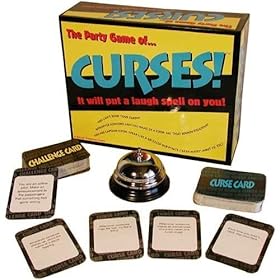 We last discussed Curses on, to be needlessly precise, October 2, 2002. We, in fact, gave it a Keeper award, no less. The highest ranked, most Major award we have. Recently, Curses has been "refreshed." Same package, same art, same basic gameplay as in the original Brian Tinsman design. The bell is maybe a little more modern-looking. The cards a little easier to shuffle. And some of the curses and challenges are new, and, of course, funny. But all in all the game isn't any more commercial-looking than it was then. Simple text graphics. Two decks of cards. A bell. And yet, it's as much of a Keeper now as it was then. Because we're still playing it. What we learn from all this, is that the Major FUN Awards, and especially the Keeper award, represent games that are unforgettably fun. The original review is the same review I'd be writing for the game today. It follows: Curses - a game of geometrically increasing silliness for 3-6 players, age 9 and up. There are two decks of cards and a very nice hotel-type hit-the-top-and-it-rings bell. One deck of cards is called "Challenges," the other "Curses." Let's start with the "Curses," which, of course, are the real challenges. A Curse is something silly that you have to do. For example, you might have the Curse of having to talk in a French accent, or having your wrists glued to your head (well, there's no real glue, but you have to pretend there is), or having to bow every time someone applauds. As the game progresses, you get more Curses. From other players, actually. Remembering two Curses is at least twice as difficult as remembering one. By the time you have three Curses you are at a conceptual point likened only to patting your tummy and rubbing your head while singing "Boat your row, row, row." In a French accent. When you break a Curse, some observant player dutifully rings the bell. If you break enough Curses, you're kind of out. Kind of, because you still get to be a bell-ringer and cause of Curse-breaking.  The Challenges make the Curses evermore Curselike. You might have to ask someone else out to a school prom, or be in a TV commercial explaining why your deodorant is best or demonstrate how you celebrated your what you did when you scored the winning touchdown in the Superbowl. Each challenge takes on a very different light when you have to perform it under multiple Curses. Curses radiates at least 120 Gigglewatts of pure Guffaw-power. It's can get very, very difficult to play, very quickly, and is challenging enough to occupy the most limber-minded of collegiates, whilst silly enough to keep even us over-the-hillsies laughing and coughing in glee. The cards on the refreshed version pass the shuffle-test quite nicely. Their graphic design could make it a little easier to distinguish between the two kinds of cards. But that, compared to the sheer hysteria that this game catalyzes, is clearly, at most, a nano-niggle. Labels: Keeper, Party Games
Wednesday, August 12, 2009
Word on the Street
Take all your consonants except for the ridiculous ones like Q, X and Z. Put them on your satisfyingly hefty bakelite tiles. Now, make a long game board, like a 4-lane highway with a divider strip just wide enough and long enough to accommodate all of your happily hefty letter tiles. Next, get together a deck of 216, often surprisingly laugh-provoking, double-sided category cards, like: "The Brand of Clothing Worn by One of the Players," and "Something that is Wasted," and "Something Used by Scuba Divers," and "A Word that Describes a Car Crash," "A Title Used for Males but not for Females." Add a cardholder and sand timer. And those are all the ingredients needed for a new and notably Major FUN word game called " Word on the Street" from those frequently Major FUN game publishers, Out of the Box.
Everything, of course, except for the rules. And there in lies the tickle.
 Designed by Jack Degnan to give a couple or a couple of teams of word-lovers ample opportunity to demonstrate their brilliance and/or befudlement, the game is a contest to see who, in 30 seconds, can think of a word that 1) fits the category, and 2) has as many as possible of the letters still in play, many of which are doubled - as in MISSISSIPPI which would allow us to move the M one lane closer to us, the P two lanes closer, and the S clear off the board, which would put us one letter ahead. Only 7 more to go and we win!
Though Mississippi would in deed be a coup, it would not be considered a valid response to the category "A Brand of Clothing Worn by One of the Players." To which the best I could do at this time is probably MAIDENFORM (getting to move M twice as well as a D, N, F and R once). Or would MASSIMO with its two M's and two S's be better?
As the game progresses, different letters, and hence different words become more desirable, offensively or defensively, so the challenge keeps on changing. The best word might not have the most double letters in it if some letters only one space away from us, or more enticing yet, one space away from the opponent's goal. The 30-second timer keeps the game moving apace. The cards keep the game surprising and funny. The tiles are large enough for all to read. The board works perfectly in directing player's attention to the strategically most valuable letters. All this makes the game absorbing and delightfully tense, from the moment the first card is read until one team finally manages to capture the eighth letter.
Recommended for 2 to 12 players old enough to appreciate each other's verbal mastery. Labels: Party Games, Tops for 2009, Word Games
Monday, August 10, 2009
Jarts
 There's something about throwing a dart in a long, slow. graceful 35-foot arch that is innately, deeply fun. Grace, yes, a key contributor to the long-lived fascination of Jarts and the Jart-like. Not horseshoes, not bocce or corn hole, but a long and slow flight of hefty, dart-like Jarts. Nothing like it.  About the older version, the one with the needle at the end: yes, it was exceptionally extra-satisfying to see your Jart land point down into the ground and just stay there, all a-quiver with the thrill of landing anywhere, point down, into the ground. The one that killed a few and maimed many more. So don't come running to me with disappointments and complaints about modern overprotectionism. Wait 'til you've played a game or two, and noticed, once again, the grace of those long, gentle flights, and maybe managed to get a throw or two actually into the target, or thought about how fun it might be to try some kind of Frisbee Golf with Jarts game or maybe a Jarts Olympics or something. Not as pointed, perhaps, but still Major FUN. Labels: Dexterity
Thursday, August 06, 2009
Travel Litterbug
 If you were a Jack-in-the-Box who wanted to be game, Litter Bugs is what you'd be. You'd be just as surprising, suspenseful, and almost as frightening, as a good jack-in-the box, but unpredictably and instead of getting cranked, people would take turns pressing your buttons, never knowing which one of eight was going to make you pop, having one less choice with each passing of the trash can. You might not be a toy trash can, per se. Or a trash can with such an evil, oddly smirking face, as illustrated. But if you were a toy trash can with a toy trash cad lid, attached, beneath which a large, very fly-looking plastic fly lies ready.. to....... pop-up. To play the surprisingly one-piece Travel Litter Bugs game, one of you presses down on the plastic fly - all the way down until the fly, well, clicks. Close the lid. Randomly select any randomly selected button. Push it down. Give the trash can to one of your partner/opponents. Let them push down any of the other still unpushed-down buttons. And so on and so on, button-by-button, until there are, for example, only two buttons left and it's your turn and you still can never tell which is going to release the fly, which, just as you press the other button, suddenly pops straight up, forcefully flipping open the toy lid in satisfyingly complete surprise. You can play with it by yourself, with you friends, you can play with it as a toy, you can play it to decide who goes first. (Rocky and I were play/working on a puzzle together, using the toy as a kind of victory timer. Every time one of us would get a piece in, we'd get/have to press a different button.) Travel Litterbugs is an elegant, well-designed toy/game, for children of any persuasion. As decisive as a game of Rock/Scissors/Paper, fun as a jack-in-the-box, and about as long to play. Major FUN! Labels: Family Games, Kids Games, library, Toys
Tuesday, August 04, 2009
The Fundex, Great American Puzzle Factory, Map of the World Puzzle
 Fundex Fundex acquired the great American puzzles of The Great American Puzzle Factory. And we, because of our ongoing interest in all things Fundex, acquired the Map of the World puzzle. Yes, it's a many-pieced jigsaw puzzle (600). And yet, no, it's not like so many of those many-pieced jigsaw puzzles.  Let's start with the art itself. Yes, it's a map of the world, but it's by Dino Kalogjera, who makes maps that are fact-filled and cartoon-encrusted voyages into geographic and historic detail with seemingly endless humor. There are tables and lists of dates and inventions and voyages and explorers, famous sites, products, wildlife. And cartoons that add humor and detail everywhere, even in the middle of the ocean. So you're never faced with a vast expanse of blue nothingness or dun-colored, detailess desert. Always a hint of something which, no matter how funny, will magically reveal itself to be a discovery and guide. Armed with strong enough eyes or a good enough magnifying glass, you plunge into into a wonderfully entertaining world. Then there's the shape and the fit of the pieces. Did I mention 600 of them? Each relatively large, well-cut, unusually-shaped. Surprisingly surprising, as one might say, from the first pieces you put together to the last. The pieces are sturdy without being thick, cut into odd, and clearly original shapes that fit together in almost always surprising ways (sometimes overhanging adjacent pieces, sometimes bridging gaps you didn't know were bridgable, often the other way around). Fitting two pieces together always leads to something funny and useful, in fact and fancy. There are so many illustrations that often getting one piece where it belongs completes several other illustrations, simultaneously. Again with the surprising. The finished puzzle is 2x3 feet, and you are glad for every inch of expanded detail. So much to look at that it's like seeing the whole world at once. Which is, of course, precisely what this map has to show you, and surprisingly more. If I were teaching teachers how to design a good lesson plan, I think I'd begin with this puzzle. Labels: Puzzles
| |


