|
Thursday, September 24, 2009
Consensus Junior Edition
 Consensus Junior Consensus Junior is the third and newest addition to the award-winning Consensus collection. As the name implies, this one's for the kids. The game follows the same, award-winning design as the other two versions. There's a large, colorful board, a deck of 200 noun cards, a deck of 75 adjective cards, a deck of voting cards (8 sets of cards, each with a unique border color, numbering 1-10) and a collection of 8 colored pawns, one for each of the sets of voting cards. The board has numbered spaces for 10 noun cards, a space for the adjective card, and a scoring track. The noun cards are drawn and placed face-up, one in each of the numbered spaces on the board. An adjective card is turned over. Players select the one noun they think most closely fits the adjective, place their vote face down on the table, and then take turns revealing their selection. The answer receiving the greatest number of votes is deemed the winning answer and the players who chose the winning answer move ahead one space. In a case where there is no clear majority, no one scores. Hence the name, Consensus. The key to the difference between the Junior Edition and the other editions of Consensus is the content of the noun and adjective cards. Given, for example, the following randomly selected noun cards: - Bee Hive
- Bed Bug
- My Daddy
- Nemo
- World Peace
Which would you vote for if the adjective were (also a random sample): - Rare
- Adorable
- Unforgettable
 If the adjective were "rare," which do you think is, um, rarest: your daddy, world peace, Nemo? Which the most adorable? Which the most self-evidently unforgettable? Even as the mature person you most obviously are, you'd still have a somewhat clear and more or less patently obvious choice, regardless of which adjective was chosen. And, with an "opponent" of the unabashed certainty of an eight-year-old, you know there will be strong opinions about everything. This is what makes the Junior Edition so appealing: everyone counts, everyone in the family finds themselves personally invited, everyone has an opinion, everyone feels equally entitled, equally correct, and, with the Junior edition, pretty much equally informed. How many family games can you say that about? Labels: Family Games

Wednesday, September 16, 2009
Kim and Jason Kotecki - Defenders of the Playful
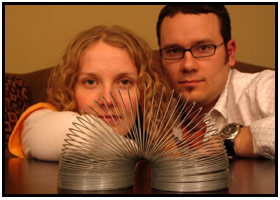 First, take a minute to read how Kim and Jason Kotecki explain their passion for play: "...we’ve made it our mission in life to uncover the secrets of childhood and share them with others. We’ve written books, conducted interviews, experienced exciting adventures, and traveled all over the place inspiring and encouraging audiences to live life with less stress and more fun."
Sure, they're being funny. They're inventing silly words like " Adultitis" (they even have a " test" you can take to see if you are a "carrier"). They're cute. They're talented. They're very much in love. They have tremendous energy. And they're channeling all of that into helping people embrace life.  It was their most recent book, There's an Adult in My Soup, that made me realize that these people really aren't kidding. Every little story is their little book is funny, touching and freeing. No matter how playful you think you might be, each story brings you insights into yet another dimension of playfulness. No matter how important or responsible or hard-pressed you are, Kim and Jason show you that it's still OK to play. You can object to their depiction of what it means to be "adult." You can argue about their definition of maturity. But you can't deny that Kim and Jason are genuine Defenders of the Playful. Labels: Defender of the Playful
Sunday, September 13, 2009
Circle Out
 It is a distinct pleasure to introduce you to a new card game called " Circle Out." Distinct, because it's unique, a pleasure because its most definitely fun. The closest approximation I can come up with is the Major FUN Award-winning card game Set. Like Set, Circle Out engages both logical and perceptual skills. It's called Circle Out because the object of the game is to find sequences of cards that can be connected, color to color, the first color matching the last in the sequence, making a circular chain. The longer the chain, the higher the score value (if score is what you're keeping). The game begins by laying out 12-16 cards. The first player to find a circular chain (using each color only once per circle), takes the cards from the array, places them in front of her, and then replaces those cards with the same number of cards from the deck. The game continues until the deck, or the players, are exhausted. If you need more graphic clarity, watch this demonstration of the game.  Joseph Lytle, the designer of Circle Out, has a deep appreciation for math and fun. In one of his Youtube videos, called "Splitting the Deck/ Circle Out as a Mathematical Curiosity," he gives us a taste of the some of the more hidden properties of the deck. For more background, here's Mr. Lytle expostulating on the inspiration for the game, which, oddly enough, has to do with a meditation on economics. Lytle describes another variation of the game, which, in turn, helps us realize that the game is elegant enough to invite yet more variations - always a sign of a game that will prove high in replay value. Recommended for 2-4 players, ages 8 and up, Circle Out can engage the entire family. Prepare to be surprised by who will prove better at the game. The skills required have little to do with education or maturity, which explains a lot about why Circle Out has earned a Major FUN Award. Labels: Family Games
Arvind Gupta - Defender of the Playful
 Arvind Gupta Arvind Gupta, teacher, physicist, maker of toys from trash, has received world-wide recognition for his "outstanding contribution in designing science teaching aids for young children."  His website features an incredibly generous (more than 600) collection of toys, made mostly from found objects, each exemplifying the intrinsic fun of science. Each toy pictured includes easy-to-follow, well-illustrated instructions for making your own. He has written extensively, and been written about even more extensively. He has been recognized by "several international organisations such as UNESCO, UNICEF, International Toy Research Association, Halmstad University, Boston Science Centre, MIT (Media Lab), Walt Disney Imagineering and Research, Auhof Rehabilitation Centre, Hilpolstien, Germany and the International Play Association, Finland. As a UNESCO consultant on science education he has been invited to share his experiences in science teaching with teachers of several developing countries. He has been actively associated with the Bombay Natural History Society, Conservation Society of Delhi, Spastic Society of North India and the Bharat Gyan Vigyan Samiti. He is an advisor to the National Book Trust on popular science books. He has received several awards for his outstanding contributions. These include Eklavya Award (1982), the inaugral National Award for Science Popularisation amongst Children (1988), Hari Bhau Mote Award of the Marathi Vigyan Parishad (1988), a special award given by the National Association for the Blind for designing teaching aids for pre-school blind children (1991), Granthali award for his book Khel(1992), Ruchi Ram Sahni Award for science popularisation(1993)and the Hari Om Ashram Award by the UGC (1995)." Arvind Gupta comments: "I work in a Children's Science Centre in the City of Pune in India. I have been making simple science toys for children for over 25 years. The Internet provided me with a tool to share them with children all over the world." On behalf of the children of the world, Mr. Gupta, allow me to express our respect and gratitude, adding to your copious honors the title Defender of the Playful. Labels: Defender of the Playful
Thursday, September 10, 2009
Run Wild
 It's a card game. It's a well-made card game, with exceptionally colorful cards in a convenient card-size tin. It's a card game for 2-4 players of any age, as long as they're old enough to know the difference between sequences of the same color and groups of the same number. It's Run Wild, a tense, heads-down card game, where everybody plays simultaneously and the first person to play all the cards in their hand wins. Lay down your sets and runs of three or four. Once a set or run is played, it belongs to everybody. You can add your cards to any set or run on the table. You can use cards from any set or run on the table (as long as there are at least three cards remaining). And there are wild cards, O yes, indeed there are wild cards. Lovely, colorfully wild, wild cards. Cards of two kinds of wildness: one of which can be used, as you would expect, in place of any card. The other, as you might not expect, a "draw-three" card, making the other players add three more cards to their hand - resulting in what some may see as sweet revenge, and others as just desserts. There are 72 cards in the deck. The deck is divided equally between all players, and placed in a face-down pile. Each player draws the top eight cards. At a mutually agreed upon signal, everyone starts laying down their sets and runs. If you have no cards to lay down, you can pick from the cards that remain in your portion of the deck. This is really not a thing you want to do, because it means that you have more cards that you'll have to get rid of. So you focus, with somewhat passionate intensity, on what everyone else has played. If you are trying to be exceptionally strategic, you might try to hold off on laying out any new sets or runs, because every new set or run is someone else's new opportunity. On the other hand, the longer you hold on to your cards, the less likely it is that you will win the round. At the end of the round, you are penalized five points for each card still in your hand, and ten points for each wild card. Hence the added incentive to get rid of your cards mingles somewhat acidly with the strategic value of waiting for the right moment to give that draw-three card to someone who is just about to go out. Ah, so sweet the desserts. Yet, wait one a minute too long, and O the bitterness and remorse of it all. Designed by Brad Carter, Run Wild is not frantic like the two-player solitaire game of Spit or Speed. It's a light-hearted game that will probably make you laugh, but it will also challenge you, pretty much entirely. Its rules are not only easy to understand, but also inviting to tinker with. For example, should the game prove too challenging for some players, all you need to do to level the playing field is give the player who won the last round an additional card or two when she starts the next, or play in teams, or see if you can get everyone to go out at the same time. Even untinkered-with, it's worthy of your most determinedly playful consideration. Labels: Family Games
Friday, September 04, 2009
Boggle renewed - introducing the Library Games category
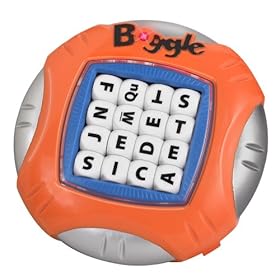 The classic word game Boggle (click to play online) has been repackaged. The game is the same, but it now comes in a sealed plastic case. You twist the case, expanding the cavity that holds the letter dice. You shake the case to make the letter dice change position. You twist the case the other way, the dice all snuggle into their new position, and the timer starts. All you need is paper and pencil. Everything else (even the battery) is included in one handy package (click on the demo tab to see how it works). So there's nothing to lose - except the game.
There's nothing new about the way the game is played, but the new package of this clearly Major FUN game is innovative enough to be worthy of our collective attention. Yes, it's convenient, and could easily be classified as a "travel" game. But because there are no loose parts at all, it's something more.
 Of late, I've been holding many of my Games Tastings at the Irvington Library in Indianapolis. In addition to the Tastings, I've been donating some of our award-winning games to the library so we can start a small collection. The challenge, as you can imagine, is dealing with all the small parts. It takes a lot of dedication to make sure that a game comes back completely in tact. Boggle's new packaging solves that problem beautifully. So exemplary is its design, that it has led me to create a new award category. For want of a better term (I was thinking of Ludotheque, which is French for public libraries devoted to games and play - why France, why don't we have them everyhere, you might ask?), I decided to use "library." It could mean school library, public library, club library, senior center library, even your own personal games library. But the point is, Hasbro has done something exemplary with its new rendition of Boggle - something that makes the game that much more accessible, especially to institutional environments, and hence, that much more worthy of appreciation and recognition. Labels: library, Word Games
| |


